
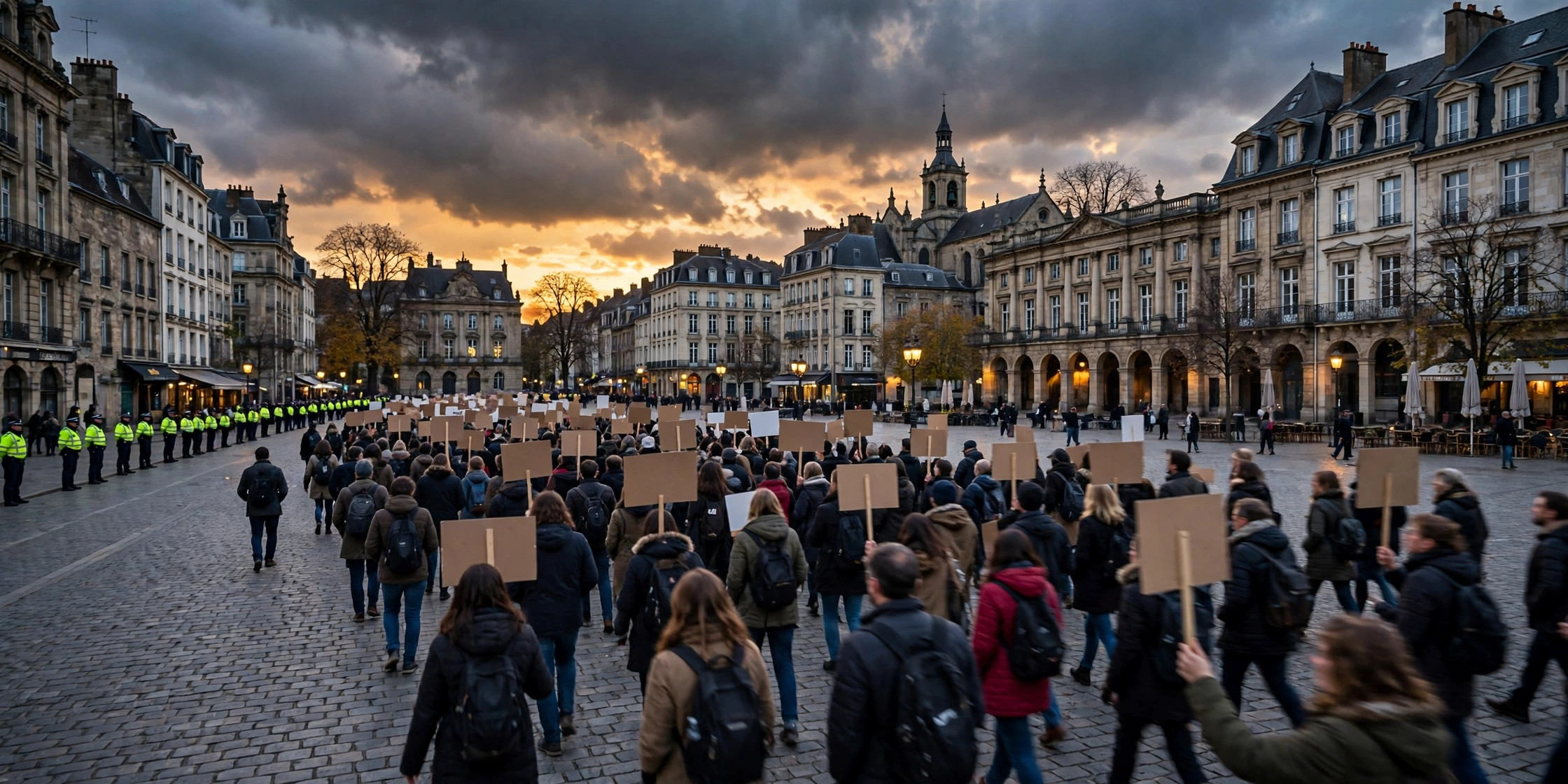
Europe protests 2026 reached a new flashpoint on Saturday, 24 October, as more than 410,000 people marched across France and anti-government demonstrations spilled into Albania, Italy and Belgium. What began as a French protest movement over living costs, education funding and opportunities for young workers is now trending per news coverage across the continent, with shops boarding up in Milan, water cannons deployed in Brussels and Tirana, and a warning of a nationwide general strike in France on 5 November.
The scale of Saturday's mobilisation surprised even officials who had prepared for it. France deployed around 70,000 police officers, backed by specialist units, helicopters, armoured vehicles and water cannons, for the second weekend of mass demonstrations. By late evening, Interior Minister Laurent Nuñez said nearly 1,000 people had been detained across France — up sharply from 385 detentions the previous weekend — even as he stressed that most marches had passed off peacefully.
Europe protests 2026: what happened on Saturday
According to France's Interior Ministry, cited by CNN, around 110,000 of the more than 410,000 protesters were in Paris — roughly the same number as in the capital the previous weekend. The Paris march itself was largely peaceful, but trouble flared at its endpoint at Porte de Vincennes, where a crowd of several thousand confronted police, who responded with tear gas and a water cannon, according to a CNN team at the scene.
Elsewhere in France, the picture was mixed. In Marseille, the country's second city, protesters launched mortar fireworks at police during running street skirmishes, and there were reports of looting, including a jewellery store with smashed windows and a supermarket being pillaged, according to CNN's French affiliate BFMTV. In Bordeaux, images showed tear gas drifting across the famous Place de la Bourse as masked protesters hurled objects at officers. In Nice, BFMTV reported that dozens of far-right activists attacked people who were protesting peacefully.
Nuñez said police had deliberately restricted protesters' movements, preventing unauthorised roving marches or moves toward city centres. "In certain cities there was some damage or looting of businesses, in very limited numbers," he said, adding that it was far less than during the protests a week earlier. He also said there had been "no targeted attacks" on public buildings such as town halls and police stations, unlike the previous weekend — but described an "extremely high level of violence" from some protesters, "with projectiles constantly being thrown and mortar fireworks fired."
France: 410,000 marchers and nearly 1,000 detained
Saturday was the second consecutive weekend of mass mobilisation in France, following a first round that drew more than half a million people to the streets. The jump in detentions — from 385 to nearly 1,000 — partly reflects the sheer size of the security operation: with 70,000 officers mobilised, police were ordered to hold positions late into Saturday evening to guard against looting. Readers following the French unrest can read our earlier coverage of the Paris protests and arrests and the 70,000-officer deployment for Saturday's protests.
The political stakes rose further on Saturday when Jean-Luc Mélenchon, leader of the far-left La France Insoumise party, warned from the front line of the Paris demonstration that nationwide industrial action would follow if President Emmanuel Macron does not respond to protesters' demands. "A general strike, called by the CGT, looms over the government for the 5th of November," he told BFMTV. Separately, reports said the French prime minister had asked telecom companies to prepare for a possible temporary suspension of social media access in case of a repeat of urban violence — a claim that, if confirmed, would mark a dramatic escalation in the government's response.
How the Europe protests spread to Albania, Italy and Brussels
While France dominated the headlines, Saturday's most striking development was geographic: the unrest is no longer a French story alone. In Albania's capital, Tirana, thousands of students and opposition supporters rallied outside the Ministry of Education, demanding lower tuition fees, greater state investment in education and the resignation of Prime Minister Edi Rama. Crowds set fire to dumpsters and to couch cushions that Rama had placed as a symbolic invitation to dialogue, according to Euronews. More than 2,500 police officers were deployed in the capital and turned water cannons on the crowd, while protesters threw stones and tear gas canisters. The Associated Press reported that thousands rallied in Tirana in the latest of several clashes between police and protesters since mid-October, with dozens of demonstrators detained.
In Belgium, students in Brussels built barricades in the streets and held up placards, prompting police to deploy a water cannon, according to public broadcaster VRT. High-end retailers in the city boarded up their shops, fearing a repeat of looting seen the previous week, and protesters attempted to set fire to rental scooters, road signs and bicycles before police intervened. At least five people were arrested, though police said no major incidents had taken place.
In Italy, shops across Naples, Rome, Turin, Bologna, Florence and Milan boarded up their windows ahead of planned protests, after looting in earlier demonstrations. Milan was placed on particularly high alert, with Prime Minister Giorgia Meloni deploying 500 soldiers into the city, supported by drone surveillance, railway station checks and rapid-response units. The spread echoes the pattern covered in our earlier report on cost-of-living protests spreading beyond France, and in Albania the latest clashes follow weeks of student anger documented in our report on the Tirana student protests and calls for Rama's resignation.
Why are people protesting across Europe in 2026?
The grievances differ by country, but a common thread runs through them: the rising cost of living, housing shortages, and frustration among young people over education and job prospects. In France, protesters have called for greater investment in education, more opportunities for young workers and solutions to surging living costs. In Albania, the trigger is education — tuition fees and state funding — fused with broader anger at alleged government corruption. In Italy and Belgium, cost-of-living pressures and student grievances have driven people onto the streets. Elsewhere in southern Europe, housing-cost protests have continued in Spain and Portugal in recent weeks, with long-running encampments in some cities.
Economists and political analysts quoted in coverage of the unrest describe a continent where inflation and housing costs have squeezed household budgets for years, and where young voters in particular feel locked out of secure work and affordable homes. That shared frustration helps explain why protests in one country can inspire or coincide with protests in others, even when the immediate demands are local. It also explains why governments are responding with such heavy security: the fear in Paris, Rome and Brussels alike is that a peaceful march can tip into looting and property damage, as happened in parts of France the previous weekend.
What happens next: the 5 November strike warning and a tense autumn
The immediate question is whether Saturday's escalation cools or hardens. In France, the 5 November general strike threat gives the government less than two weeks to answer protesters' demands on education funding, youth opportunities and living costs. Security forces are expected to remain on high alert for further weekend demonstrations, and the reported social-media blackout contingency — if it is ever used — would itself become a major political flashpoint.
Beyond France, the test will be whether the student protests in Tirana and Brussels and the shop-boarding precautions in Italy's big cities grow into sustained movements or fade after a single weekend. For now, the continent's protest wave shows no sign of ending: from Paris to Tirana, from Milan to Brussels, demonstrators are signalling that the cost-of-living crisis is not an abstract economic statistic but a daily grievance — and they are prepared to keep marching until governments respond.
Sources: CNN, "France sees another weekend of mass protests, with nearly 1,000 detained" (24 October 2026); New York Post, "Europe falls under siege as demonstrators battle police, set fires in cities across continent" (24 October 2026); Associated Press reporting via EuropeSays on the Tirana protests (24 October 2026); Euronews and Belgium's VRT as cited in those reports.