
A French movement goes European
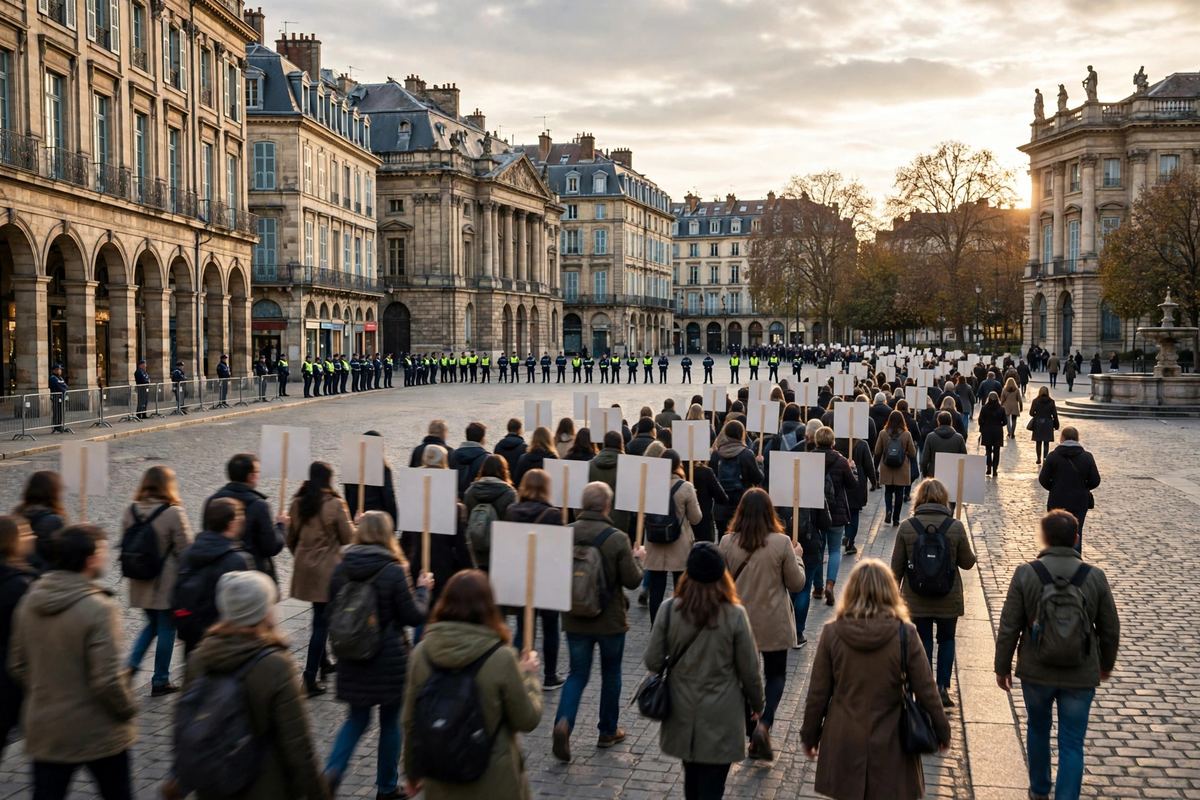
Protests that began in French schools have spread across Europe. On Saturday, 17 October 2026, more than 500,000 people gathered in Paris and other French cities for protests uniting students, teachers, unions and supporters of the Yellow Vest movement, according to Al Jazeera's reporting. The same day, youth activists led solidarity protests in Belgium, Albania and Italy, and cost-of-living protests were reported in Belgium, Italy and Portugal. France remains the epicentre of the movement, but there are now signs that it is spreading beyond France, with early-stage mobilisation also reported in Greece, Germany and Austria, where further protests are expected in the coming week.
The demonstrations in France itself were large and, in places, violent. Police deployed tear gas and water cannon in parts of Paris as confrontations broke out between officers and groups of masked demonstrators. In Marseille, protesters entered the city hall, while vandalism and fires were reported in other cities. France's Interior Ministry reported that 272 people had been arrested nationwide by mid-afternoon, following incidents involving clashes with law enforcement, attempted looting, fires and damage to public buildings. Posting on X, Jean-Luc Mélenchon, leader of the far-left La France Insoumise Party, emphasised that the majority of demonstrators had made their point peacefully. "While news channels are flooded with images of violence in dozens of cities, everything is unfolding peacefully with tens of thousands of people calmly mobilized. Two worlds, two realities," he wrote. Both things were true: most protesters were peaceful, and a violent minority caused serious disorder.
How the protests began
The demonstrations began in mid-September at French schools and have expanded, tapping into wider grievances. Earlier this fall, high school students in France organised scattered protests demanding reduced class sizes, increased spending on teachers, investments in infrastructure designed to withstand the climate crisis, and an end to police violence against young people. In the past decade and a half, a rise in fertility coupled with funding cuts has led to more students but fewer teachers in classrooms. The French Education Minister Edouard Geffray has met with student protesters multiple times in recent weeks, although an agreement has yet to be reached.
What turned a school protest into a national movement was the way it connected with broader frustrations: rising living costs, economic dissatisfaction, and concerns about the quality of public services. Student groups were joined by trade unions, cost-of-living campaigners and Yellow Vest supporters, who previously mobilised against fuel taxes and economic inequality. Some demonstrators have also criticised the police response to earlier protests, following reports of serious injuries among young people taking part in school demonstrations. The result is a movement that is not one organisation but several protests happening at the same time, with some shared grievances: underfunded education, rising costs, and, for students, uncertain prospects after graduation.
What happened in Belgium, Italy and Portugal
In Brussels, riot police fired water cannon during a youth protest, and similar scenes were reported in other European cities. In Italy and Portugal, cost-of-living protests drew crowds concerned about prices, wages and public services. The protests are not a single, coordinated movement — analysts describe them as several protests happening at the same time, with shared grievances rather than a shared leadership. That makes them harder for governments to negotiate with, because there is no single representative to talk to, and harder to predict, because local grievances can trigger new mobilisations quickly.
The spread matters because it suggests the underlying pressures are European, not just French. Across the continent, households face high energy prices, rising food costs, and public services that have been squeezed by years of austerity and then by the pandemic. Young people face a particular squeeze: they enter a job market that is uncertain, pay high rents, and see public investment in education and housing falling short of what they need. When a movement speaks to those shared experiences, it can travel across borders even without a central organisation.
Why the timing matters: a super-cycle of elections
The unrest comes at a crucial time for Europe, as the continent prepares for what one analyst described to Al Jazeera as an "unprecedented super-cycle of national elections" in the coming 12 months, with votes scheduled in Spain, France, Italy and Poland. "Inevitably, all these protests, all these mobilisations, are going to be at the centre of the political conversation," the analyst said. Elections are moments when grievances can be translated into political change, and parties across the spectrum are already positioning themselves to respond to the protests. For incumbent governments, the protests are a warning that voters are unhappy with the status quo. For opposition parties, they are an opportunity to present themselves as the voice of that discontent.
The protests also raise a question about the European Union's role. Many of the grievances — energy prices, fiscal rules, climate policy — are shaped by EU-level decisions, but the protests are happening at the national level, where voters can hold their own governments accountable. That mismatch between where decisions are made and where accountability is felt is a long-standing tension in European politics, and the protests are bringing it back into focus.
How governments are responding
Governments have responded in two ways: with policing and with promises. The policing response has been visible and controversial. Tear gas, water cannon and mass arrests are designed to prevent disorder, but they can also inflame tensions, especially when young protesters are involved. Reports of injuries among young people in earlier school demonstrations have become a grievance in themselves. The promises have been slower and vaguer: meetings with student protesters, commitments to review education spending, and general statements about the cost of living. So far, no government has announced a package that matches the scale of the protesters' demands.
The challenge for governments is that the protesters' demands — more teachers, better classrooms, lower prices, better public services — all cost money, and public finances are tight. Raising spending in one area means cutting it in another or raising taxes. That is why the protests are as much about priorities as about amounts: protesters argue that governments choose to spend on some things and not others, and that those choices reflect whose interests are served. Governments reply that they must balance competing demands and that no single protest can determine the budget. That argument will be tested in the coming elections.
Why it matters
This story matters because it shows how quickly a local protest can become a continental movement in an age of social media and shared economic pressures. It also shows the power and the limits of street protest: protests can force issues onto the agenda, but they cannot by themselves decide policy. That requires elections, negotiations and legislation. The coming months will show whether the energy of the streets translates into political change, or whether it dissipates as the weather turns cold and the news cycle moves on. Readers can follow our earlier coverage of the nationwide protests in France and the student protests in Albania for more on the movement's roots.
What happens next
Watch for mobilisation in Greece, Germany and Austria in the coming week, where early-stage movements are reported to be emerging. Watch for whether the French government reaches an agreement with student protesters, and whether other governments announce concrete measures on education spending or the cost of living. And watch for how the protests feature in the coming election campaigns in Spain, France, Italy and Poland. The movement that began in French schools in September has already changed the European conversation. Whether it changes European policy is the next question.
The fiscal squeeze behind the street protests is visible in Brussels too, where Belgium's budget negotiations have stalled over €10 billion in planned savings.