
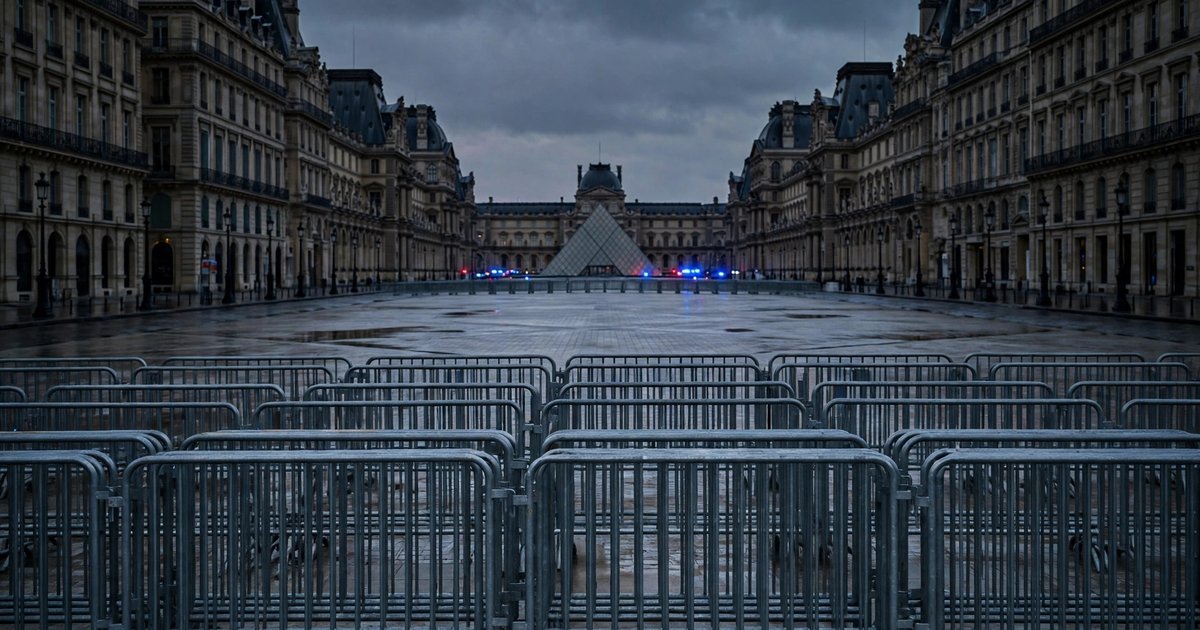
France is preparing for one of the largest peacetime security operations in its recent history. On Friday, October 23, 2026, Interior Minister Laurent Nunez announced that some 70,000 security forces will be deployed across the country on Saturday, October 24, as authorities brace for a fresh wave of demonstrations expected to turn violent.
The Louvre, the Musée d'Orsay, the Musée national Picasso-Paris, the Grand Palais, and the Fondation Louis Vuitton are among the major Paris museums that will close their doors on Saturday. The announcement, trending per news coverage from Reuters, the Associated Press, and broadcast outlets worldwide, marks an extraordinary escalation in a crisis that has pushed France's government, police, and cultural institutions into a defensive posture not seen in years.
What the French government announced
Speaking to reporters on Friday after crisis meetings involving President Emmanuel Macron and Prime Minister Sébastien Lecornu, Nunez said the deployment would include specialist units and that security forces were instructed to be "uncompromising with rioters, looters and all those who commit acts of violence."
"We are not talking about a nice, friendly demonstration," Nunez said, adding that authorities had identified numerous calls circulating on social media from hard-left and ultra-left groups encouraging attacks, looting, and assaults on public buildings. "We will be extremely vigilant, extremely firm, and we will let absolutely nothing pass," he told reporters.
The scale of the deployment is striking: 70,000 officers and gendarmes represents a mobilization on par with France's biggest counter-terrorism operations. Roughly 24 Paris metro stations along expected demonstration routes will be shut, and a curfew remains in place in parts of the capital.
What's closed and cancelled on Saturday
Beyond the flagship museums, the disruption list is long:
- Museums: The Louvre, Musée d'Orsay, Musée national Picasso-Paris, Grand Palais, Musée de l'Orangerie, Bourse de Commerce–Pinault Collection, Foundation Cartier, and Fondation Louis Vuitton all confirmed Saturday closures. Visitors holding tickets for October 24 are being issued automatic refunds.
- Art Basel Paris: The capital's biggest annual art fair announced it would end its run two days early, closing for the entire weekend over protest risks.
- Football: Paris Saint-Germain's Ligue 1 home match against Olympique Lyonnais, scheduled for Sunday evening, was moved to Monday at the police's request so officers can be redeployed. The French league confirmed the rescheduling, which awkwardly clashes with the Ballon d'Or ceremony in London on Monday evening — ten PSG players are among the 30 nominees.
- Transport: Around two dozen metro stations in Paris will be closed along protest routes.
- Commerce: The Marseille Chamber of Commerce urged businesses to shut on Saturday.
Why France is bracing for another violent weekend
Last weekend's protests over the rising cost of living descended into what authorities called the country's most violent unrest in years. Demonstrators set fires, stormed public buildings, smashed shop windows, looted stores, and clashed with police in several cities. France has already imposed localised curfews after the unrest, and Paris was placed under a central curfew when the interior ministry admitted police had lost control, with more than 2,500 arrests and the US issuing a security alert for its citizens.
What began as anger over living costs and strained public services has morphed into a broader crisis of authority. Workers and students took to the streets first, but the government says radical militants and bands of looters hijacked the movement. Intelligence agencies pinned the radicalisation on France Unbowed (LFI) and its proxies, with one October 1 government crisis readout describing "an operation organised by LFI and its proxies on the far left."
Macron himself has adopted harsh language. After returning from a three-day Gulf tour, he admitted "failures in anticipation and surprise effects" last Saturday while demanding punishment for "criminal acts" and "political and even seditious acts," accusing ultra-left groups of trying to "bring down the Republic." Prime Minister Lecornu told parliament the unrest stemmed from an "insurrectionary plan" by far-left and ultra-left fringe groups.
Authorized demonstrations versus banned protests
Police have authorized only one demonstration in Paris on Saturday — a union-led march. Requests from France's main student union, UNEF, and the Yellow Vest movement were rejected outright. UNEF, whose rallies grew out of high-school protests against teacher shortages and run-down facilities, said its demonstrations would go ahead regardless of the ban.
The restrictions extend well beyond the capital. All protests planned for Saturday in Marseille and Lyon — France's second- and third-largest cities — have been banned by local authorities. According to news coverage, at least 19 cities, including Nantes, Narbonne, Avignon, and Montpellier, have banned protests altogether, while two imposed curfews and seven imposed curfews for minors.
A separate flashpoint is expected in Orléans, in central France, where the far-right National Rally is scheduled to hold a party meeting, with thousands of counter-demonstrators expected to gather in opposition.
The deeper crisis driving the unrest
The protests are rooted in economic strain: soaring energy costs, pressure on household budgets, and deteriorating public services, with demonstrators protesting budget cuts and demanding higher wages. The government says it understands the concerns but must keep spending in check to contain rising borrowing costs.
The financial pressure is real. The risk premium on French government debt over German bonds widened to its highest level in 15 years on Thursday, and France's 10-year bond yields recently topped 5% for the first time since 2002. Credit rating agency Moody's is expected to announce a ratings action on France late on Friday — a decision that could deepen the crisis depending on its severity.
The political class is also deeply split on how to respond. Government officials frame the violence as an organized insurrectionary threat from the fringe left; opposition voices argue the state is criminalizing legitimate social anger over genuine economic hardship. With an already fractured parliament and limited fiscal room, neither narrative offers an easy exit.
What to watch next
Saturday has now happened. About 410,000 people marched across France on 24 October, including 110,000 in Paris, according to the Interior Ministry; the CGT union put the total near 800,000, with 250,000 in Paris. Police made 1,314 arrests nationwide and 53 officers were injured — both far below the previous Saturday's 2,628 arrests and 1,144 injured officers — and tear gas and water cannon were used as crowds were dispersed in Paris. The looting of the previous weekend was largely avoided. Further rallies were called for Saturday, 31 October, and a nationwide strike day for 5 November.
Internationally, the fallout is already spreading: US President Donald Trump has publicly tied the French unrest to his broader criticism of Europe, threatening the US could "leave" Europe in a fresh NATO ultimatum. And for travellers, the immediate practical advice is clear — check museum refund policies, avoid demonstration zones in Paris, and expect disruption across major French cities through the weekend.
Sources
Reporting drawn from Reuters wire coverage (October 23, 2026), the Associated Press Paris dispatch (October 23, 2026), BBC News, The Hindu, theScore, and the Washington Examiner. Figures for deployments, closures, and arrests reflect official statements and wire-service reporting as of Friday, October 23, 2026.