
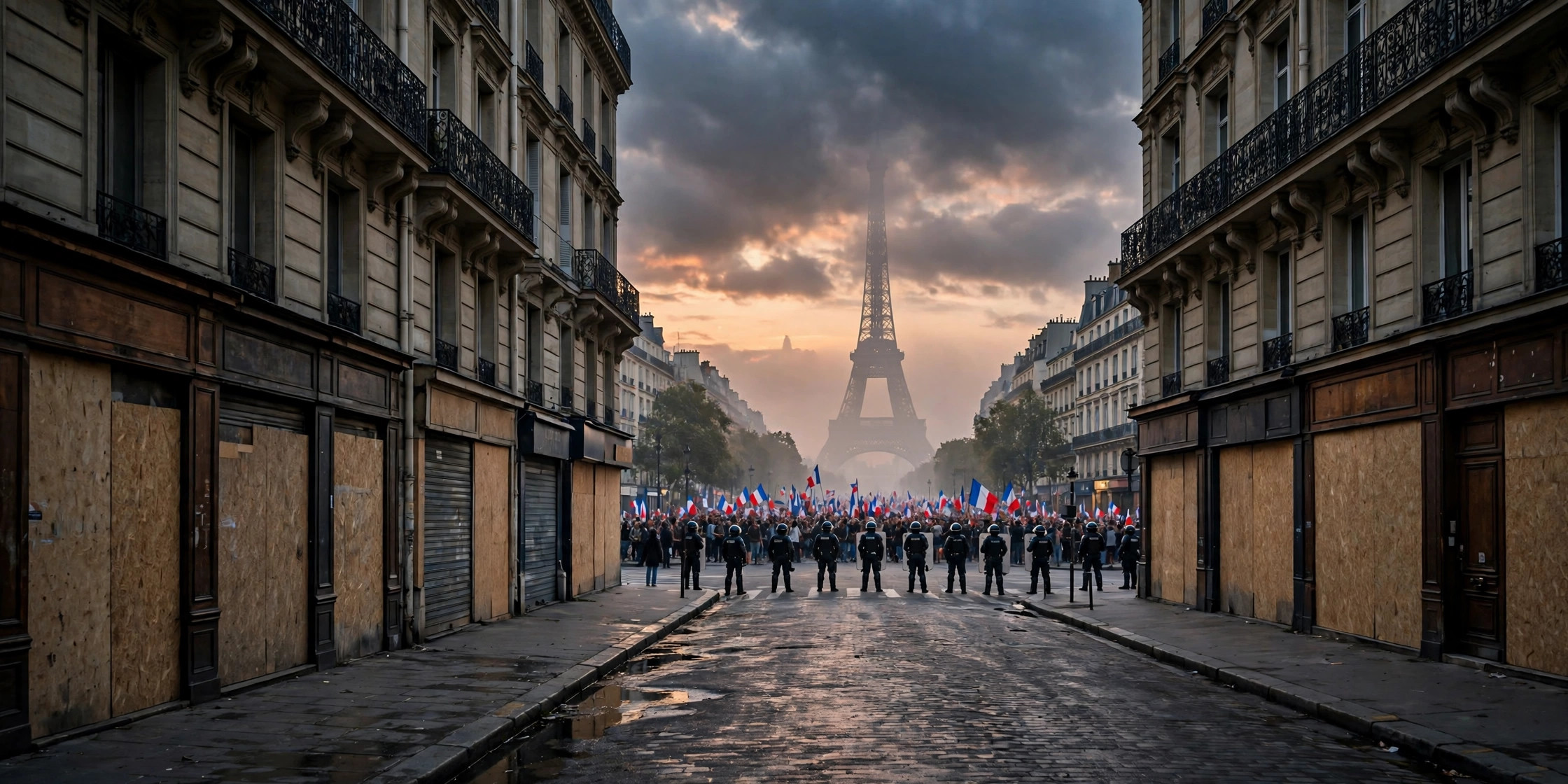
France protests October 2026 reached a new flashpoint on Saturday, 24 October, as tens of thousands of people marched across the country over the cost of living, strained public services and conditions in schools — while a 70,000-strong police operation shut down large parts of central Paris. The France protests today, trending per news coverage around the world, saw 135 people arrested by early afternoon, tear gas fired in Lyon, and the Louvre, the Musée d'Orsay and the Paris Opera closed for the day as authorities braced for a repeat of last weekend's rioting and looting.
The scale of the security response told its own story. Shopfronts along the main Paris march route were boarded up, merchandise was pulled from shelves, and more than 20 metro stations closed on police orders. Interior Minister Laurent Nuñez said many of the arrests followed pre-emptive searches that uncovered fireworks, ball bearings and other items that could be used as weapons. "We have to be ultra, ultra responsive. We have significant calls for disruption from political groups and quite simply from criminals," he told reporters. "It is going to be a long day."
Why Are France Protests Happening in October 2026?
The movement that produced the France protests in October 2026 began in mid-September as school blockades in suburbs around Paris. High-school students took to the streets demanding better conditions in their schools — fewer staff shortages, less overcrowding and repairs to dilapidated buildings — and the protests quickly widened. Rising living costs, fuel prices and pressure on public services drew in trade unions, workers and the Yellow Vest movement, the anti-establishment force that first emerged in 2018 over fuel taxes and the cost of living.
Student organisations have put concrete demands on the table: 250,000 more university places and a deep overhaul of Parcoursup, the national university admissions platform that many students say is opaque and unfair. On Friday, President Emmanuel Macron met student representatives and promised more teachers and a Parcoursup overhaul, but student leaders said they would keep mobilising until the government presents concrete actions. That refusal to stand down is what set up Saturday's nationwide day of action, dubbed "Act II" by Yellow Vest organisers after the 17 October marches.
France Protests October 2026: What Happened in Paris and Lyon
In Paris, the start of the main march was peaceful. The only authorised route ran from Porte d'Italie to Porte de Vincennes along the Boulevards des Maréchaux, keeping demonstrators on the capital's south-eastern edge and away from the city centre. Even so, much of central Paris took on the appearance of a city under lockdown: luxury boutiques boarded up their windows, some high-end retailers near Place Vendôme — including a Rolex dealer and a De Beers store — stayed closed all day, and tourists found the city's most famous museums shut. Art Basel Paris cancelled its weekend programme at the Grand Palais.
The sharpest clashes came in Lyon, France's third-largest city, where police fired tear gas to disperse around 150 protesters near the city centre after they briefly attempted to block a road. Demonstrations had been banned in central Lyon, as they were in central Toulon, while union-led marches elsewhere, including Marseille, went ahead with permits. The government deployed 10,000 more police and gendarmes than on 17 October, and the operation included France's Sentinelle military force alongside specialist tactical units including the GIGN and RAID. Authorities also cancelled leave and recalled officers to duty, with one minister describing the country as being on "maximum vigilance".
What Happened on 17 October — and Why 24 October Matters
Saturday's marches cannot be understood without the previous weekend. On 17 October, roughly 550,000 people took part in demonstrations nationwide, according to the Interior Ministry, in what became some of the worst unrest France has seen in years. Largely peaceful marches ended in looting, arson and clashes: hundreds of shops were smashed and looted in Paris, Marseille and Bordeaux, thousands of businesses were damaged, and more than 2,000 people were taken into custody. The violence — and the government's response to it — is now the central argument of both sides.
Macron has blamed "ultra-left" groups wanting to "bring down the republic" for the worst of last weekend's violence. Protest organisers accuse the government of ignoring widespread public anger and of attacking the right to protest by banning non-union-led demonstrations. Rights groups have added their own criticism: Amnesty International warned of "a slide toward authoritarian practice", while Human Rights Watch said police must protect the public from violence while ensuring that peaceful protests can take place safely. Nighttime curfews for unaccompanied minors, first introduced in Lille, Denain, Douai and Wattignies, were extended until Monday morning and widened to Marly and Valenciennes.
Le Pen, Counter-Protests and the Politics Behind the Marches
Saturday's demonstrations also drew counter-protesters opposing far-right leader Marine Le Pen, whose National Rally party was holding a congress in Orléans to launch her campaign for presidential elections scheduled in six months. Thousands marched against both Le Pen and Macron, chanting "Macron resign. Le Pen in prison", according to reports from the marches. The dual target captures the breadth of the discontent: the France protests today are not a single-issue movement but a collision of anger over living standards, education, policing and the political direction of the country.
The economic backdrop matters too. France is the world's most visited country, and its luxury retail sector — Chanel handbags, Hermès scarves, high-end watches — is an important source of revenue for brands already facing slowing demand. Business groups urged retailers to remain closed after last weekend's damage, and one boutique manager in Paris summed up the mood bluntly: with hardly any customers, it was not really worth staying open. The Yellow Vests listed more than 700 planned actions for Saturday at roundabouts, petrol stations, stations and near oil depots, a reminder that the movement's reach extends far beyond the Paris march route.
What Happens Next in the France Protests
By Saturday evening, the immediate question was whether the day would end as it began — largely calm in Paris, tense in Lyon — or whether nightfall would bring the kind of clashes that defined 17 October. The government has signalled no softening: the curfews run until Monday morning, the heavy police presence remains, and ministers have warned that disorder will not be tolerated. Student leaders, meanwhile, have said they will keep mobilising until concrete measures on teachers, university places and Parcoursup are announced.
For readers following the France protests October 2026 story, the key dates are now clear: the school blockades of September, the mass marches and riots of 17 October, and Saturday's "Act II" under the heaviest security deployment of the movement so far. Whether the protests fade, force concessions, or escalate further will depend on what the government offers in the coming days — and on whether Saturday's relative calm in Paris holds when the next round of marches is called. For background on the security build-up to this weekend, see our earlier report on France's 70,000-officer deployment for Saturday's protests, and for the earlier escalation read how curfews hit central Paris as police admitted losing control. The economic pressure behind the unrest is also reflected in Moody's decision to keep France's credit rating on negative outlook.
Reporting: Reuters, BBC News, Le Monde, Press TV.