
Iceland NATO troops are back in the headlines, and the message from Reykjavik is a careful one: more allied soldiers are welcome, a permanent foreign base is not. Prime Minister Kristrún Frostadóttir said in a Bloomberg interview on Friday 6 November 2026 that Iceland is open to a larger allied troop presence under the NATO umbrella, while ruling out a permanent presence for now. Her words were: "We are very open to the idea that there be more troops in Iceland as part of the NATO umbrella under which we find ourselves, so I don't think we have reached a point where we need a permanent presence." No troop numbers were announced, no dates were set, and no decision was taken. What was announced is a position: openness, not a deal.
The position matters because Iceland is unlike any other NATO ally. It is a founding member of the alliance, joining in 1949, and it is the only NATO member with no standing army. That fact shapes everything about how the country is defended, who defends it, and what a larger allied presence would actually look like. To make sense of Frostadóttir's words, it helps to start with the history that made Iceland the exception inside NATO, and then look at the Arctic pressures that are pushing the question back onto the table now.
What Frostadóttir actually said about Iceland NATO troops
The interview, published on 6 November 2026, put two ideas side by side. First, Iceland is "very open" to the idea of more troops on its soil as part of NATO. Second, the country has not reached the point of needing a permanent allied presence. The two halves belong together. More troops on rotation, for exercises or for air policing, is one thing. A permanent garrison, with families, infrastructure, and a standing footprint, is another, and the Prime Minister drew the line between them clearly.
Nothing in the interview amounts to an invitation with a timetable. Frostadóttir did not name a number of troops, a location, or a date. She did not say Iceland would host a new base, and she did not say the government had agreed anything with any ally. The statement is best read as a signal to allies and to voters at home: Iceland will do more inside NATO, and it will do so on terms that stop short of a permanent foreign military presence. That distinction will matter in the debate that follows, because supporters and critics of a larger presence will both be able to quote the same interview.
Frostadóttir also said Iceland's executive will analyse the September 2026 security framework agreement between the United States and Denmark on Greenland. The agreement covers the security of Greenland, the vast Arctic island that sits between Iceland and North America, and its terms bear directly on the security of the whole North Atlantic. An Icelandic government that studies that agreement is a government weighing how the security map around it is changing, and whether its own arrangements still fit.
The NATO member with no army
Iceland joined NATO in 1949 as a founding member, and it did so on a condition: it would not be expected to create an army of its own. That condition has held for more than 75 years. Iceland has no standing army, no navy in the military sense, and no air force. It is the only ally in NATO in that position, and the alliance has been built around the gap ever since. The arrangement works because other allies provide the capabilities Iceland does not have, and because Iceland provides something they need in return: location.
The island sits in the North Atlantic between North America and Europe, astride the sea and air routes that connect the two continents. During the Cold War, that position made Iceland one of the most strategically valuable pieces of real estate in the Western alliance. Soviet submarines passing between Greenland, Iceland, and the United Kingdom — the so-called GIUK gap — had to pass through waters Iceland overlooks. The island's radars and airfields watched that gap, and the alliance built its North Atlantic defence around them. Geography has not changed, and the renewed attention to the Arctic has only made the position more relevant. That geography is why the question of Iceland NATO troops keeps returning: the island is small, but the sea and air around it are not.
What Iceland does have is a Coast Guard, with three ships and four aircraft, and a police force. The Coast Guard patrols the waters around the island, carries out search and rescue, and monitors the exclusive economic zone. It is a civilian service with military-style capabilities, not an army, and it is not built to fight a war. The police handle internal security. Everything beyond that — air defence, deterrence, the ability to respond to a military threat — comes from allies, under NATO and under a separate bilateral agreement with the United States.
Keflavík: from American base to air-policing rotations
The history of foreign troops in Iceland runs through Keflavík, the air base on the Reykjanes peninsula near the international airport. American forces were stationed there for decades under the 1951 bilateral defence agreement between Iceland and the United States, which remains the legal backbone of the defence relationship. The base, Naval Air Station Keflavik, hosted fighter aircraft, patrol planes, and thousands of personnel at its height. Then, in September 2006, the United States withdrew its forces, and the permanent foreign military presence in Iceland came to an end.
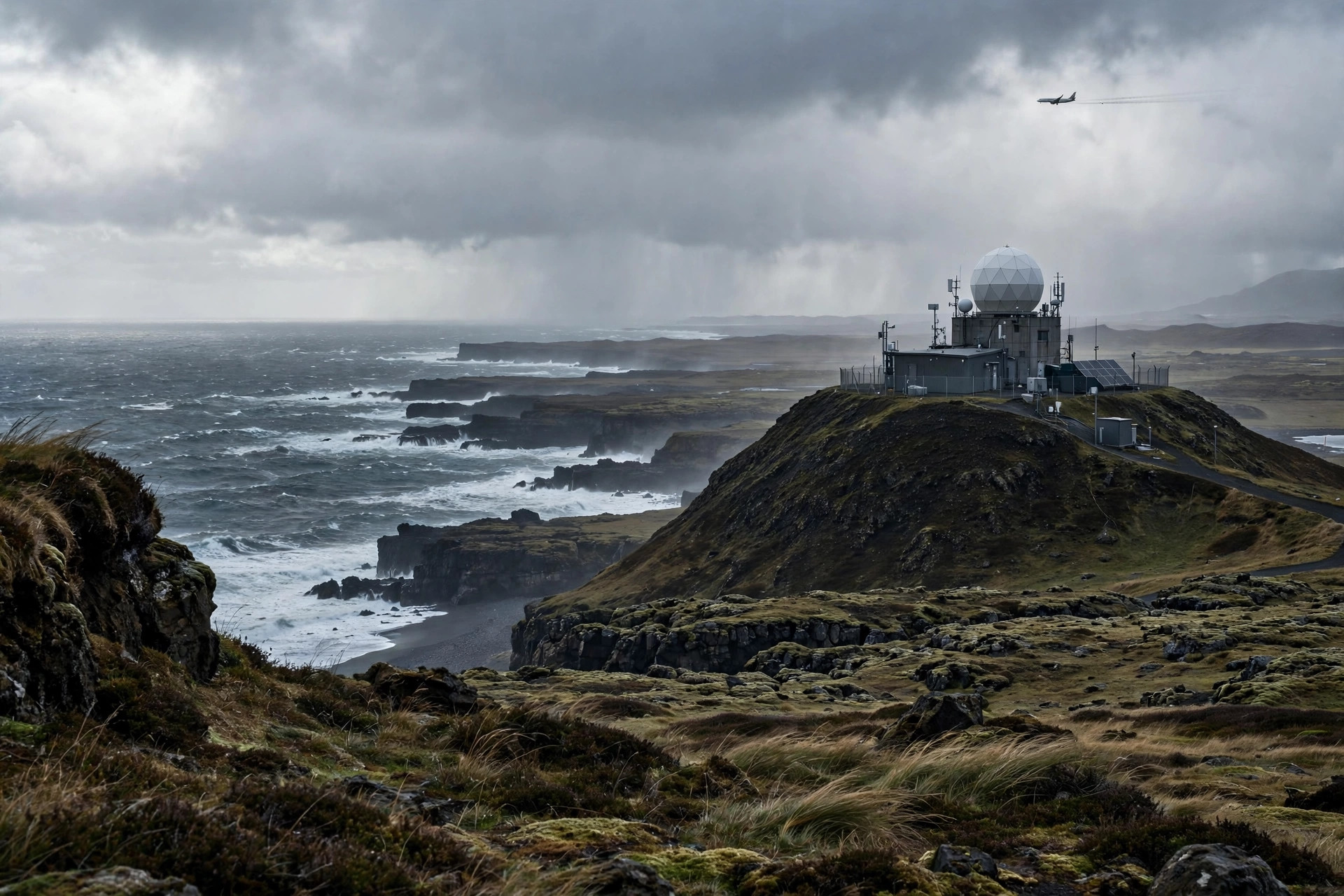
Since 2006, there has been no permanent foreign military presence in Iceland. What there has been is a rotating one. Since 2008, NATO allies have taken turns providing air policing from Keflavík, sending fighter aircraft for short deployments to guard Icelandic airspace. The Iceland Air Defence System, a network of radars, watches the skies between rotations. The arrangement gives Iceland air cover without a standing garrison, and it gives allies a place to operate from in the North Atlantic. NATO's warnings about the alliance's eastern flank show the same logic at work elsewhere: presence that rotates, rather than forces that stay.
Keflavík still matters because the infrastructure never fully went away. The runways, the hangars, and the radar sites remain, and the base can receive allied aircraft at short notice. Any future discussion of Iceland NATO troops will start from what Keflavík can already receive, rather than from a blank slate. When Frostadóttir speaks of more troops, the practical question is what "more" would use: existing facilities, expanded for longer or larger rotations, or something new. The interview gave no answer to that question, and the answer will depend on what allies ask for and what Iceland's government is willing to agree.
How Iceland's defence works without soldiers
Iceland's defence rests on three legs. The first is NATO membership itself, and the collective defence commitment in Article 5 of the North Atlantic Treaty: an attack on one ally is treated as an attack on all. The second is the 1951 bilateral defence agreement with the United States, under which the US commits to the defence of Iceland. The third is what Iceland contributes itself: funding, infrastructure, and host-nation support — the runways, the ports, the fuel, the airspace, and the civilian services that let allied forces operate from Icelandic soil.
Host-nation support is the part of the bargain that gets least attention and does the most quiet work. When allied aircraft deploy to Keflavík for air policing, someone has to house them, fuel them, feed their crews, and keep the airfield running. Iceland provides that. When NATO runs exercises in the North Atlantic, Icelandic ports and airfields are part of the logistics chain. The contribution is real, and it is measured in money and infrastructure rather than in soldiers. Frostadóttir has said Iceland is unlikely to establish its own army, and the contributions she points to are these: funding, infrastructure, and host-nation support, rather than a new military of its own.
The arrangement has critics on both sides. Some argue that a country without an army is free-riding on its allies, and that Iceland should contribute more in hard capabilities. Others argue that any foreign military presence, even a rotating one, compromises the independence Iceland has guarded since 1949. The Prime Minister's position sits between those two views: do more, host more, but do not cross the line into a permanent presence. It is a position that can be defended to both audiences, and it is also a position that leaves the hardest questions — how many troops, for how long, and under what terms — for later.
Why more Iceland NATO troops are on the agenda now
The timing of the interview is not accidental. The Arctic has become a sharper focus of NATO planning, and Iceland sits at its southern edge. Russia's military activity in the High North, the opening of Arctic sea routes as ice recedes, and the competition over Greenland have all pushed the region up the alliance's agenda. The September 2026 security framework agreement between the United States and Denmark on Greenland, which Frostadóttir said her government will analyse, is part of that same shift. Greenland's security and Iceland's security are linked by geography: the same waters, the same airspace, the same gap between the continents.
Iceland is also part of a joint Arctic approach known as Arctic Sentry, involving seven Arctic NATO nations. The name covers cooperation on surveillance, exercises, and presence in the region, and Iceland's role in it is built on the same assets it has always offered: location, airfields, and radar coverage. A larger allied troop presence in Iceland would fit inside that framework rather than standing outside it, and it would be presented, if it happens, as part of a regional posture rather than a bilateral deal with any single ally.
None of this means a decision is close. The Prime Minister's words open a door; they do not walk through it. Any agreement on more troops would need negotiation with the ally or allies involved, a decision by Iceland's government, and a debate in the Althing, Iceland's parliament, where the question of foreign troops has always been politically charged. The history of 2006, when the Americans left and Iceland chose not to replace them with a permanent presence of its own, still shapes that debate. NATO's planning for a postwar deployment shows how slowly such decisions move even when the strategic case is clear.
What to watch next
Three things will show whether Frostadóttir's openness turns into anything concrete. The first is the government's analysis of the US–Denmark Greenland framework, and whether it leads to a public statement about Iceland's own posture. The second is any request from an ally — the United States, the United Kingdom, or another NATO member — for a longer or larger rotation at Keflavík, and how the government responds. The third is the debate at home, where the line between "more troops" and "a permanent presence" will be tested by people who read the same interview in very different ways.
For now, the facts are simple enough to state in one paragraph. Iceland is a founding NATO member with no army. It has hosted no permanent foreign military presence since the American withdrawal from Keflavík in September 2006. The debate over Iceland NATO troops will now move to the Althing and to allied capitals, and the Prime Minister's line — open to more, no permanent presence — is the starting point for that debate. It does host rotating NATO air-policing deployments and operates a radar network. Its Prime Minister said on 6 November 2026 that Iceland is very open to more troops under the NATO umbrella, and that it has not reached the point of needing a permanent presence. Everything else — numbers, dates, locations — is still to be decided, and anyone reporting a decision has gone beyond what was actually said. Iceland's Golden Circle and Blue Lagoon draw the visitors; the radar stations and runways at Keflavík do the quieter work of keeping the island inside the alliance's shield.