
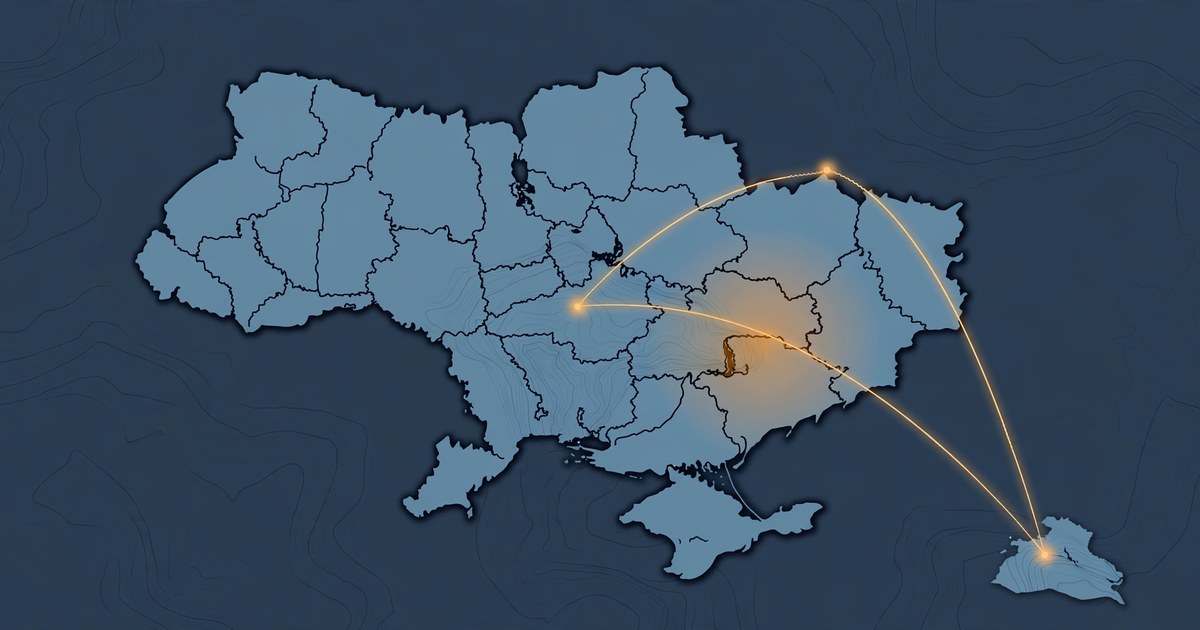
The Ukraine Donbas NATO membership question moved to the centre of the war's peace talks this week, after President Volodymyr Zelensky revealed that American negotiators had raised it directly with him. "The Americans raised a question: 'What if Ukraine joins NATO? Would Ukraine withdraw from Donbas?'" Zelensky told reporters on Friday 13 November 2026, in remarks released by his office the following day. "This was the first time this had been raised," he said. The disclosure, reported by Reuters, CNN and other major outlets on 14 November, is the first time the question of linking NATO membership to a territorial concession has been raised in the talks, Zelensky said — and it immediately became the most sensitive question in a peace process that has produced a prisoner exchange but no breakthrough.
What did Zelensky say about Donbas and NATO membership?
Zelensky was speaking to journalists on Friday after a week of diplomacy that took him to Copenhagen and Dublin, and after two days of US-brokered talks between Russian and Ukrainian delegations in Abu Dhabi. According to Reuters, he said the American side had asked whether Ukraine would withdraw from Donbas if it were allowed to join NATO — a question he described as new to the talks. He stressed that Kyiv was not ready to concede territory. But he added that if the United States and its NATO partners confirmed a comprehensive package, he would put the question to the Ukrainian people. "If the American side confirms precisely this to us, together with other NATO partners, then I will ask our Ukrainian society what it thinks: do we accept it or not? I have no right to make that decision on my own," he said, as reported by CNN. "But we need specifics, and we don't have them yet."
Zelensky set out what that package would have to contain: security guarantees from NATO and the European Union, a strong and well-funded Ukrainian army, and money for reconstruction. Guarantees modelled on NATO's Article 5 mutual defence clause are the minimum he wants, and he said any agreement would come "without any recognition of the occupied territories as Russian", according to the Kyiv Independent. He also ruled out writing neutrality into Ukraine's constitution.
What is Donbas and who controls it?
Donbas is the name for the Donetsk and Luhansk regions of eastern Ukraine, a mineral-rich industrial heartland that Russia has coveted since the full-scale invasion began in February 2022. It is also the ground where the war's hardest fighting has taken place, and where the question of territory is most concrete: a withdrawal would mean Ukrainian forces leaving land they still hold, not simply recognising losses that have already happened.
Russian forces control about 80% of Donetsk and nearly all of Luhansk, according to estimates by the US-based Institute for the Study of War published on 11 November. The same estimates put the land Ukraine still holds at roughly 20% of Donetsk and 0.38% of Luhansk. CNN reported that Moscow's grinding ground offensive in the region has largely stalled in recent months — which is why the territory Ukraine still holds in Donbas has become a bargaining chip rather than a foregone conclusion.
Why NATO membership for Ukraine is so difficult
For Russia, Ukrainian membership of NATO has been a red line from the start. President Vladimir Putin has cited the alliance's eastward expansion as one of the reasons for launching the full-scale invasion in 2022, and Moscow has demanded both total control of Donbas and permanent Ukrainian neutrality as part of any settlement. That is the position Zelensky's disclosure runs directly into: the very thing the Americans are said to have floated as a reward is the thing Russia says it went to war to prevent.
There is a second problem. NATO membership is not Washington's to give. Admitting a new member requires the unanimous consent of every existing member state, as former US ambassador to Ukraine William Taylor told CNN — and "most would agree", he said, but "there may be, however, a couple of nation member states in NATO who would not agree". Taylor's conclusion was blunt: "So it's not a firm offer at this point." NATO leaders declared at their Bucharest summit in April 2008 that Ukraine "will become" a member, but set no date — and eighteen years later, that promise is still undated.
What Russia and the United States have said
Moscow's first response was to distance itself from the idea. Russian Foreign Ministry spokeswoman Maria Zakharova said that, as far as her department was aware, the issue had not been discussed during the talks between US envoys Steve Witkoff and Jared Kushner and Putin in Moscow. The Kremlin did not immediately respond to Zelensky's disclosure itself, the New York Post reported. Nor has the White House said anything on the record about a Donbas-for-NATO exchange: as of late morning UTC on 14 November, no American official had confirmed or denied Zelensky's account.
The disclosure came at the end of a fast-moving week of shuttle diplomacy. Witkoff and Kushner met Putin at the Kremlin on Thursday 12 November, then flew to Dublin to brief Zelensky the same evening. Zelensky also used his remarks to warn that Putin "personally does not support a ceasefire" and is "betting everything" on the winter campaign. He dismissed Putin's call for a local humanitarian ceasefire in the contested city of Kostiantynivka, and said Russia had rejected Ukraine's proposal for a ceasefire covering energy infrastructure during the Abu Dhabi talks.
What happens next in the Ukraine peace talks
The two days of US-brokered talks in Abu Dhabi on 10 and 11 November ended without a breakthrough, but the two sides did agree on a large prisoner exchange involving more than 1,000 people from each side — possibly rising to 1,500 each — to take place within two to three weeks, according to Russian General Alexander Zorin. Witkoff said after the Moscow meeting that a new trilateral meeting has been set, though no date or venue has been announced yet.
Europe is pushing for a seat at the next round. Five European nations have formed a group to speak for Europe after a deal struck in Dublin, but the Kremlin remains sceptical: spokesman Dmitry Peskov said Moscow "can decide" on a European seat once it sees Europe is ready to contribute to the peace process. For now, the Donbas question has no specifics attached to it — no written proposal, no agreed text, no date for a referendum. As Zelensky put it: "All of this is still under discussion."
Why the Donbas NATO membership question matters
This disclosure matters because it names the trade that everyone in the negotiations has been circling and no one had said out loud: land for security. Until now, the argument has been conducted in euphemisms — "territorial questions", "security guarantees", "realities on the ground". Zelensky has now put the blunt version on the record, and attached a condition that changes the politics of it: the decision would go to Ukrainian voters, not be taken by a president alone. That makes the proposal harder for Moscow to dismiss as a backroom deal, and harder for Kyiv's partners to treat as a hypothetical.
It also exposes the gap at the heart of the peace process. Washington can ask the question, but it cannot answer it: NATO membership needs every ally to agree, and Russia has to accept the outcome of a deal built around the thing it calls a red line. The fighting, meanwhile, has not stopped for the diplomacy — Russia fired 36 ballistic missiles at Kyiv on 8 November, of which only four were shot down. The next test is whether the Americans return with the specifics Zelensky asked for, or whether the Donbas-for-NATO idea fades as quickly as it surfaced.
Sources: Reuters; CNN; Kyiv Independent; Al Jazeera; Institute for the Study of War; New York Post.