
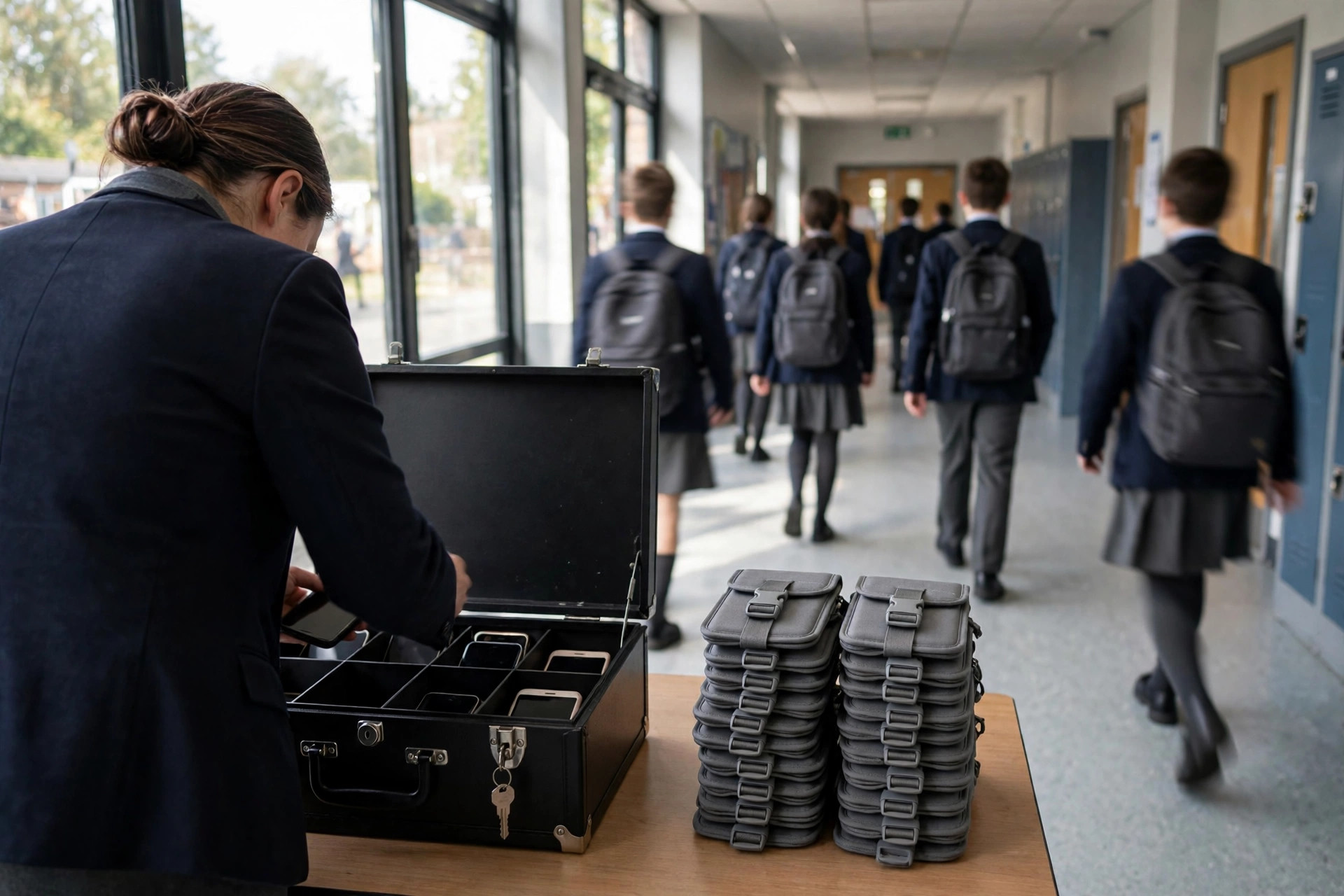
The England school phone ban is about to get teeth. On the evening of 9 November 2026, the Department for Education (DfE) announced strengthened statutory guidance that will require schools in England to go further than the current “not seen, not heard” approach, with the new rules taking effect from September 2027. From that date, the guidance will make clear that schools should adopt whole-school strategies that keep phones out of use and inaccessible throughout the school day — through lockable pouches, collection at the start of the day, secure storage, or banning phones from the site altogether. Education Secretary Lucy Powell put it bluntly: “Children should not be using smartphones at any point during the school day, full stop.” The announcement matters because it closes the gap between a ban that exists on paper and one that works in practice — and because it arrives with no new money attached, a point headteachers’ unions raised within hours.
What the England school phone ban changes in September 2027
The first thing to understand is that a ban itself is not new. The Department for Education first issued non-statutory guidance in February 2024 asking schools to prohibit phone use during the school day. That guidance was strengthened in January 2026 to say schools should be mobile phone-free by default. Then, in April 2026, Parliament gave the policy legal force: section 36 of the Children’s Wellbeing and Schools Act 2026, which received Royal Assent on 29 April 2026 and came into force on 29 June 2026, requires schools in England to have regard to the Secretary of State’s guidance on pupils having and using mobile phones during school hours. Schools were expected to begin following the statutory guidance from 1 September 2026. The House of Commons Library set out this position in a research briefing published on 18 September 2026.
What changes in September 2027 is the enforcement expectation. Under the current guidance, many schools run what the DfE calls a “not seen, not heard” policy: pupils may keep their phones in their bags, switched off or silent, as long as the devices are neither visible nor audible. The DfE now says that is not enough. In its announcement, published on GOV.UK on 10 November 2026, the department said the strengthened guidance “will make clear that schools should go beyond ‘not seen, not heard’ — where phones may remain in pupils’ bags — and adopt whole-school strategies that keep phones out of use and inaccessible throughout the school day.” Schools Week, reporting the announcement on 9 November, noted that the government has so far set out only an intention to change the guidance and has not published the exact new wording. The same report noted that the change will not be a legal requirement to adopt any single method: schools will be encouraged, rather than compelled, to stop the “not seen, not heard” practice. That distinction matters. The news is a tougher enforcement steer, not a new criminal offence and not a single prescribed system.
How the England school phone ban will work in practice
The DfE pointed to four approaches schools are already using. The first is lockable pouches: pupils seal their phones in a magnetic pouch when they arrive and staff unlock it at the end of the day. Chace Community School in Enfield adopted lockable Yondr pouches during the 2025–26 academic year, requiring pupils to secure their phones on arrival. Schools in Cheshire use a similar magnetically sealed pouch system. The second approach is collection at the start of the day, with phones handed in and returned when lessons end. The third is secure storage, such as lockers. The fourth is prohibiting phones from the school site altogether.
Schools keep the freedom to choose which of these fits their building, their budget and their pupils. That flexibility is deliberate: the England school phone ban sets the outcome — phones inaccessible all day — not the method. The guidance does not prescribe one system for every school, and the DfE has said the strengthened rules will build on what leading schools already do. Exceptions remain part of the picture. The House of Commons Library briefing explains that schools may adapt their policies for pupils who need phones for medical reasons, for pupils with special educational needs and disabilities, and for particular circumstances such as trips, boarding and sixth-form use. Ofsted already checks that schools have a phone policy and apply it consistently, and the DfE has said inspectors will assess mobile phone policies and their implementation as part of every school inspection.
Why the government says “not seen, not heard” is not enough
The DfE’s case rests on a simple observation: rules that rely on pupils keeping phones hidden are widely ignored. Only 16% of secondary pupils say phone rules are followed all of the time, according to a DfE survey carried out in June 2026 and reported by Radio NewsHub. Powell’s message to parents and pupils was that “school is for learning and friendship, not scrolling.” The England school phone ban, ministers argue, protects both the learning time and the friendships Powell mentioned. The department also cited polling published in March 2026 which found that 40% of children aged 9–16 were turning down real-world opportunities to spend time online. An interim report from the Milburn review warned that disengagement from school can begin as early as 12 or 13 years old.
The research evidence on bans is more mixed than the announcement suggests, and any honest account should say so. The largest English study so far, the SMART Schools study led by Dr Victoria Goodyear at the University of Birmingham and published in The Lancet Regional Health – Europe in February 2025, compared 1,227 pupils aged 12 to 15 across 30 English secondary schools. Pupils at schools with restrictive policies spent less time on their phones during school hours, but the researchers found no clear difference in overall mental wellbeing, and no difference in total phone or social media use across weekdays and weekends. The study was observational, not a randomised trial, so it cannot prove that bans have no benefit over several years. A US working paper on schools that introduced lockable phone pouches found substantial reductions in phone use during the day. The fair reading is that a ban is a reasonable tool for cutting distraction in lessons, while the wider claims sometimes made for it — better grades, better mental health, an end to online harm — go further than the evidence supports. The England school phone ban debate also runs alongside wider concern about children’s health and the services around them, including the pressures described in the NHS winter plan for GP appointments. Children’s Commissioner for England Dame Rachel de Souza welcomed the new guidance.
The funding question schools keep asking
The sharpest criticism of the announcement is not about the principle. It is about the bill. The government has not announced a dedicated funding package for the proposed phone storage measures. Paul Whiteman, general secretary of the school leaders’ union NAHT, supports the ban but warned: “Many schools already have restrictions on phones, but going beyond a ‘not seen, not heard’ approach comes at a cost. If schools are to implement some of the more robust measures suggested in this guidance, they will need access to additional funding and support.” Pepe Di’Iasio, general secretary of the Association of School and College Leaders (ASCL), said schools will need time to develop a new policy that works in their setting.
The sums are not trivial, and the England school phone ban will only work in practice if schools can afford the storage it requires. Reporting on the announcement put the cost of secure pouches at about £20–£25 each. For a secondary school with 1,000 pupils, that alone implies roughly £20,000 to £25,000 before the cost of lockers, staffing the collection point each morning, or replacing lost and damaged pouches. Schools that choose lockers or a staffed collection desk face their own costs. The DfE has not said whether any of this will be funded centrally, and that silence is likely to dominate the response from headteachers over the coming weeks. The unions’ position is not opposition to phone-free schools. It is that a policy which asks every school to buy storage for every pupil cannot be delivered on existing budgets.
A second announcement: safety rules for classroom technology
The phone guidance did not arrive alone. On the same day, the DfE launched a consultation on technology in the classroom, exploring independent safety certification for education technology. The consultation, reported in detail by Tes, would require edtech products to be designed to “minimise the risk of emotional or developmental harm to children”. In scope are filtering products, products conducting high-risk data processing of children’s data — including AI tutoring tools, special educational needs and disabilities (SEND) platforms and management information systems — and pupil-facing generative AI tools and personalised learning tools. The certification scheme would set out the safety criteria a product must meet and the rules for assessing whether it meets them.
The backdrop is a fast-moving market that ministers say has become a “wild west”. Education minister Paul Waugh used that phrase last week to describe the range of education technology products in schools across England. A Technology in Schools Survey published in 2025 found that half of school leaders said safeguarding and data concerns were a barrier to increasing the uptake of technology by schools, to a great or some extent. More than 150 clinicians have warned of a “crisis” in children’s physical and developmental health linked to screen-based learning. The consultation is open until 4 February 2027, according to Schools Week, and the DfE has said participation in the certification scheme would be technically non-mandatory, though there would be a clear expectation in statutory guidance that products become certified. Security is part of the same conversation: attacks on everyday technology keep making headlines, as in the recent case where France blamed Iran for a supermarket fridge cyberattack. The government is developing its own AI tutoring tools, as Tes first revealed last year, so the certification question also touches its own products.
What happens next
The revised statutory mobile phone guidance will be implemented from September 2027, with schools encouraged to move sooner where possible. That gives schools most of the 2026–27 academic year to decide which approach to take, cost it, consult parents and pupils, and write a new policy. The first thing to watch is the wording itself: Schools Week reported that the DfE did not provide the exact text it would include, so the strength of the final guidance will only be clear when it is published. The second is funding. If the government holds to no new money, many schools are likely to pick the cheapest compliant option — collection or a site ban — rather than pouches or lockers. The third is the edtech consultation, which closes on 4 February 2027 and will shape which AI tutors and learning platforms schools are expected to use.
For parents wondering what the England school phone ban means for their child, the scope is worth noting: the rules apply to England. Education is devolved, and approaches differ across the UK. Within England, the change is real but narrow: the ban on phone use during the school day already exists in statutory guidance, and what September 2027 adds is the expectation that schools make phones genuinely inaccessible, not merely invisible. Whether that turns a widely ignored rule into a working one will depend less on the announcement than on the money, the wording and the months of planning that follow it.