
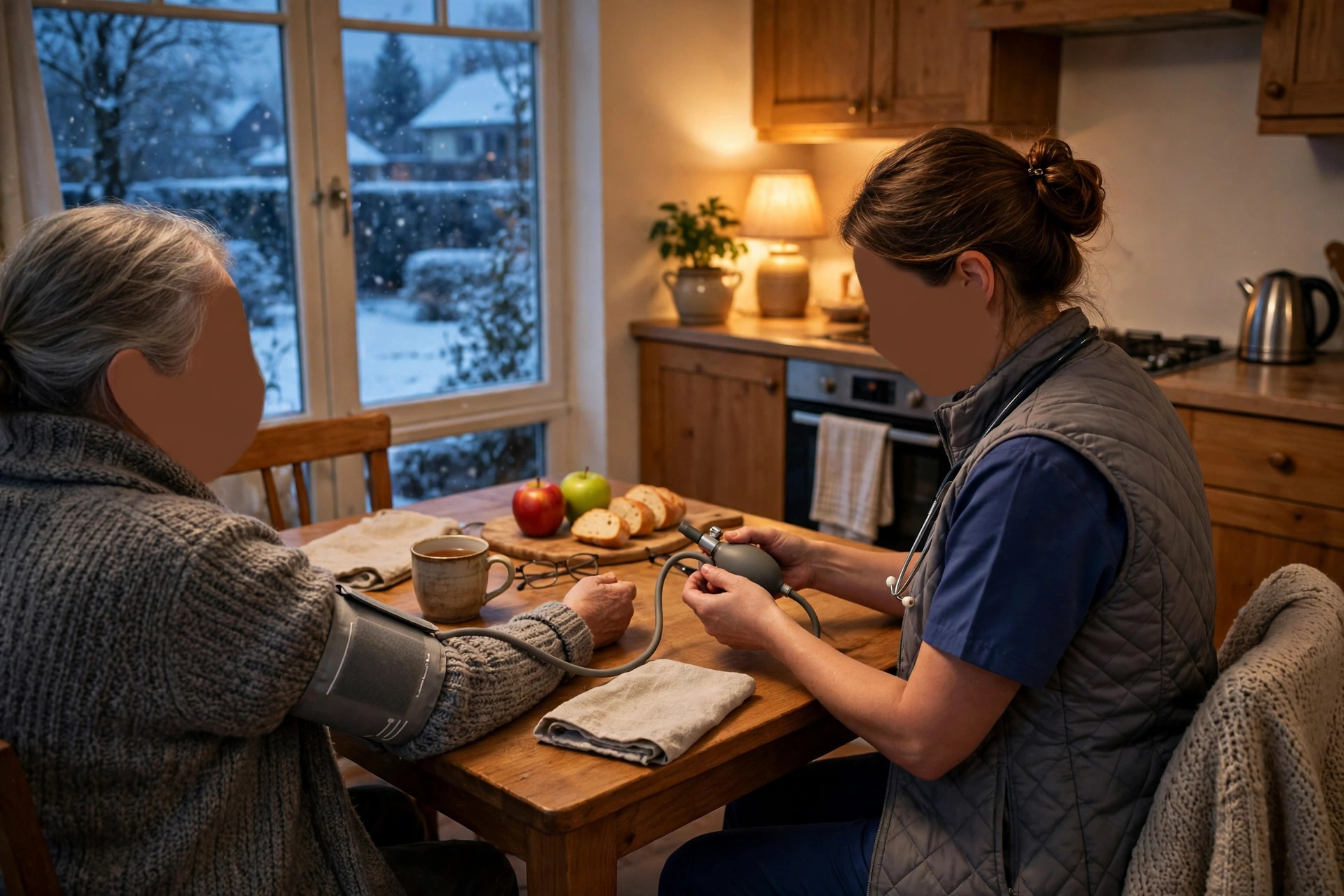
Up to 300,000 vulnerable patients in England will get extra GP support this winter under a £40 million programme announced on 9 November 2026. The NHS winter plan GP £40m scheme, announced by Prime Minister Andy Burnham and Health Secretary Yvette Cooper, funds health checks, home assessments, medication reviews and nurse-led respiratory clinics for the patients most at risk of ending up in hospital. The headline number is real, but the money is not new: it is reallocated from existing GP budgets. That detail, and the question of who actually gets help, sit at the centre of this plan.
What the NHS winter plan GP £40m programme actually does
The programme is aimed at the patients GPs already know are most likely to need hospital care in the cold months: older people living with frailty, people with heart disease, and people with long-term lung conditions such as COPD and emphysema. Those patients will be offered extra support from their GP practice this winter, including health checks, home assessments, medication reviews and nurse-led respiratory clinics. The aim is to catch problems early, at home, rather than in an ambulance or an A&E corridor.
One limit matters from the start. This is an England-only programme. The NHS in Scotland, Wales and Northern Ireland is run separately, and the £40 million applies to GP services in England alone. A patient in Glasgow or Cardiff is not covered by this announcement, and the devolved governments make their own winter plans. Anyone reading about the scheme should check which nation's NHS is being discussed before assuming it applies to them. Our NHS services guide explains how the four UK health services differ.
How the £126 per patient works
The money reaches patients through Primary Care Networks, the groups of GP practices that work together to cover a local area. Each network will receive £126 for every eligible patient it supports under the programme. The networks, not individual practices, hold the funding and decide how to organise the extra clinics and visits, which is one reason the scheme has drawn criticism from doctors' leaders, as explained below.
The patients are chosen by risk, not by application. Each network is expected to identify the 0.5% of its population at greatest risk of an avoidable hospital admission, and to focus the extra support on them. That is a small slice of any practice list: a network covering 50,000 patients would be looking at about 250 people. The figure of 300,000 patients across England is the ceiling for the programme, not a promise that every eligible person will be reached, and the networks will decide whom to prioritise within their own lists.
Who counts as vulnerable, and who decides
There is no public sign-up for this support, and no form patients can fill in. GP practices and their networks choose whom to prioritise, using their records of who has been admitted to hospital before, who lives with several long-term conditions, and who is frail or housebound. A patient who thinks they should be included cannot apply; the decision rests with the practice that knows their history.
That gatekeeping is both the strength and the weakness of the design. On the one hand, GPs are well placed to spot the patients most likely to deteriorate in winter, and a targeted programme reaches people who would never ask for help themselves. On the other, it means the scheme's reach depends on how well each network identifies its highest-risk patients, and on whether practices have the staff to run the extra clinics. The 300,000 figure is a ceiling set by the funding, and the number actually supported will depend on how many networks take part and how quickly they can staff the work.
Why the NHS winter plan GP £40m money is contested: reallocated, not new
The sharpest argument about the NHS winter plan GP £40m programme is not about the care it funds but about where the money comes from. The £40 million is reallocated from existing GP budgets for 2026/27. It is not new money added to the NHS, and the government has not hidden that fact. The funding comes from savings in NHS England's GP list-cleansing drive, the exercise that removes patients who have moved away or died from practice lists, and it is being moved from individual practices to Primary Care Networks.
The British Medical Association has criticised the move. It describes the £40 million as repurposed, and says moving it from individual practices to networks could threaten the sustainability of local surgeries. Dr Clare Bannon, chair of the BMA's GP committee in England, made the point that taking money from practices to fund a network-level programme leaves the practices themselves thinner. Critics also note that proactive care for frail patients has been a contractual duty for GP practices since 2017-18, which raises the question of what is genuinely additional in this winter's offer. The government answers that ring-fencing the money for the highest-risk patients, with a fixed payment per patient, makes sure the work actually happens rather than being absorbed into everyday practice. Winter planning takes different forms elsewhere: Delhi's winter action plan shows how another large city organises its cold-season response, though its measures are about air quality rather than GP care.
The wider winter package
The £40 million sits inside a larger winter package. The Budget on 28 October set aside £190 million for NHS winter pressures, and £140 million of that is going to 14 urgent care schemes. Twenty-five new or expanded urgent care sites are opening this winter, including a £29 million same-day emergency care unit that opened on 20 October at William Harvey Hospital in Ashford. The pattern is the same as the GP programme: find the patients who can be treated without a hospital admission, and treat them earlier and closer to home.
Flu vaccination is the other half of the winter plan. By 1 November 2026, 13.6 million people in England had been vaccinated against flu, about 300,000 more than at the same point last year. That is a genuine improvement on last winter's pace, and it matters because flu admissions are one of the largest avoidable pressures on hospitals in January. The GP programme and the vaccination drive are aimed at the same problem from different directions: one keeps vulnerable patients well at home, the other keeps a virus from putting them in hospital in the first place.
What patients should expect from the NHS winter plan GP £40m scheme this winter
For patients, the practical question is simple: will my GP contact me? If you are among the highest-risk patients on your practice's list, the answer should be yes, with an offer of a health check, a medication review or a home assessment. If you are not contacted, there is no route to claim a place on the programme, and the best step is to use the usual channels: book a review with your practice, ask about a flu jab if you have not had one, and raise any new symptom early rather than waiting.
The Prime Minister set expectations plainly at the launch, saying he was not going to pretend this winter will be easy, and that the aim is to keep people well at home before a small problem turns into a trip to A&E. That is the honest frame for the scheme: a targeted programme, funded by moving money inside GP budgets, aimed at the patients most likely to need a hospital bed. No published estimate exists of how many admissions it will prevent, and that absence is worth stating plainly. The 300,000 figure is a ceiling, the £40 million is reallocated, and the test of the plan will be written in hospital admission figures over the winter, not in the announcement.