
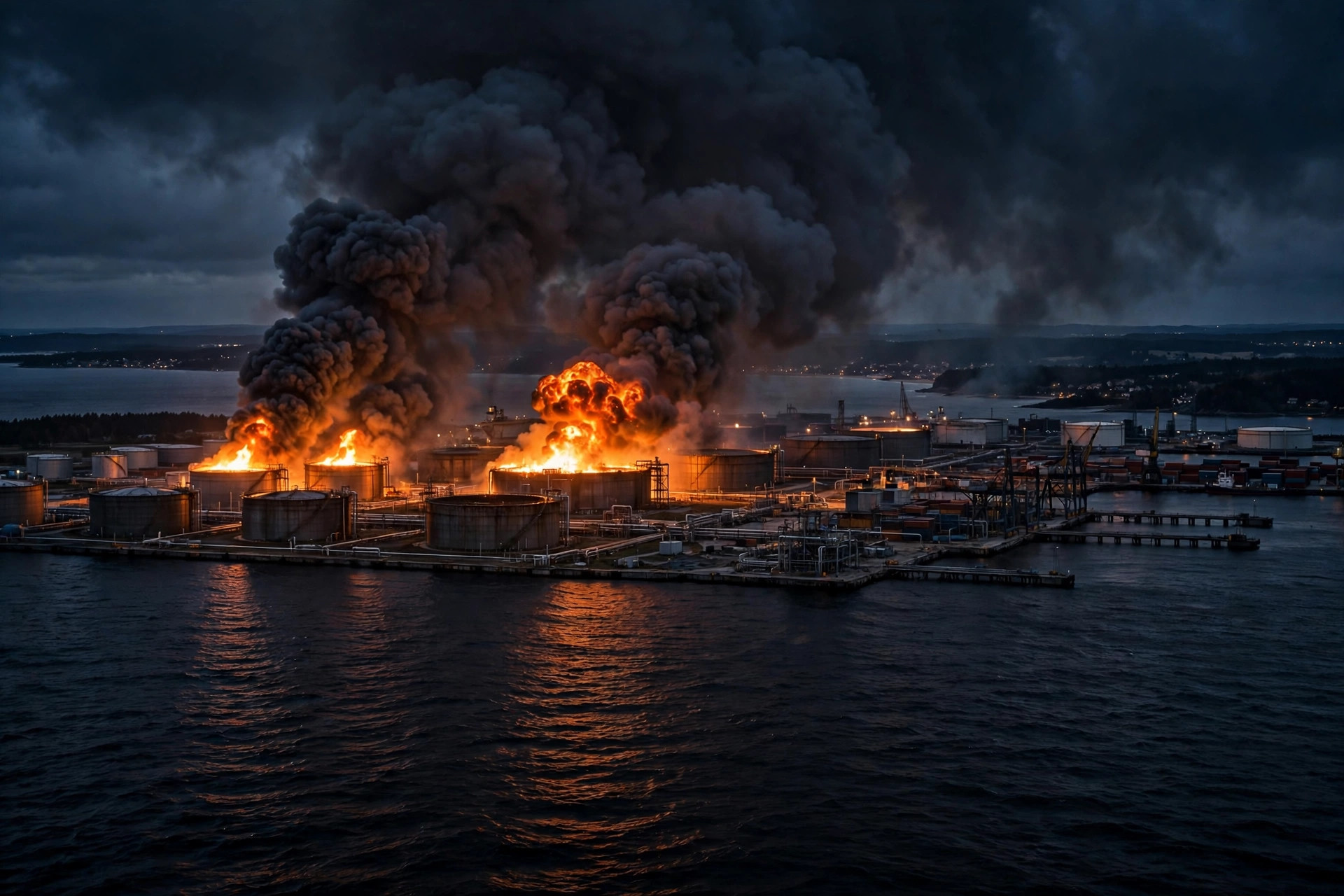
The Ust-Luga drone attack turned a quiet stretch of Baltic coastline into a fireball visible from another country. Overnight on 10–11 November 2026, Ukrainian drones struck the Ust-Luga port area in Russia's Leningrad region, starting a fire and shutting down a transformer substation. Three port workers were injured. The attack was the latest in Ukraine's campaign against Russia's oil export infrastructure, and it set off air-raid warnings across three NATO states the same night. This is what is confirmed, what is claimed, and why the night mattered beyond the port itself.
Ust-Luga is Russia's main export hub on the Baltic Sea. The port loads crude oil, fuels, coal, fertiliser and grain, and the Maritime Executive reported it handles about 700,000 barrels per day of petroleum. Its Novatek complex processes gas condensate into fuel. That is why Ukraine has struck it repeatedly: in January 2024, on 14 August 2026, on 1 September 2026 and again in October. The November attack was the biggest yet on the Leningrad region, according to the regional governor's own count.
What happened in the Ust-Luga drone attack
Leningrad region governor Alexander Drozdenko said on Telegram early on Wednesday 11 November that drones had hit the port area of Ust-Luga in the Kingisepp district, starting a fire, and that a transformer substation had shut down in an emergency. Firefighters were working to put out the blaze. Three workers were injured, one of them taken to hospital with a shrapnel wound to the leg; Drozdenko said their lives were not in danger. That much is confirmed by the Russian side itself.
Ukraine's Security Service, the SBU, said its drones carried out the attack together with other units of Ukraine's Defence Forces. The SBU said the operation damaged five petroleum storage tanks with a combined capacity of 150,000 cubic metres at the Ust-Luga Oil terminal, a hydrocracking unit and a tanker-loading berth, and caused a petroleum spill, with fires also at the Factor terminal and Luzhskaya railway station. The SBU also said it struck the Russian missile ship Naro-Fominsk, a Buyan-M-class vessel that can carry Kalibr and Oniks cruise missiles. That ship claim has not been independently confirmed: Russian authorities confirmed the fire at the port but not damage to a warship, and German broadcaster n-tv noted the same gap. NASA's Fire Information for Resource Management System detected a large fire at the port during a satellite pass, with heat anomalies across the port area suggesting several fires.
The 150 drones claim and what it means
Governor Drozdenko said 150 drones were shot down over the Leningrad region overnight. That figure is his claim, not a verified count. Reuters said it could not independently confirm the governor's report, and Euromaidan Press reported it would be the region's largest attack, above 145 drones claimed on 18 October. Treat the number as the governor's preliminary count: it tells you the scale of the air-defence response he is describing, not a confirmed tally of aircraft destroyed.
The same caution applies to the wider claims from that night. Pro-Russian media reported three Russian aircraft lost while forces tried to repel the attack, and the SBU said information about the destruction of Russian combat helicopters was being verified. Neither has been confirmed. The fire, the three injured workers and the substation shutdown are confirmed. The tank damage and the ship strike are claims from one side, backed so far only by satellite fire data that shows heat, not what burned.
Why the Ust-Luga drone attack set off alarms across the Baltic
The night of 10–11 November was not only about Ust-Luga. Estonia, Latvia and Lithuania issued drone threat warnings, and Finland imposed temporary airspace and maritime curbs in the eastern Gulf of Finland. Lithuania reported four unidentified aerial vehicles approaching from the Belarus direction, with red alerts around Vilnius expanding to Kaunas and central-northern districts. NATO Baltic Air Policing fighters were scrambled, and Lithuania's prime minister, Mindaugas Sinkevicius, said NATO jets made two unsuccessful attempts to destroy one drone; debris from a missile fired by a NATO aircraft was later found near Birzai. Vilnius and Kaunas airports enforced temporary airspace restrictions.
Latvia activated prepositioned anti-drone units and air-defence assets near Ludza, Kraslava and Augsdaugava, and issued its highest-level orange alerts as a drone crossed its territory. Estonia issued alerts for eight counties — initially Tartu, Jogev, Viljandi, Valga, Voru and Polva, later adding Laane-Viru and Ida-Viru — urging people to shelter and report unusual aerial objects. Finland set a temporary airspace restriction at 02:09 local time and a maritime restriction at 02:15, covering coastal areas around Kotka and Hamina. Estonia's defence minister, Martin Herem, later confirmed that Ukrainian drones had briefly violated Estonian airspace from both the southeast and northeast, and said one drone entered from Latvia at about 03:30 before continuing toward Russia. Lithuania's defence minister said the drones were most likely Ukrainian and off course, aimed at Ust-Luga and other targets in Russia. That origin has not been confirmed by officials, and the drones' exact flight path remains unproven.
The Kirishi strike two days earlier
The Ust-Luga drone attack followed a strike on the Kirishi refinery, also in the Leningrad region, on 9 November. That refinery fire prompted Rosneft to ration fuel, according to reporting on the attack. The two strikes together show the shape of Ukraine's campaign in November 2026: hit the refineries that supply Russia's domestic fuel and the ports that earn its export revenue, in the same region, within days of each other. Ukraine's General Staff had not commented on the Ust-Luga damage by early afternoon Kyiv time on 11 November, while the SBU's detailed claims came later that day.
The strikes also landed while Ukrainian and Russian negotiators were meeting with US mediation in Abu Dhabi, after talks began on Tuesday 11 November. The timing underlines a pattern of this war: battlefield pressure and negotiation running at the same time, each side trying to improve its position before any deal is discussed.
What happens next after the Ust-Luga drone attack
Three questions will decide how much this attack matters. First, the damage: satellite images after the smoke clears will show whether five tanks were really destroyed and whether loadings at the port are disrupted. Russian authorities have not provided a detailed assessment, and there was no word on 11 November on whether shipments were disrupted. Second, the ship: the Naro-Fominsk claim will stand or fall on visual evidence, and none has been published. Third, the Baltic response: NATO's Baltic Air Policing mission fired and missed, and a missile fragment landed in Lithuania. That will force a hard conversation in Vilnius, Riga and Tallinn about how to intercept stray drones without endangering the people below.
For the Baltic states, the lesson of the night is that a Ukrainian strike on a Russian port 36 kilometres from the Estonian border can empty streets in three NATO countries. Ust-Luga will be repaired or it will not; the port has burned before. The harder problem is the airspace above it, where one night's drones crossed four borders and no one could bring them down safely.
Read more: Ukraine peace talks open in Abu Dhabi, Ukraine's pause on refinery strikes under US pressure, Brent oil prices as OPEC meets and why European gas prices hit 100.