
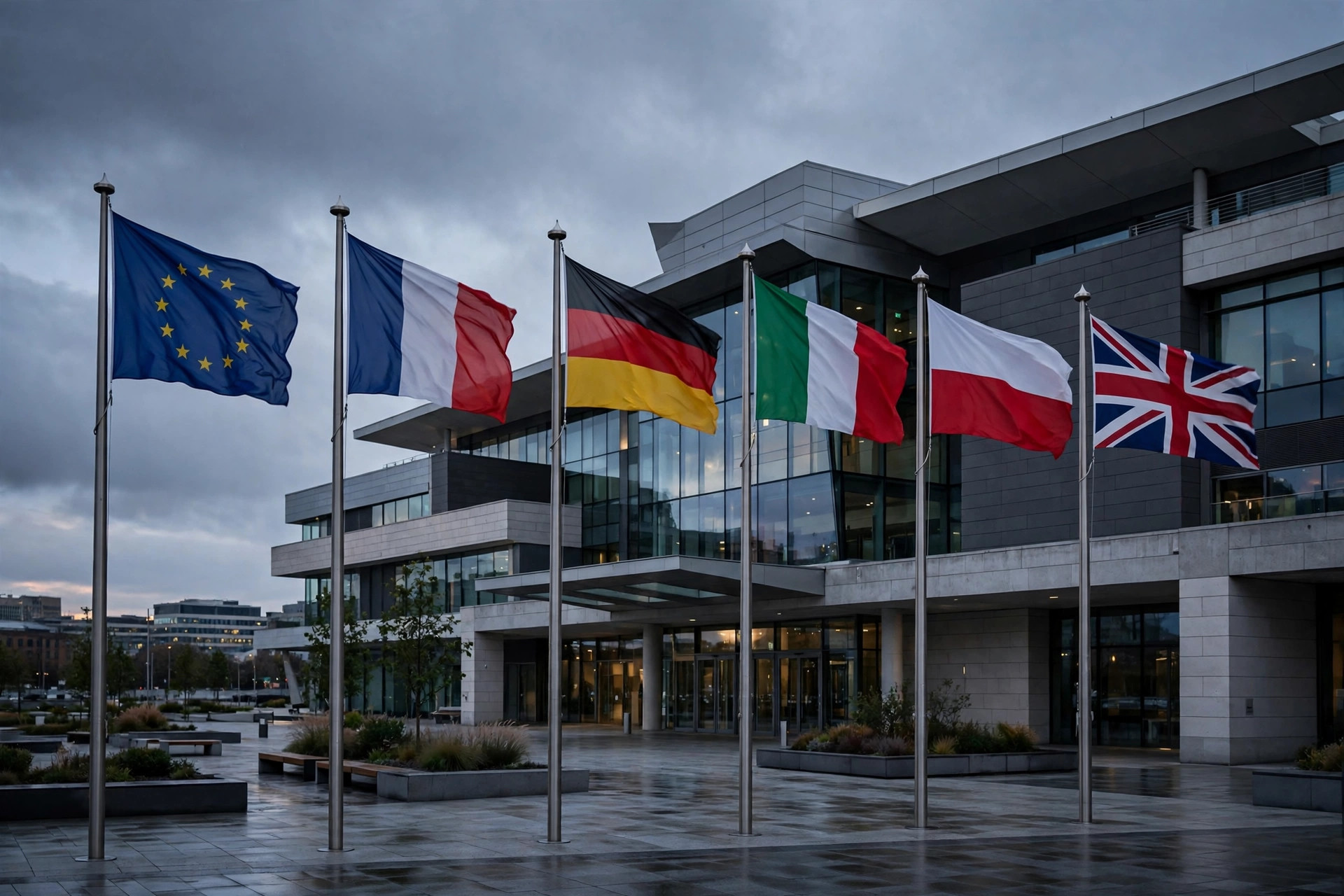
Europe finally has a name for the people who will speak for it at the Ukraine peace talks. The Europe Ukraine peace talks E5 team — France, Germany, Italy, Poland and the United Kingdom, working with the European Union’s institutions — was agreed by EU leaders at an informal European Council meeting in Dublin on Friday 13 November 2026. European Council President António Costa announced the arrangement, calling it a team effort and saying Europe must speak with one clear voice. The decision settles a question that had hung over European diplomacy for months, but it does not settle everything: no date or venue has been announced for the next round, no high-level European representative has been named, and Russia has not confirmed that Europeans will be admitted to the talks.
Europe Ukraine peace talks E5: who is on the team
The team has two parts. The first is the E5 itself: France, Germany, Italy, Poland and the United Kingdom, the five countries of the Coalition of the Willing that have taken the lead on planning security guarantees for Ukraine. The second is the EU institutions — the European Commission and the European Council. Costa put it in a single sentence after the Dublin meeting: “Today the Leaders agreed that the European Team for negotiations on peace in Ukraine is the EU institutions and the E5 of the Coalition of the Willing – France, Germany, Italy, Poland and the United Kingdom.” The Europe Ukraine peace talks E5 label will now be the shorthand used for the group in the negotiations ahead.
The five were chosen as Europe’s major military powers. Four are EU member states; the United Kingdom is not an EU member, but it remains part of the Coalition of the Willing, the group of more than 30 countries backing Ukraine and preparing security guarantees for any future ceasefire. The Europe Ukraine peace talks E5 line-up brings the three largest economies in the European Union — France, Germany and Italy — into the common team, while Poland has become a principal logistical and military-support hub for Ukraine and a voice for the countries on the EU’s eastern flank. EU officials told Reuters that the representatives for Europe in future talks were likely to be national security advisers from the five countries, plus delegates from the European Commission and the European Council. The team will work with all 27 EU member states and coordinate Europe’s contribution to negotiations alongside Ukraine, the United States and NATO, according to the European Council’s account of the Dublin meeting.
Why Europe needed one voice
The Europe Ukraine peace talks E5 decision ended months of wavering over who would speak for the continent, as Reuters described it. Until now, the diplomacy aimed at ending the war has been driven largely by Washington, Kyiv and Moscow, and European leaders have worried openly about being shut out of decisions on a war being fought on their own continent. That worry sharpened this week: envoys from Washington, Moscow and Kyiv met in Abu Dhabi for the first direct Russia–Ukraine contacts in nine months, while several European countries, including the UK, France and Germany, attended discussions nearby rather than in the main talks, according to the Associated Press.
French President Emmanuel Macron put the European case bluntly on Thursday at a meeting of the European Political Community in Dublin, saying: “Without Europeans, there is no support for Ukraine.” German Chancellor Friedrich Merz sent a pointed message to the United States, saying: “Please, no surprises. Keep playing as part of Team Europe and as part of the team with Ukraine, and let us work together for a genuine peace in Ukraine.” The pressure produced movement from the American side as well: after meeting Ukrainian President Volodymyr Zelenskyy in Dublin late on Thursday, US envoy Jared Kushner said Europe would take part directly in the next round of talks. That confirmation is what turned the Europe Ukraine peace talks E5 plan from a European wish into a live negotiating track. The groundwork for that shift was laid a day earlier, when US envoys Steve Witkoff and Kushner met Russian President Vladimir Putin in Moscow on 12 November, as covered in the Moscow talks between US envoys and Putin, following the Abu Dhabi talks that began this week.
What the team can and cannot decide
Costa was careful to define the limits of the mandate. The team is not there to negotiate Ukraine’s territory on Kyiv’s behalf. “This is ultimately a team effort. Only Ukraine has the legitimacy to decide on matters concerning its territory and sovereignty,” Costa said. That line draws the boundary around the Europe Ukraine peace talks E5 team’s role: Europe can argue for a ceasefire, for security guarantees and for financing, but the decisions about Ukrainian land belong to Ukraine alone.
European Commission President Ursula von der Leyen welcomed the renewed momentum and said Europe would defend both Ukraine’s and Europe’s interests, adding: “We have agreed on a European team – E5 plus EU Institutions. We will defend both Ukraine’s and Europe’s interests.” She said the European objective is to end the conflict while ensuring strong security guarantees and a framework for Ukraine’s post-war recovery, and she pointed to two concrete steps coming soon: “This is why we will soon propose our 22nd sanctions package. And a proposal to close Ukraine’s financing gap for 2027.” Security guarantees themselves are to be discussed within the Coalition of the Willing framework, in close coordination with NATO. A ceasefire remains the stated priority for the Europeans.
Polish Prime Minister Donald Tusk confirmed the arrangement in a post on X, writing: “Five European countries—France, Italy, Poland, Germany and the United Kingdom (E5)—and European institutions will represent Europe in negotiations with Russia, Ukraine and the USA. At stake are peace in Ukraine and the security of Poland and all of Europe. This is our time.” Tusk’s wording matters because Poland is the only eastern-flank state in the five, and its government has consistently argued that the security of countries bordering Russia is inseparable from Ukraine’s fate.
Europe Ukraine peace talks E5: what is still undecided
For all that Dublin settled for the Europe Ukraine peace talks E5 line-up, several questions remain open. Europe has not yet chosen its high-level negotiating representative — the single person who would carry the European position into the room. EU foreign policy chief Kaja Kallas laid claim to the envoy role on Friday, according to NationWire, and under EU rules Costa, von der Leyen and Kallas already represent the bloc on foreign and security policy, the German news agency dpa noted. Whether the job goes to one of them, to a national security adviser, or to someone else entirely has not been decided for the Europe Ukraine peace talks E5 team.
No date or venue has been announced for the next round of talks. Zelenskyy and Kushner confirmed after their Dublin meeting that a European delegation would participate directly in the next round in Abu Dhabi next week, according to EuropeSays, but the formal timetable has not been published. And the biggest uncertainty sits outside Europe altogether: Russia has not confirmed that Europeans will be admitted. Kremlin spokesperson Dmitry Peskov responded coolly, saying “Putin has never refused to engage with the Europeans” and adding that if the Europeans truly have someone authorised to hold discussions, Russia would be prepared to talk with them — while also saying Moscow would first need to understand their intentions. Russia’s Foreign Ministry said it knew of no agreement on European involvement. So the Europe Ukraine peace talks E5 team exists on the European side, but its seat at the table still depends on acceptance from Moscow and on the trilateral format built by Washington, which has so far run as a Ukraine–Russia–US process.
What happens next
The next fixed date on the European calendar is the European Council meeting on 26 and 27 November, where leaders will discuss Ukraine’s financial needs for 2027 and beyond, based on proposals from the European Commission. Von der Leyen said her executive will present an option paper on covering those needs alongside the 22nd sanctions package, and Bytes Europe reported the aim is to adopt the package by the end of the year. That timetable gives the Europe Ukraine peace talks E5 team only a fortnight to turn a Dublin agreement into a working negotiating position before the financing debate begins.
Three tests will show whether the Europe Ukraine peace talks E5 team works. The first is internal: whether five capitals plus the EU institutions can hold a single line when the bargaining gets hard. The second is diplomatic: whether Washington keeps Europe inside the process it built, and whether the next round in Abu Dhabi actually includes European delegates in the room. The third is Russian: whether Moscow moves from Peskov’s conditional language to a clear acceptance of a European role. Europe’s stake in the answer is not abstract — as the debate over Russian gas returning to Europe via Ukraine shows, the war’s endgame will shape European energy and security for years. Dublin answered the question of who speaks for Europe in the Europe Ukraine peace talks E5 format. The question of whether anyone listens is still open.
Key facts
- The Europe Ukraine peace talks E5 team was announced on Friday 13 November 2026, at an informal European Council meeting in Dublin, by European Council President António Costa.
- The team: France, Germany, Italy, Poland and the United Kingdom (the E5 of the Coalition of the Willing), plus the EU institutions (the European Commission and the European Council).
- Costa, announcing the Europe Ukraine peace talks E5 team: “Europe must speak with one clear voice” and “Only Ukraine has the legitimacy to decide on matters concerning its territory and sovereignty.”
- Von der Leyen: a 22nd sanctions package and a proposal to close Ukraine’s financing gap for 2027 are coming soon.
- Tusk confirmed the arrangement on X, calling it crucial for peace in Ukraine and the security of Poland and all of Europe.
- Representatives are likely to be national security advisers from the five countries plus Commission and Council delegates, according to EU officials cited by Reuters.
- Still undecided: the high-level European representative; the date and venue of the next round; and Russia has not confirmed European participation.
- Next date: the European Council meets on 26–27 November to discuss Ukraine’s financing needs for 2027 and beyond.