
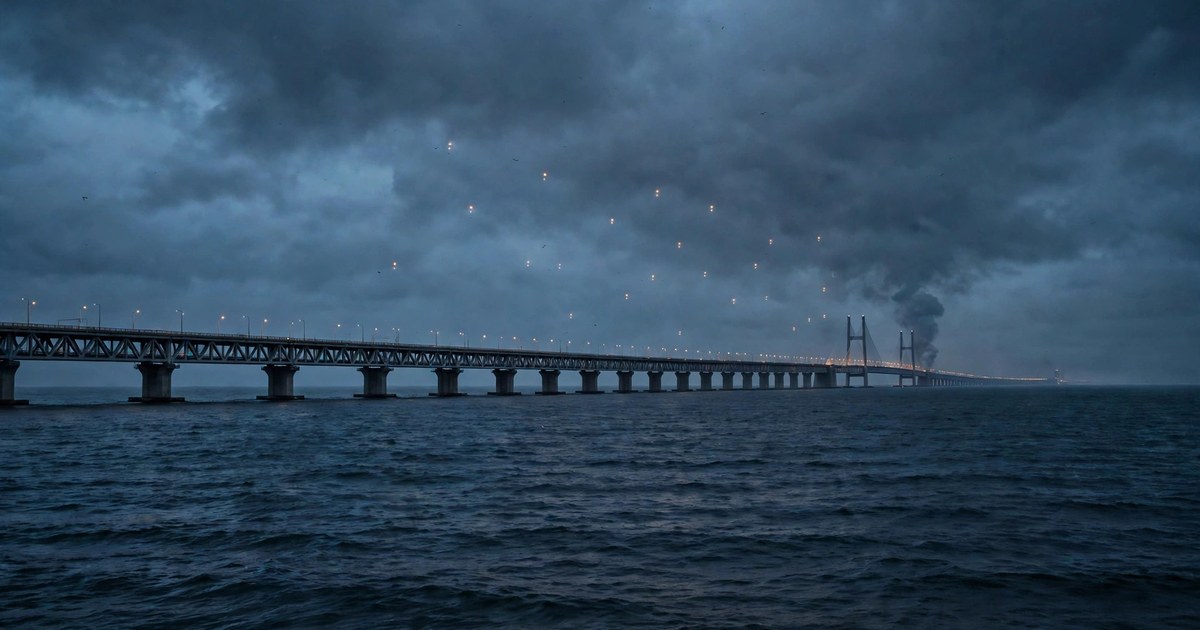
Ukraine struck the bridge linking Russian-annexed Crimea to mainland Russia for a second straight day on 17 November 2026, collapsing a road arch into the Kerch Strait and severing the road link, as Moscow claimed its air defences downed a record 1,441 drones. The first strike, an overnight drone barrage through 15–16 November, disrupted traffic across the 19-kilometre Kerch Strait bridge; the second, using missiles and drones, did the structural damage the first had only threatened — and came just days before a planned summit in Shenzhen between Vladimir Putin, Donald Trump and Xi Jinping.
Russia’s defence ministry said its air defences intercepted 1,336 Ukrainian fixed-wing drones across 17 regions, occupied Crimea and the waters of the Black Sea and the Sea of Azov. The figure is Moscow’s claim and has not been independently verified. An AFP tally of official Russian statements put it as the second-highest daily figure so far in 2026, while the Associated Press described the assault as appearing to be the largest since Russia launched its full-scale invasion in February 2022.
What the Ukraine Drone Attack Looked Like Overnight
The barrage was aimed across a wide sweep of Russia. Moscow’s mayor, Sergey Sobyanin, said about 600 drones approached the capital overnight and into Monday morning, and that 191 were downed on approach to the city. Russia’s defence ministry said the rest were intercepted over other regions, Crimea and the Black Sea and the Sea of Azov.
The most visible strike was on the Crimea bridge. On Tuesday, Ukrainian Neptune missiles struck the railway section and Palianytsia drones struck the road section, President Volodymyr Zelenskyy said, calling the operation “unprecedented” and the seventh stage of a campaign that had methodically degraded Russian air defences around the peninsula. Ukraine’s Security Service said one of the metal arches and the road span beneath it were completely destroyed. Sergey Aksyonov, the Russian-installed head of Crimea, said two people were killed elsewhere in Crimea and traffic was suspended; train travel resumed on Tuesday after a brief pause, Reuters reported, although the railway arch was damaged. The rail operator had reported on Monday that four trains travelling to or from the peninsula were delayed.
Kremlin spokesman Dmitry Peskov had described Monday’s damage as minor and said traffic was already continuing. That description did not survive Tuesday: images verified by CNN showed a section of the road bridge collapsed into the water, and Ukraine’s General Staff said an arch and a span of the road section had collapsed, severing the road link. The parallel rail bridge appeared still to be standing. The full extent of the damage was still unclear on Monday; by Tuesday a 227-metre road arch span had fallen into the strait, blocking the main navigable route beneath the bridge. The Ukrainian monitoring channel Crimean Wind had reported, citing testimony from residents, an impact on one of the arches of the bridge’s navigable section, while the Russian channel Mash claimed around 2,000 vehicles were stuck in queues. Neither account has been independently verified.
The exchange ran in both directions. Ukraine’s air force said Russia launched 158 drones into Ukraine on Sunday night into Monday morning, 77 of them jet-powered, and that defenders downed or suppressed 131, including 55 jet-powered drones. Ukraine’s State Emergency Service said Dnipro was among the targets, where one person was killed and 10 others were injured.
Why the Crimea Bridge Is a Target Again
The 19-kilometre bridge across the Kerch Strait was built after Moscow annexed Crimea in 2014 and carries road and rail traffic between the peninsula and Russia’s Krasnodar region. For Kyiv it is both a supply route for Russian forces in southern Ukraine and a symbol of the annexation. For Moscow it is a prestige project, opened with ceremony and defended as a point of pride.
That is why it has been a priority target for Ukraine since the full-scale invasion began in February 2022, and why it has been attacked several times. Each strike forces Russia to close or restrict the crossing, inspect the structure and reroute traffic, even when the physical damage turns out to be limited. Monday’s Ukraine drone attack fits that pattern: a brief closure, a damage assessment, and a dispute over how much was actually hit.
It is also part of a wider campaign. Ukraine has spent months striking Russian energy and military infrastructure with long-range drones, including a drone attack on the Ust-Luga oil port on Russia’s Baltic coast. Kyiv says its long-range strikes have degraded Russian oil refining capacity by more than 55 percent, a claim that has not been independently verified.
The 1,441 Figure: What Russia Claims and What Is Verified
The headline number from this Ukraine drone attack needs careful handling. The 1,336 drones was the figure Russia’s defence ministry announced for Monday, and it counts what Moscow says its air defences intercepted — not independently confirmed launches, and not confirmed damage on the ground. On Tuesday the ministry said it had downed 1,441 drones over 22 regions, surpassing Monday’s figure, which state news agencies called the largest Ukrainian drone attack on Russia since the full-scale invasion began in 2022. The Associated Press, reporting the ministry’s figures, noted that the extent of damage from the strikes inside Russia remained unclear and that local officials rarely provide details.
What can be said with confidence is that the barrage was large by the standards of this war. AFP’s tally of official Russian statements put 1,336 as the second-highest daily figure so far in 2026 before Tuesday’s 1,441 surpassed it, and the Associated Press described the attack as appearing to be the largest since the invasion began. The mayor of Moscow’s separate figure — about 600 drones approaching the capital, with 191 downed — points to the scale of the effort aimed at a single city.
Claims on the Ukrainian side deserve the same caution. Kyiv has claimed that Russia suffered more than 50,000 casualties in October, a figure that has not been independently verified. And President Volodymyr Zelenskyy has accused SpaceX’s Starshield service of imposing speed limits, above about 161 km/h, that sever interceptor-drone links — a constraint Kyiv says is reducing its ability to stop fast Russian Shahed drones. SpaceX and Starlink have denied imposing such restrictions.
What Happens Next After the Ukraine Drone Attack
The timing of the barrage is hard to ignore. It came days before a planned trilateral summit in Shenzhen between President Vladimir Putin, US President Donald Trump and Chinese President Xi Jinping, a meeting that would put the war at the centre of great-power diplomacy. A mass Ukraine drone attack in the days before such a summit is both a military operation and a message: Ukraine can still reach deep into Russia, and the war will not pause for the diplomacy around it.
Drone warfare has meanwhile become the daily currency of conflicts well beyond Ukraine. In the Gulf, Iran has repeatedly struck at targets in Bahrain, most recently in an attack that Tehran claimed hit a US radar installation. The technology has spread faster than the defences against it, and the claims made about each strike are getting harder to check in real time.
Three things are worth watching now. First, the bridge itself: the road link is severed and the fallen arch blocks the main navigable route beneath the bridge, so the question is how long repairs take and whether the rail line — which Reuters said resumed on Tuesday afternoon, with a damaged arch — stays open. Second, Russia’s retaliation, which in this war has usually followed a major Ukrainian strike within days; Moscow was already striking Kyiv’s bridges on Tuesday. Third, whether the Shenzhen summit goes ahead as planned, and whether the barrage changes what any of the three leaders is willing to say in public about the war.
Why It Matters
This Ukraine drone attack matters for three reasons, and none of them is the headline number alone. The first is scale: if the 1,336 figure is even broadly right, Ukraine mounted one of the biggest single-night drone operations of the war, reaching from the Black Sea to the approaches of Moscow. The second is the target: the Crimea bridge remains the most symbolic piece of infrastructure in the conflict, and every successful strike on it reminds both sides that no Russian asset is out of reach. The third is the timing: days before Putin, Trump and Xi sit down together, the war has produced a fresh reminder that it is escalating, not winding down.
There is a fourth lesson, quieter but just as important. In this war, the first numbers are always claims — Moscow’s 1,441, Kyiv’s 55 percent, the 2,000 vehicles in a queue. The verified facts so far are narrower: a road arch has collapsed into the strait, the road link is severed, train travel resumed on Tuesday, Reuters reported, two people were killed elsewhere in Crimea, one person was killed in Dnipro, and a summit is due within days. Everything else is still being checked, and the honest reporting of this attack is the reporting that says so.
Sources
- Agence France-Presse — Ukraine hits Russia’s Crimea bridge in 1,300-drone barrage (16 November 2026)
- Associated Press — Russia reports more than 1,300 drone interceptions (16 November 2026)
- Reuters reporting on the overnight barrage, via syndication (16 November 2026)
- Kurdistan24 — Ukraine strikes Crimea-Russia bridge as Moscow claims interception of 1,336 drones (16 November 2026)
- Statements: Russia’s defence ministry; Sergey Aksyonov (Telegram); Sergey Sobyanin; Dmitry Peskov; Ukraine’s air force; Ukraine’s State Emergency Service
- CNN — Ukraine strike collapses section of Putin’s prized bridge to occupied Crimea (17 November 2026)
- Reuters — Ukraine strikes Crimea bridge for second day as Russia pounds Kyiv bridges (17 November 2026)
- Associated Press — Ukraine strikes Russia’s Kerch Bridge with drones and missiles as aerial attacks escalate (17 November 2026)