
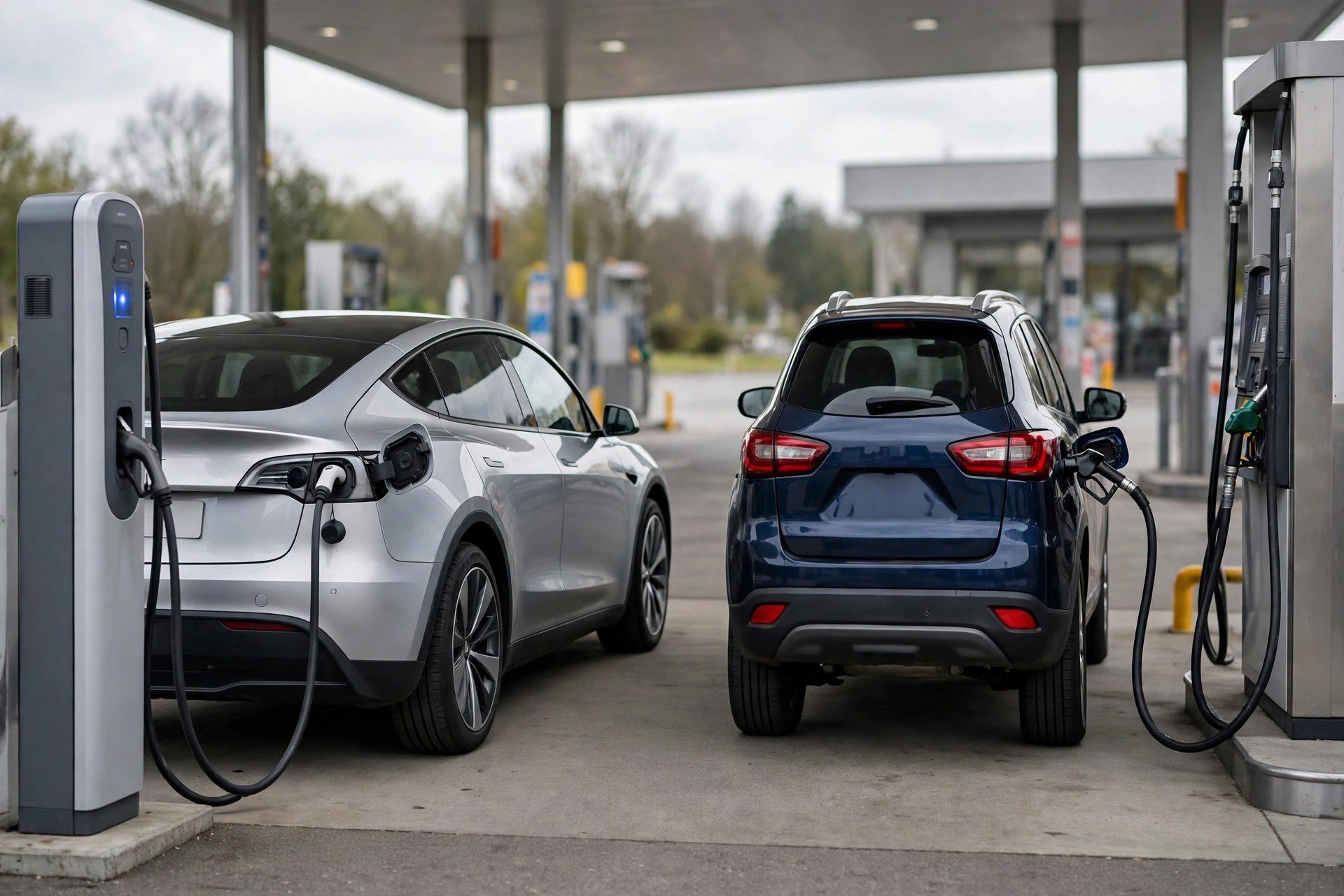
Shopping for your next car now means answering a question that barely existed a decade ago: gasoline or electric? Both choices are backed by passionate fans, marketing departments, and more than a few myths. This guide skips the hype and compares the two honestly — what each one costs, how they fit into daily life, what they do to the planet, and which one actually suits the way you drive.
How Each One Works
The difference between a gas car and an electric car is not just what fills the tank — it is an entirely different way of turning energy into motion.
The Gasoline Engine
A conventional car burns refined petroleum in an internal combustion engine. Controlled explosions inside cylinders push pistons, which spin a crankshaft, which — through a transmission and drivetrain — turns the wheels. The process is well over a century old and refined to an extraordinary degree, but it is inherently wasteful: most of the energy in a gallon of gasoline leaves as heat rather than motion. That waste is why gas cars need cooling systems, exhaust systems, catalytic converters, and frequent servicing.
The Electric Powertrain
An electric vehicle stores energy in a rechargeable battery pack and feeds it to one or more electric motors, which turn the wheels directly. Electric motors are simple, compact, and highly efficient — they convert the large majority of electrical energy into motion. There is no transmission in the traditional sense, no exhaust, no oil to change, and no idling: when the car stops, the motors stop. Many EVs also use regenerative braking, which recovers energy when you slow down and feeds it back to the battery.
Total Cost of Ownership
The sticker price is only the beginning. The real comparison is what a car costs over the years you own it.
Purchase Price
Gas cars still tend to cost less upfront than comparable electric models, though the gap has narrowed considerably. Entry-level gasoline cars remain the cheapest way to buy new wheels, and the used market offers deep discounts on gas vehicles of every type. EVs carry a premium largely because of their batteries — although battery costs have fallen dramatically over the past decade, and that trend is expected to continue.
Tax incentives can change the math. Several countries offer purchase rebates or tax credits for new and sometimes used EVs, and some regions add registration discounts or exemptions from congestion charges. These incentives vary by country and change often, so check what applies where you live before comparing sticker prices — and never count on an incentive until you have confirmed you qualify.
Fuel vs. Charging
This is where EVs usually win decisively. Per mile driven, electricity typically costs a fraction of what gasoline costs — often roughly half to a third, depending on local energy prices. The advantage is largest for drivers who charge at home overnight, when many utilities offer cheaper off-peak rates. Public fast charging is considerably more expensive per mile and narrows the gap, so heavy road-trippers who rely on fast chargers save less.
Maintenance and Repairs
EVs have far fewer moving parts — no spark plugs, no timing belts, no transmission fluid, no exhaust system, no oil changes. Regenerative braking also means brake pads last much longer. Over several years of ownership, routine maintenance bills for an EV are typically noticeably lower than for a comparable gas car.
Two caveats. First, EVs still have tires, suspension, 12-volt batteries, and cabin filters that need attention — they are not maintenance-free. Second, when something does go wrong, especially with the battery or power electronics, repairs can be expensive and must usually be done by specialists. Battery replacement out of warranty is the nightmare scenario, though battery warranties are typically long (often around 8 years or 100,000 miles in many markets) and modern batteries usually outlast the car. For a balanced view of keeping any car healthy, see our guide to car maintenance basics.
Range and Charging: The Honest Reality
Range anxiety is the EV question everyone asks, so let us be straight about it. A modern gas car typically travels 350 to 500 miles on a full tank and refuels in five minutes at any of tens of thousands of stations. Nothing electric can yet match that combination of range and refueling speed.
But here is the other side: the average driver's daily travel is far less than most people think — usually well under 50 miles. An EV that starts every morning with a full "tank" because it charged overnight covers that daily driving without anyone ever thinking about range. For this kind of use, charging at home is actually more convenient than visiting a gas station, not less.
The friction appears in two situations. First, long road trips: EVs need planned charging stops, and while fast chargers can add significant range in 20 to 30 minutes, the stop is longer than a gas fill-up and charger availability varies by region. Second, apartment dwellers and anyone without reliable home or workplace charging face a real daily hassle — public charging works, but it costs more and takes planning. If you cannot charge where you park, think very carefully before buying an EV. To understand the underlying technology better, read how electric vehicles work.
The Environment: An Honest Accounting
EV supporters sometimes talk as if electric cars have no environmental footprint; critics sometimes talk as if the battery makes them worse than gas cars. Neither is true.
The honest picture: manufacturing an EV — especially its battery, which requires mining and processing lithium, nickel, cobalt, and other minerals — produces more emissions than manufacturing a comparable gas car. An EV therefore starts its life with a carbon deficit. But once on the road, the EV produces zero tailpipe emissions, while the gas car keeps burning fuel every single mile. Over a typical ownership period, the EV almost always pays back its manufacturing deficit and ends up responsible for substantially less lifetime emissions.
How big the advantage is depends on two things: how long you keep the car (the longer, the better for the EV) and how clean your local electricity grid is. On a grid powered mostly by renewables or nuclear, the EV's advantage is enormous. On a coal-heavy grid, it is smaller but still positive in most analyses. Battery recycling is also scaling up, which will gradually shrink the manufacturing footprint over time.
What It Feels Like to Drive
This is the part spec sheets miss. Electric motors deliver full torque instantly — press the accelerator and the response is immediate and silent, with no gear changes interrupting the surge. Most drivers find it addictive. EVs are also remarkably quiet and smooth, with a low center of gravity from the floor-mounted battery that makes them feel planted in corners.
Gas cars are not standing still, though. Modern engines — especially turbocharged ones and hybrids — are responsive, characterful, and far more refined than their predecessors. Enthusiasts often prefer the sound, the involvement of gears, and the mechanical feel of a good gasoline car. And on a long highway journey, a gas car's effortless 400-plus-mile range with a five-minute refuel remains genuinely relaxing.
Resale Value and the Road Ahead
Historically, EVs have depreciated faster than gas cars. Rapid improvements in battery technology and falling new-EV prices keep pulling used values down — why pay nearly new price for a three-year-old EV when the new one goes further and costs less? Well-regarded models with strong reputations hold up better, but resale remains the murkier side of EV ownership.
Gas cars face a different uncertainty: tightening emissions regulations and announced phase-out dates for new combustion-car sales in several countries could soften long-term demand, though the existing fleet will be on the road for decades. The safest approach for either powertrain is to buy for your actual needs over your actual ownership period, not as a financial speculation.
So, Which One Should You Buy?
There is no universal winner — but there is usually a clear winner for you:
- Buy electric if: you can charge at home or work, your daily driving fits comfortably within the range, you value low running costs and a quiet, instant driving feel, and you want the smaller lifetime carbon footprint.
- Buy gasoline if: you lack reliable charging access, you regularly drive long distances through areas with sparse charging infrastructure, you want the lowest purchase price, or you simply prefer the driving character and refueling freedom of combustion.
- Consider a hybrid if: you want better fuel economy than a pure gas car without any charging commitment — hybrids are the quiet middle ground many buyers overlook.
Whichever you choose, buy the car that fits the life you actually live — the commute you actually drive, the parking you actually have, the trips you actually take. Explored more broadly, the whole automotive section of this site covers everything from buying guides to maintenance, so you can keep researching with confidence.