
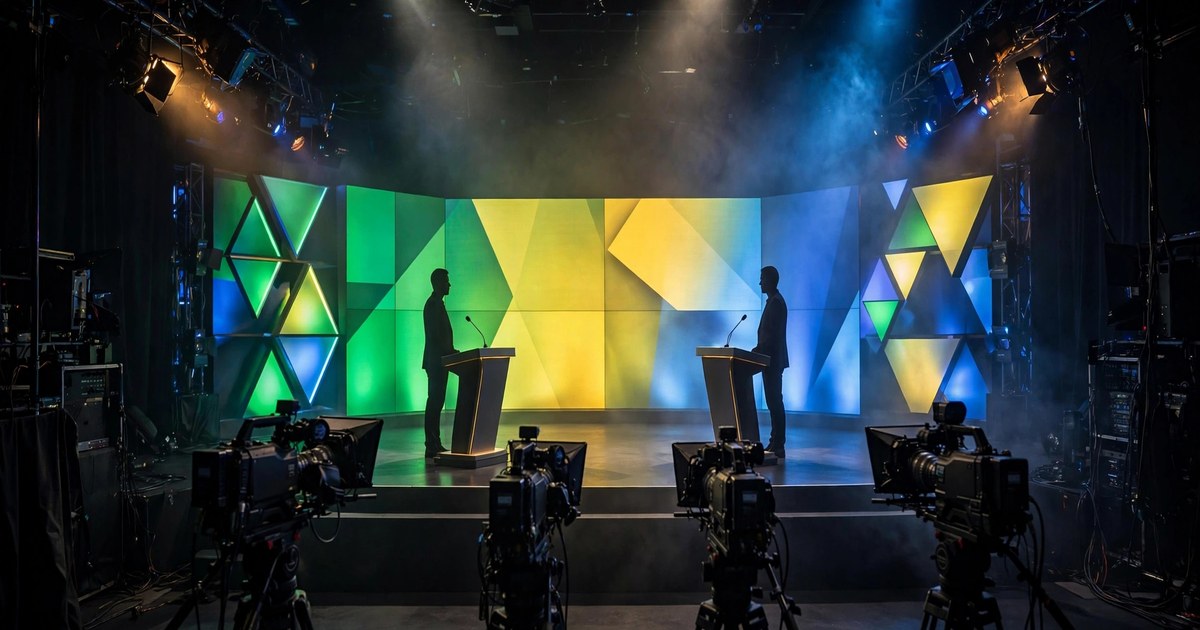
Brazil's presidential race reaches its most dramatic moment yet on Sunday night, when President Luiz Inacio Lula da Silva and Senator Flavio Bolsonaro meet face to face in the first direct debate of the entire campaign. The two-hour Band/Estadao encounter, scheduled for 20:00 Brasilia time, comes one week before the October 25 runoff — and with the race effectively tied, both campaigns are treating it as the best remaining chance to sway undecided voters. The story is trending per news coverage.
This is not just another television slot. The two rivals have not debated each other once during this election cycle. A Record network debate planned for October 11 was cancelled over scheduling conflicts, and Flavio Bolsonaro initially said he would skip the Band debate too — only to reverse course after internal tracking data and online backlash suggested that skipping would cost him more than showing up. Both candidates are now confirmed for tonight, and a second debate is planned on Globo for October 23.
Why tonight matters so much
Debates in the final stretch of a Brazilian presidential campaign are about more than policy arguments. Both campaign teams have been open about their real objective: provoke a mistake, capture it, and flood social media with shareable video clips before the October 25 vote. In a race where the polls sit inside the margin of error, a single viral moment could genuinely move numbers.
The format gives them room to fight. Band's programme is built around roughly two hours with free-time interactions between the candidates, two blocks of direct confrontation, and journalist questions. The rules were negotiated with both campaigns and filed with the electoral court, the TSE. The show will air across Band's television, radio and digital channels alongside partner outlets including Gazeta, Cultura, Jovem Pan and Estadao.
The Sudeste — especially Sao Paulo — is seen as decisive. Turnout worries hang over both camps: a tight race is often decided not by persuading the other side's supporters, but by who actually shows up on voting day. That is why both teams spent the weekend not in debate prep rooms alone, but on the streets.
The polls: a statistical tie across the board
Recent surveys describe essentially the same race. A Vox Brasil poll published this weekend has Lula at 51% and Flavio Bolsonaro at 49% of valid votes — inside the margin of error. Datafolha reads the other way, with Flavio at 51% and Lula at 49%. Quaest has Flavio ahead 46% to 44% among all voters, while PoderData calls it a 50-50 tie. CNT/MDA (50.5% to 49.5%), Ipespe (51.2% to 48.8%) and Verita (51.1% to 48.9%, with more than 15,000 interviews) all land within a couple of points of each other. The one consistent outlier has been Gerp, which has Flavio up 52% to 48%.
Prediction markets lean harder toward the Bolsonaro family: Polymarket prices Flavio Bolsonaro at 81% against Lula's 20%, in a market with $186.8 million traded. Markets are not polls — they reflect money, not a representative sample — but the gap between the betting odds and the polling average is itself part of the story: one side's supporters appear far more confident than the surveys justify.
Compare that with the first round on October 4, when Flavio Bolsonaro — the eldest son of former president Jair Bolsonaro — took 47.0% against Lula's 45.2%, a margin of about 2.2 million votes. History offers Lula a warning and Flavio a comfort: no presidential candidate in the history of Brazilian democracy has ever reversed a second-place finish in the first round to win the second. Here is how the two-round runoff system works and what is at stake on October 25.
Attack lines each side is bringing
Campaign sources say the debate strategies are built around each rival's perceived vulnerabilities. Flavio's team plans to press Lula on alleged links to figures caught up in fraud scandals — including Roberta Luchsinger and Vorcaro — part of a broader effort to paint the administration as tainted by corruption. Lula's team plans to hammer Flavio on labour votes, particularly the "escala" work-schedule votes, and on the senator's ties to Marcio Canella — seeking to portray him as hostile to workers' rights.
Labour has become one of the most charged policy fronts of the final week. Flavio's camp reversed its stance on ending the 6x1 work schedule after Lula's campaign gained ground on the issue, and Lula has accused his rival of electoral opportunism over the 5x2 schedule. Both sides claim to defend the CLT, Brazil's consolidation of labour laws, while warning that the other's proposals would entrench precarious and intermittent work. Expect tonight's confrontation blocks to spend serious time on who really stands with workers.
Public security is the other battleground. At weekend rallies, Flavio pushed hardline proposals including chemical castration for sexual offenders and classifying criminal gangs as "narcoterrorists" — language aimed squarely at voters who rank crime as their top concern. On October 17 he received the Title of Citizen of Salvador after a brief judicial suspension was overturned by the Bahia state court, a symbolic win his campaign is amplifying in the Northeast.
The final-week ground game
Neither campaign is leaving the last week to television alone. Flavio staged a "Bloco da Vitoria" on Avenida Paulista in Sao Paulo and toured Salvador and Vitoria, leaning on street mobilisation and motorcades. Lula's coalition answered with concerts and local acts designed to energise supporters in Rio and Salvador — events that double as voter-registration and turnout drives in the final stretch.
The economic backdrop matters too. Brazil's environmental and industrial policies are being watched closely by foreign investors, from the fight over Amazon deforestation to disputes over critical minerals and energy. Lula points to domestic pharmaceutical production, the Petrobras oil discoveries and education investment as his legacy; Flavio's camp promises a sharp break toward business-friendly fiscal adjustment.
What to watch on Sunday night
Analysts say three things will decide whether the debate moves votes. First, temperament: in a country where presidential debates are remembered for meltdowns more than manifestos, the candidate who keeps his cool while landing the sharper attack usually wins the night. Second, the labour exchanges: the 6x1 and escala debates cut directly into working-class households that both candidates need. Third, the clip war afterwards: both teams have professionalised their rapid-response operations, and the winner may be decided as much on social media as on the Band stage.
After tonight, one more set-piece remains: the Globo debate on Friday, October 23, moderated under the network's flagship news banner. Then, on October 25, voters go to the polls between 08:00 and 17:00 Brasilia time to pick Brazil's president for the next four years — in a contest the polls say is anyone's to win.
Since that debate, the polls have tightened to a dead heat: our eve-of-vote guide breaks down the 50–50 runoff and what to watch on Sunday.
Sources: Particle News (18 October 2026); rg.org Polymarket Daily (18 October 2026); Newsy Today (18 October 2026); Sociedad Media; iGaming Express (12 October 2026).