
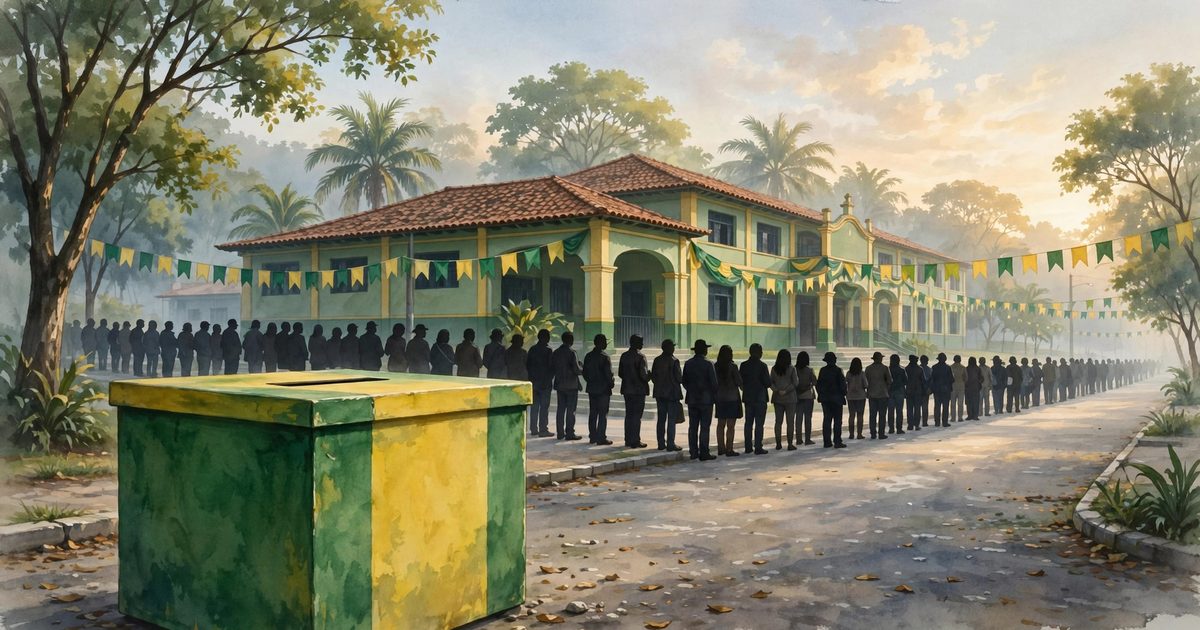
The Brazil presidential runoff 2026 reaches its climax tomorrow, Sunday 25 October, in one of the closest presidential elections in the country's modern history. President Luiz Inácio Lula da Silva, the 80-year-old Workers' Party (PT) veteran seeking an unprecedented fourth term, faces Senator Flávio Bolsonaro of the Liberal Party (PL) — the eldest son of former president Jair Bolsonaro — in a runoff that every major pollster describes as a statistical dead heat. This guide sets out where the race stands on the eve of the vote, how Sunday will work, what separates the two candidates, and what to watch once the counting begins.
Brazil presidential runoff 2026 polls: a genuine coin toss
The last full week of polling produced the same picture from every direction: a tie. Datafolha's final survey, conducted with 2,154 voters between 20 and 22 October, put Flávio Bolsonaro on 47 percent and Lula on 46 percent of all voting intentions — a gap far inside its two-point margin of error. Stripping out blank votes (5 percent) and the undecided (2 percent) to leave only valid votes, the two men stand at exactly 50 percent each. Datafolha's trend through October tells the story of the runoff: Bolsonaro led 52–48 on valid votes on 8 October, 51–49 on 15 October, and now 50–50.
Vox Brasil's poll, released on 23 October, nudged Lula fractionally ahead — 50.6 percent of valid votes to Bolsonaro's 49.4 percent — also well within its margin of error. Quaest, the third major pollster, has likewise shown a one-point race (45–44 in its latest head-to-head). One small consolation for the incumbent: Datafolha measured Lula's government approval at 49 percent against 48 percent disapproval, his first positive rating since July. But approval is not the same as votes, and in the contest that matters, neither camp can claim momentum with any confidence. Our earlier explainer, Brazil 2026 Election Runoff Explained, sets out how the two men reached this point.
How the runoff came about
Brazil elects its president by absolute majority: clear 50 percent of valid votes in the first round, or the top two finishers meet again three weeks later. The first round on 4 October produced a shock. Flávio Bolsonaro — who had never previously run for national executive office — finished first with 47.03 percent of valid votes, ahead of Lula's 45.16 percent, overturning years of surveys that had suggested the president would lead comfortably. Since then, the campaign has been a three-week sprint of debates, advertising and increasingly personal attacks, closing with a final televised debate on TV Globo on Friday night, which we previewed in our runoff debate coverage.
The final days were dominated by an extraordinary transparency duel. Lula challenged his rival to lift banking, tax and telephone secrecy for both candidates and their families; Bolsonaro accepted, with conditions — a move legal experts say has constitutional limits where third parties are concerned. Bolsonaro, who remains under a corruption and money-laundering investigation that he denies any wrongdoing in, has tried to turn the exchange into proof of his confidence. Lula's camp, meanwhile, points to analysis showing 34 percent of Flávio's donors also funded his father's 2022 campaign, framing the senator as a dynasty candidate rather than a fresh start.
How voting works in the Brazil presidential runoff
Brazil's election machinery is one of the most mechanised in the world. More than 150 million registered voters cast their ballots on electronic voting machines at polling stations — usually schools — in every municipality. Voting is compulsory for citizens aged 18 to 69 and optional for 16- and 17-year-olds, the over-70s and illiterate voters; abstention without justification carries a small fine and administrative inconveniences. Polls open at 8:00 and close at 17:00 Brasília time, a unified national schedule adopted to avoid results leaking across time zones. If you want the broader mechanics, our guide How Does Voting Work? explains the rules in plain terms.
Because every vote is recorded electronically and transmitted to the Superior Electoral Court (TSE), counting is fast. In recent elections the national picture has been clear within two to three hours of polls closing, and there is no postal-vote tail to drag the result into the following week. Sunday's ballot also settles runoffs for state governorships in the states where no candidate cleared 50 percent on 4 October — but the presidency is the prize that will move markets, and capitals, on Monday morning.
What each candidate is offering
Lula is asking voters to extend a political career that began with his first inauguration in 2003. A victory would give him a fourth term and a total of 16 years in office — a record for Latin America's largest economy. His pitch is continuity with delivery: protect and expand social transfers, keep public investment flowing, defend Brazilian industry in trade talks, and present himself as the experienced hand for an uncertain world. His vulnerabilities are equally clear: voter fatigue, rejection rates around 50 percent, and an economy whose fiscal numbers worry investors.
Flávio Bolsonaro offers rupture with a familiar surname. He has pledged a fiscal adjustment of R$200 billion, a smaller state, tax simplification and a tough line on crime — and, in a notable pitch to workers, support for ending Brazil's six-day "6x1" work schedule, an issue that has cut across the usual left-right divide. His father's movement supplies him a loyal base, but also its baggage: Jair Bolsonaro's legacy, the investigations touching the family, and rejection rates matching Lula's own.
What is at stake
Domestically, the result will set Brazil's fiscal course for four years: whether the spending framework Lula defended survives, or whether a Bolsonaro government attempts the deep adjustment it has promised, with consequences for interest rates, the real and the Ibovespa stock index, all of which have twitched with every poll release this month. Social policy — the size and shape of cash transfers to Brazil's poorest families — hangs on the same choice.
Internationally, partners are watching Brazil's stance on the Amazon and climate — deforestation fell to a record low in the run-up to the vote, as we reported in Amazon Deforestation Falls to Record Low in Brazil — as well as its balancing act between Washington, Beijing and the BRICS bloc, and its role as Latin America's anchor economy. Few elections anywhere this year carry comparable weight for so many people who cannot vote in it.
What to watch on Sunday
Three things will tell the story early. First, turnout: compulsory voting keeps Brazilian participation high, but abstention rose in the first round and tends to hurt the challenger and incumbent in different regions. Second, the early count from the Southeast — São Paulo, Minas Gerais and Rio de Janeiro hold the largest electorates, and Minas in particular has backed every winning presidential candidate for decades. Third, the blank and null vote: at 5 percent in the final polls, protest ballots are the runoff's invisible third candidate; if they surge, they shrink the winner's mandate whoever it is.
By Sunday night, Brazil should know its next president. What kind of mandate he carries — and how graciously the loser concedes — will shape the country's first week under its new reality. Worldlession will cover the result and what it means as the count is confirmed.
Update: Lula won the runoff on 25 October and was re-elected — see the results coverage.
Sources: Reuters; Datafolha; Vox Brasil; Quaest; LaPresse; Brazil Superior Electoral Court (TSE), October 2026.