
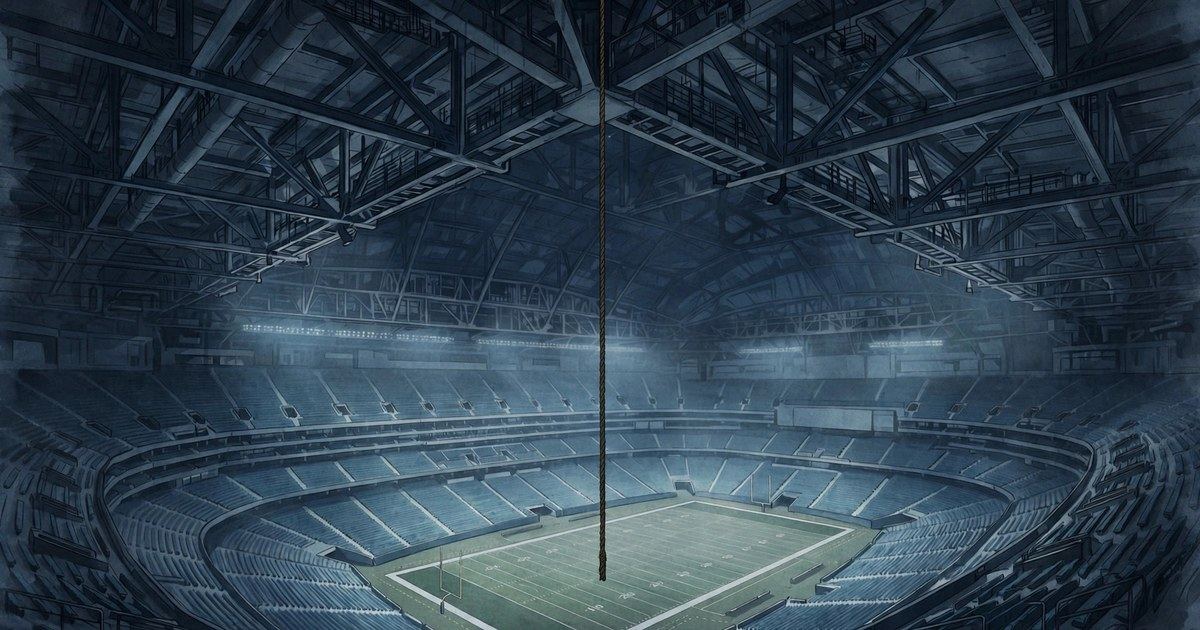
A pregame military tribute at the Alamodome in San Antonio ended in tragedy on Saturday night, 17 October 2026, when a U.S. Air Force service member fell during a rappelling demonstration and later died of his injuries. The airman was one of four military members scheduled to descend from the stadium's rafters to the field about 15 minutes before kickoff of the University of Texas at San Antonio's game against Navy. The story is trending per news coverage.
The incident unfolded in front of 23,297 fans. About halfway down the rope, the airman appeared to lose control and slid down the line in what the San Antonio Express-News described as "an uncontrolled manner," crashing to the turf near midfield. Medical crews worked on him on the field for close to 10 minutes before he was carried off on a stretcher and transported to a local hospital with life-threatening injuries, the San Antonio Fire Department said. The Air Force later confirmed he had not survived. His name has not been publicly released, and the incident is under investigation.
This was supposed to be a celebration. UTSA's annual Salute to Armed Forces and Veterans game is a tradition — a night when the university honours the men and women who serve, and a moment when soldiers and airmen are cheered rather than simply deployed. Instead, players arrived at the field to a crowd that had just witnessed a death, and kickoff was delayed by about ten minutes as the stadium tried to absorb what had happened.
What happened at the Alamodome
The demonstration was scheduled for roughly 15 minutes before kickoff on Saturday evening, 17 October. Four service members were to rappel from the ceiling rafters of the Alamodome — a drop of about 170 feet, or roughly 52 metres, from rafter to turf — as part of the Salute to Armed Forces and Veterans ceremony.
Spectator video shows the descent going wrong for one of the four. Partway down, he began moving much faster than planned, sliding down the rope rather than making the controlled descent rappelling requires, and struck the ground hard. The witness accounts describe the shock that followed. "Once the band started playing, there was a guy that fell down, and started coming down fast," witness Adrian Corey told KSAT. "Everybody was quiet, the band stopped performing, everybody was dead silent."
UTSA staff formed a semicircle around the airman while medical personnel treated him on the field for about ten minutes. He was carried out on a stretcher — according to local reporting, transported as a Priority 1 patient — and taken to a local hospital. The fall happened just before 7 p.m. local time, KSAT reported. Later on Saturday night, the Air Force confirmed the worst: the airman had died from his injuries.
The game went ahead after a delay of roughly ten minutes. UTSA coach Jeff Traylor told reporters afterward that the accident was "heartbreaking" and "tragic," and that the team could feel the effect it had on the crowd of more than 23,000 people as soon as the players arrived on the field — although Traylor himself had initially been told only that an "incident" would delay the start of the game.
Who the airman was, and what his unit does
The airman was assigned to Detachment 2 of the 6th Combat Training Squadron, Nellis Air Force Base in Nevada confirmed to Task & Purpose, the military-news outlet that first reported the death. Detachment 2 operates from Joint Base San Antonio–Camp Bullis, Texas, the large training area northwest of the city.
The 6th Combat Training Squadron trains Tactical Air Control Party — TACP — airmen. TACP airmen are the Air Force's ground combat controllers: they embed with Army and Marine units on the ground and coordinate air support from the air, calling in strikes and managing close air support in combat zones. It is one of the most physically demanding jobs in the Air Force. Rappelling is not ceremonial for these airmen — fast-roping and rappelling are core skills in their training, which is what makes the Alamodome accident so difficult to reconcile with the unit's expertise. The men and women of Detachment 2 train in these techniques routinely.
The Air Force has not released the airman's name. That is standard practice: next of kin must be notified before a service member's identity is made public, and the Air Force said only that the incident is under investigation and that more information would be released as it becomes available.
The official responses
UTSA issued a statement on the night of the incident expressing sorrow and support for the community that witnessed it. "We are deeply saddened by the incident that occurred at the start of tonight's football game. Our heartfelt thoughts and prayers are with the soldier who was affected, his family and his military colleagues," the university said. "We recognize that members of our campus community may be emotionally affected by this incident and are activating wellbeing services to support our faculty, staff and students."
UTSA president Taylor Eighmy followed with a Sunday statement: "Our hearts are heavy following the tragic incident at the Alamodome prior to Saturday's UT San Antonio football game against the U.S. Naval Academy. What was intended to be a day of camaraderie, tradition and celebration has been marked by profound sadness. I want to extend my deepest and most heartfelt sympathies to the service member's family, his fellow airmen, squadron and all those whose lives have been touched by this heartbreaking tragedy."
The Air Force's statement, issued through Nellis Air Force Base Public Affairs, was brief and factual: the service member had been injured at the stadium, transported to a local hospital, and had died. The incident is under investigation. No official word yet on what caused the fall — the Air Force had not released a statement on the cause as of Sunday.
The American Conference, whose member schools include UTSA, said it was coordinating with local authorities while respecting the family's privacy.
What the investigation will examine
Rappelling from stadium rafters is a dramatic display, but it is a real rope operation with real physics — and the investigation will likely examine several technical factors, even though officials have said nothing publicly about a cause.
First is equipment: the ropes, harnesses, descenders and anchor points used for the demonstration. A fast-roping or rappel descent depends on friction through a descender device; if the device was set incorrectly, if the rope was wet or incompatible, or if a carabiner or anchor failed, a controlled descent can become an uncontrolled slide in seconds.
Second is rigging: how the ropes were anchored to the rafters, what redundancy was built into the system, and whether a belay or backup line was in place. Stadium rafters are not designed as climbing anchors, so temporary rigging has to be engineered for the load — and for the swinging, twisting forces of a descending body.
Third is procedure: who approved the display, what safety briefing the team received, and whether the conditions in the stadium — lighting, temperature, the state of the ropes — were assessed. Fourth, and hardest to determine, is human factors: fatigue, miscommunication, or a momentary loss of grip that turned into a slide the airman could not arrest.
Readers should be cautious about short video clips that claim to show what went wrong. A spectator recording cannot establish why the descent failed, and the facts will come from the Air Force investigation, not from social media. That investigation may take weeks or months, and its findings — if released publicly — will determine whether this was an equipment failure, a rigging error, a procedural gap, or a combination of factors.
A weekend of military loss
The Alamodome tragedy did not happen in isolation. The same Saturday, on the other side of the continent, Canada's military was confronting its own catastrophe: a serious incident and major fire at CFB Wainwright in Alberta that killed and injured people during what military sources described as a live-fire training exercise — an event Canada's defence minister said he could not recall in recent memory. Two allied militaries, two training-adjacent tragedies, one weekend.
The coincidence underscores a sobering truth: training for dangerous work is itself dangerous. The Air Force's TACP airmen exist to direct airstrikes from the ground in combat — their training involves helicopters, explosives, high-altitude jumps and rappelling. Accidents in military training are rare but real, and each one prompts a reckoning with how risk is managed when the mission requires people to rehearse for war.
The game and the night's meaning
The game itself — UTSA against Navy, the Naval Academy — was, on paper, a fitting stage for a Salute to Armed Forces night. Navy is one of the service academies; the matchup already carried a military resonance. After the incident, the football became almost an afterthought, played before a crowd that had just seen something no one in a stadium expects to see.
That is the cruel symmetry of the night: a tribute meant to honour service members ended with the death of one. The airman had come to the Alamodome to descend the rafters in a display of military skill, and the crowd had come to cheer it. Instead, 23,297 people watched a man die doing his job — and then watched a football game begin ten minutes late.
For now, the honest summary is this: on Saturday 17 October 2026, a U.S. Air Force airman assigned to the 6th Combat Training Squadron's Detachment 2 fell during a pregame rappelling demonstration at the Alamodome in San Antonio and died at a local hospital. The Air Force is investigating, the name has not been released, and the cause is not yet known. The people who can answer — the Air Force, the investigators at Nellis and Joint Base San Antonio–Camp Bullis — have promised more information as it becomes available. Until then, the most useful thing is to rely on official updates and treat speculation about the cause with caution.
The incident also sits alongside other stories of military personnel facing danger this month: the U.S. Coast Guard's rescue operation after a boat capsized off Baja, and India's own military milestones like the commissioning of INS Samarthak. Sources: Task & Purpose (18 October 2026); Associated Press, via USA Today and TSN (18 October 2026); ESPN (18 October 2026); San Antonio Express-News (17 October 2026); KSAT (17 October 2026); New York Post (18 October 2026); Daily Caller (18 October 2026); UTSA official statement (18 October 2026); Nellis Air Force Base Public Affairs statements.