
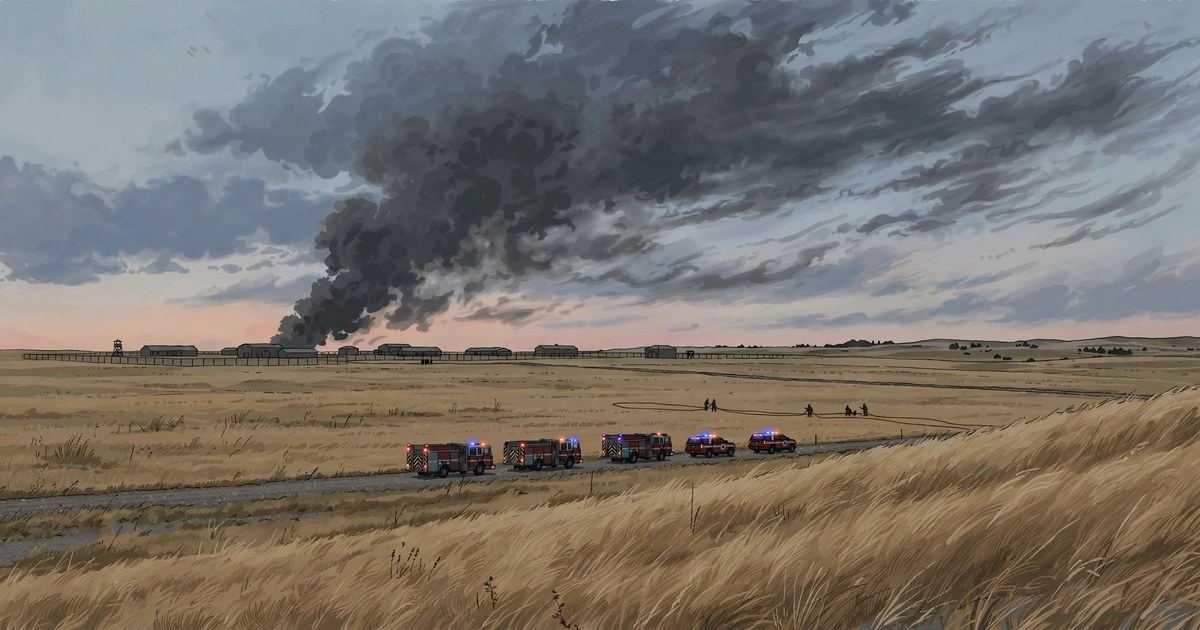
Four Canadian Armed Forces members were killed and 39 injured in a major fire at one of Canada's busiest military bases, Canadian officials confirmed. The fire broke out at Canadian Forces Base Wainwright in Alberta at about 4 p.m. MDT on Saturday, October 17, during live-fire training as part of Exercise APOLLO SHOOTER, and spread rapidly in high winds — eventually crossing the base fence into the surrounding district. The story is trending per news coverage.
Defence Minister David McGuinty confirmed that there were deaths and injuries, but he did not say how many people had been killed or injured, and he did not say what caused the incident. "I'm saddened to share that there have been both fatalities and injuries as a result of an incident on the base," McGuinty told reporters in Ottawa. He described the situation as "very, very active and delicate," and said the fire was still burning on Saturday evening.
That restraint — confirming the worst while withholding the details — defined the official response on Saturday night. The figures followed the next day: on Sunday, 18 October, the Department of National Defence named the four soldiers killed and confirmed 39 injured, and Alberta Premier Danielle Smith said at least 19 of the injured were in critical condition. What follows is what officials have confirmed, what remains under investigation, and why this base matters.
What officials have confirmed
The confirmed facts are these. At about 4 p.m. MDT on Saturday, 17 October, members of 1 Canadian Mechanized Brigade Group from the 3rd Battalion, Princess Patricia's Canadian Light Infantry, were conducting live-fire training at CFB Wainwright as part of Exercise APOLLO SHOOTER when a grass fire ignited in the training area and, driven by high winds, spread very rapidly and overtook the unit's administrative area. Four soldiers were killed — Sergeant Morgan Wong of the Loyal Edmonton Regiment, serving with 3rd Battalion, Princess Patricia's Canadian Light Infantry, and Privates Shaun Farrell, Aidan Goulding and Hayden Lykkemark, all of 3rd Battalion, Princess Patricia's Canadian Light Infantry — and 39 other members were injured, at least 19 of them in critical condition. The Royal Canadian Mounted Police are involved in the investigation, alongside the Canadian Armed Forces and other federal, provincial and local authorities. Firefighters from multiple jurisdictions were called in to fight the blaze. The fire crossed the base fence into the surrounding Municipal District of Wainwright. No evacuation order had been issued as of Saturday evening.
Prime Minister Mark Carney was among the first to speak publicly. "A serious incident creating a major fire has occurred at CFB Wainwright, in Alberta," he wrote on social media on Saturday. "Our thoughts are with all the brave women and men affected." Carney said the federal government was "working closely with the Government of Alberta and local authorities."
McGuinty, speaking later at an evening news conference in Ottawa, gave the fullest official account available. He said the Canadian Armed Forces, the Department of National Defence and federal partners including public safety officials were working with Alberta and municipal governments "to mobilize all necessary support, and working through the details of what actually occurred." He added: "We will have more to say in the coming hours and days. At this time, our thoughts are with the families and with everyone impacted by this tragic event. And I want to thank, in particular, the first responders and everyone providing assistance at a very difficult time."
Asked whether Canada had experienced a comparable incident at a military installation, McGuinty answered: "I cannot recall an incident like this in recent memory." That line, more than any other, conveyed how unusual officials consider this event.
Alberta Premier Danielle Smith described the blaze as a "significant and tragic fire" that was "affecting many of our brave military personnel." General Jennie Carignan, the Chief of the Defence Staff, said the Canadian Forces were "fully engaged with federal, provincial and local authorities," adding: "Our priority remains the welfare of our members, their families and their community."
Timeline: how the day unfolded
The incident began on Saturday afternoon, local time, at the base in east-central Alberta. According to the Wainwright detachment of the Royal Canadian Mounted Police, a call for assistance came in at around 4 p.m. The Municipal District of Wainwright first posted about the fire at about 5:30 p.m. local time, warning that it was spreading rapidly.
By Saturday evening, the fire was still burning, and McGuinty was briefing reporters in Ottawa. Emergency Health Services were at the scene, and the municipal district said firefighters were working to protect people, property and critical infrastructure. Officials urged residents to stay clear of the area and to give emergency vehicles the right of way, and asked people to use the Wainwright Health Centre only for critical medical needs so that emergency capacity stayed free.
No evacuation order was issued, even after the fire crossed the base fence. That is an important detail: the flames reached beyond the installation, but authorities judged that an evacuation of the nearby town was not required. The town of Wainwright, population about 6,600, sits just north of the base.
What has NOT been confirmed
For an event of this scale, the list of unknowns is unusually long — and it is worth stating plainly, because early coverage has contained claims that officials have not endorsed.
First, the casualty figures have now been released. On Saturday night McGuinty confirmed fatalities and injuries but gave no figures, saying more information would follow "in the coming hours and days." The Department of National Defence then confirmed on 18 October that four members had been killed and 39 injured, naming the four dead; Alberta Premier Danielle Smith said at least 19 of the injured were in critical condition.
Second, the context of the fire is now confirmed, though what started it is not. The fire began as a grass fire in the training area during live-fire training and spread rapidly in high winds, overtaking the unit's administrative area. What ignited the grass fire has not been established, and the investigation continues. Some early reports and social media posts described an explosion, and one Alberta member of Parliament, Dane Lloyd, said he had heard there were "significant casualties" after an explosion at the base. That is an account from a politician reporting what he had heard — not an official finding, and the Canadian Armed Forces has not confirmed it. Officials have said there is no indication of terrorist activity.
Third, the training link is now confirmed. The soldiers were conducting live-fire training as part of Exercise APOLLO SHOOTER — high-intensity combat training with live munitions at a grenade range and attack range, according to Major-General Wade Rutland — when the fire ignited at about 4 p.m. MDT on 17 October.
Fourth, the status of the fire has been fluid. On Saturday evening it was still burning and being actively fought. High winds were driving it, which made the firefighting effort harder and helped it jump the base fence. Whether it is fully contained will only be clear from later official updates.
What is CFB Wainwright?
CFB Wainwright is one of the Canadian Army's busiest bases. It is located in Alberta, about 210 kilometres east of Edmonton and about 110 kilometres southwest of Lloydminster, in the east-central part of the province. The town of Wainwright sits immediately to the north of the base, and many of the base's people live in the surrounding communities, with a residential community for military families on the base itself.
According to census data cited in news reports, the base had 1,310 military and civilian personnel stationed there as of 2021. It is home to the Canadian Manoeuvre Training Centre and the 3rd Canadian Division Training Centre, and it is the preferred training ground for the Army's field force units based in Edmonton. The Manoeuvre Training Centre designs and delivers collective training exercises — large force-on-force exercises, simulation training and professional development — for the Canadian Army and its allies. The training centre runs courses that prepare new infantry soldiers, develop future leaders and support programs such as the Bold Eagle youth program.
The base's history stretches back to the Second World War. It began in the 1940s as a wartime ammunition and training facility, and it also served as a prisoner-of-war camp. After the war it became a key training location for Canada's Army, and its role has evolved through several reorganisations since. One of its more unexpected features is a bison herd of about 50 animals, maintained on a protected part of the range and training area — a legacy of the land's earlier life as a national park for bison conservation.
That history helps explain why Saturday's incident has shaken the military community. Wainwright is not a remote depot; it is a working training base where soldiers prepare for deployments, where large exercises are staged, and where hundreds of families live and work. An incident that kills people there, on a scale the defence minister says he cannot recall in recent memory, is a national event in Canada, not a local one.
The investigation and what happens next
The investigation is being led with the involvement of the Royal Canadian Mounted Police, working with the Canadian Armed Forces and the Department of National Defence. McGuinty said an investigation would be launched, and officials said they were still "working through the details of what actually occurred." The minister's repeated description of the situation as "active and delicate" suggests that investigators are still securing the scene and accounting for personnel, and that the families of the dead and injured are being notified before any public accounting is given.
That sequence — notify families first, release numbers second — is standard practice in military fatality incidents, and it is one reason casualty figures can take time. It also means the first confirmed numbers, when they come, are likely to arrive through an official statement rather than through leaks or social media.
In the coming days, expect three kinds of updates. The first is the casualty count and, eventually, the names of those killed, once families have been informed. The second is the state of the fire and any damage to buildings, training areas or surrounding land. The third is the cause — and that may take considerably longer, since investigations into incidents at military installations typically involve technical examination of the scene, interviews and, where relevant, specialist safety boards.
The political context is also worth noting. Prime Minister Carney has been in the middle of a tense national debate over Alberta's future in Canada, and the incident puts the federal government in the position of managing a military tragedy in the same province at the same time. Canada has also been investing heavily in its defence and security infrastructure, and questions about safety at military installations may sharpen if the investigation finds systemic causes. Separately, allied militaries have been having their own public conversations about readiness and risk — a reminder that training bases like Wainwright sit at the centre of how Western armies prepare for real operations, and that training itself carries real danger.
For now, the honest summary is short: a grass fire during live-fire training at CFB Wainwright killed four soldiers and injured 39, and spread beyond the base in high winds. The four dead are named, at least 19 of the injured are in critical condition, and there is no indication of terrorist activity. What started the grass fire is still under investigation. The people who can answer those questions — the minister, the RCMP, the Armed Forces — have promised more information in the coming hours and days. Until then, the most useful thing readers can do is rely on official updates and treat unverified claims about numbers and causes with caution. Sources: BBC News (18 October 2026); CNN (17 October 2026); New York Post (17 October 2026); CBC News, as reported by the New York Post (17 October 2026); Associated Press via Devdiscourse (18 October 2026); Canada.ca, 3rd Canadian Division Support Base Detachment Wainwright; Municipal District of Wainwright statements via CBC/CNN reporting (17-18 October 2026).