
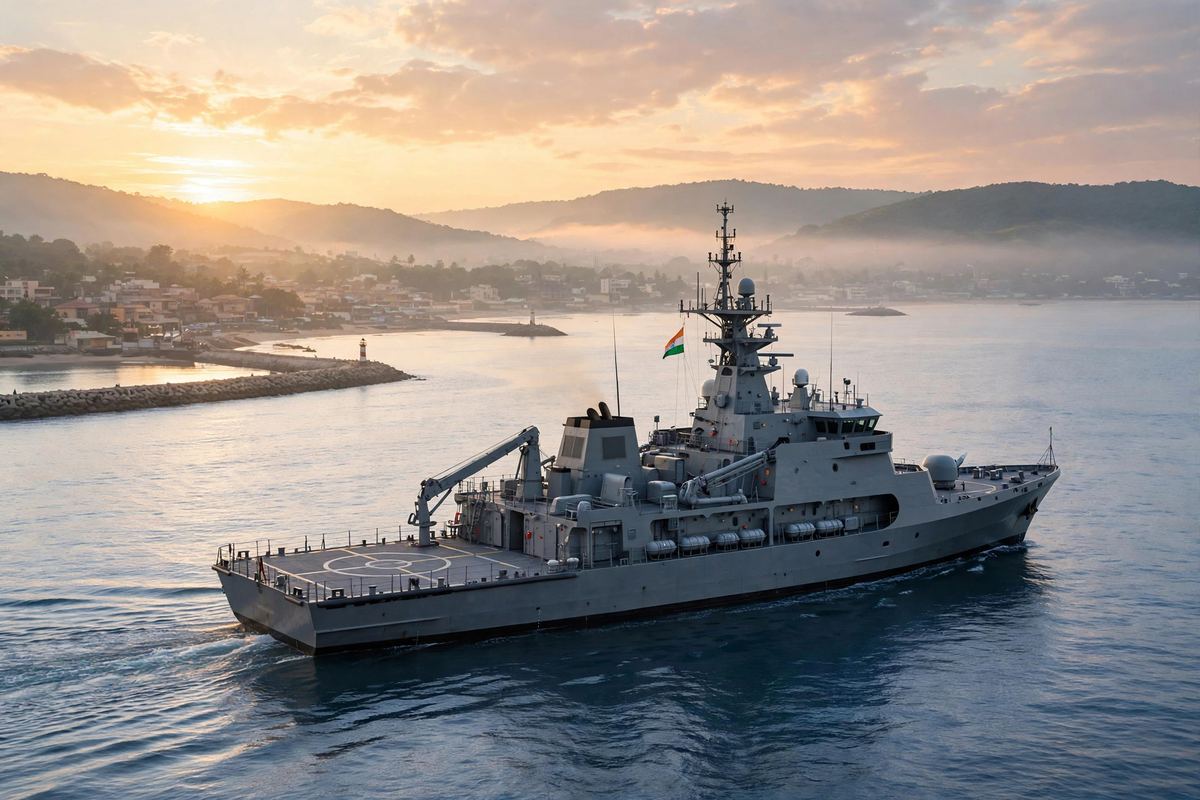
The Indian Navy formally commissioned INS Samarthak, its first indigenously designed and built Multi-Purpose Vessel, at Naval Base Karwar in Karnataka on Friday, 16 October 2026. The ceremony was attended by Vice President C. P. Radhakrishnan as chief guest and by the Chief of the Naval Staff, Admiral Krishna Swaminathan. The commissioning marks a significant milestone in India's drive toward self-reliance in defence manufacturing, because Samarthak is the first major warship contracted to and constructed by a private shipyard to enter service with the Indian Navy. It is the first of four multi-purpose vessels planned for the fleet, and its induction demonstrates that India's private sector can now design, engineer and build complex naval platforms.
The ship was built by Larsen & Toubro at its Kattupalli shipyard near Chennai, under a Defence Ministry contract signed on 25 March 2022. The agreement covered two vessels at a cost of approximately Rs 887 crore under the Buy (Indian) category. Samarthak was launched on 14 October 2024 and delivered to the Navy on 27 August 2026. Its sister ship, INS Utkarsh, was launched in January 2025 and is undergoing sea trials ahead of delivery. The vessel's crest displays an Indian elephant emerging from sea waves, with the motto Victory is Our Sole Aim. Admiral Swaminathan described the commissioning as a significant step toward Aatmanirbharata, or self-reliance, noting that the vessel was designed, engineered and built entirely in-house at L&T's Warship Design Centre and shipyard, with more than 75 per cent indigenous content.
So what exactly is a multi-purpose vessel, and why does the Navy need one? Unlike a destroyer or a frigate, which are built primarily to fight, a multi-purpose vessel is a utility ship designed to do many different jobs. Samarthak's primary role is as a specialised at-sea testbed and mothership for the trials and evaluation of next-generation weapons, sensors and emerging technologies. It can launch and recover surface and aerial targets, and it can deploy autonomous and remotely controlled vehicles for weapons and sensor evaluation. A Dynamic Positioning System allows the ship to hold its position precisely at sea, which is essential during tests that require the vessel to remain stationary while equipment is deployed and recovered. This testing role matters because every new missile, radar, sonar or drone the Navy wants to field must be validated at sea before it can be trusted in operations, and having a dedicated trials platform speeds up that process considerably.
Beyond testing, Samarthak is designed to be genuinely versatile. It can carry out maritime surveillance and reconnaissance, offshore patrolling, towing and salvage operations, and humanitarian assistance and disaster relief. It can be converted into a hospital ship when needed. It can support unmanned systems, which are becoming increasingly important in naval warfare as navies experiment with drone boats, underwater vehicles and aerial systems that can extend a fleet's reach without putting sailors at risk. The Navy has described the vessel as an ideal utility ship for strategically important operations, a phrase that captures the idea that a navy needs workhorses as well as warships. Not every mission requires a destroyer; many require a capable, flexible platform that can be adapted to the task at hand.
The specifications of the vessel give a sense of its scale. Samarthak displaces roughly 3,750 tonnes, measures about 106 to 107 metres in length, and has a beam of about 16.8 to 18.6 metres depending on the measurement cited. Its propulsion system uses a CODAD configuration, meaning combined diesel and diesel engines, giving it a maximum speed of about 15 knots. It has an operational range of about 4,500 nautical miles and carries a crew of about 116 personnel, including eight officers. Those figures place it in the category of a medium-sized support vessel: large enough to operate far from shore and to carry substantial equipment, but smaller and cheaper to operate than a frontline combatant. The modest speed reflects its role. A trials platform and support ship does not need to keep up with a carrier battle group at full speed; it needs endurance, stability and deck space.
The commissioning also carries a broader industrial significance. For decades, India's warships were built almost exclusively by public-sector shipyards. The entry of a private shipyard, Larsen & Toubro, into the construction of a major naval vessel represents a deliberate policy shift. The government has been working to expand the role of domestic private industry in defence production, both to increase capacity and to encourage competition and innovation. The fact that Samarthak contains more than 75 per cent indigenous content is presented as evidence that the policy is working. Indigenous content, in this context, means that the materials, components and systems that make up the ship were largely sourced from within India, rather than imported. That matters for strategic autonomy: a country that can build its own ships is less vulnerable to supply disruptions, sanctions or export controls.
Vice President Radhakrishnan, speaking at the ceremony, said that self-reliance in defence is no longer merely an aspiration but an emerging reality. He linked the commissioning to the vision of a Viksit and Aatmanirbhar Bharat, a developed and self-reliant India, and recalled India's rich maritime heritage, including the naval traditions associated with Chhatrapati Shivaji Maharaj and the Chola dynasty, which extended India's maritime influence across the Indian Ocean and Southeast Asia. He also highlighted the strategic importance of Karwar, noting that its deep natural harbour and proximity to the Arabian Sea make it a vital component of India's maritime security architecture. The ongoing development of modern naval infrastructure under Project Seabird is enhancing the Navy's capacity to base and sustain ships and submarines at Karwar, while generating wider economic opportunities for the region.
The timing of the commissioning is also worth noting. India has been steadily expanding and modernising its navy as it seeks to protect its long coastline, its island territories, and the sea lanes that carry much of its trade. The Indian Ocean is one of the world's busiest maritime regions, and India faces competition from other naval powers, most notably China, which has been expanding its presence in the region. A multi-purpose vessel like Samarthak does not change the regional balance of power on its own, but it strengthens the Navy's ability to test new systems, to operate unmanned platforms, and to respond to disasters and emergencies. Those capabilities, accumulated over time, add up to a more capable and self-reliant fleet.
What happens next is straightforward. Samarthak will begin operational service, conducting trials and patrols from Karwar. Its sister ship Utkarsh is expected to follow once sea trials are complete, and two further vessels are planned. The Navy will also continue to expand its fleet of indigenous ships, including larger combatants, as part of a long-term modernisation programme. For the shipbuilding industry, the successful delivery of Samarthak is a proof of concept: it shows that a private Indian shipyard can deliver a complex naval vessel on a demanding schedule. That precedent is likely to encourage further orders for private yards, and to strengthen the government's argument that defence self-reliance is achievable.
For readers, the story of INS Samarthak is a useful illustration of how a single ship can represent a much larger shift. It is not the largest or most powerful vessel in the Indian Navy, and it will not make headlines for its firepower. Its significance lies in what it represents: a country building its own naval capabilities, with its own industry, for its own strategic needs. In a world where supply chains are increasingly contested and where technological self-reliance is seen as a national security asset, that is a development worth understanding, whether or not one follows naval affairs closely.
Related reading: India-US trade deal finalised
Related reading: Gulf stocks fall on Houthi threats
Naval posturing is intensifying across Asian waters more broadly, including a standoff involving the USS Charleston near Sabina Shoal in the South China Sea.