
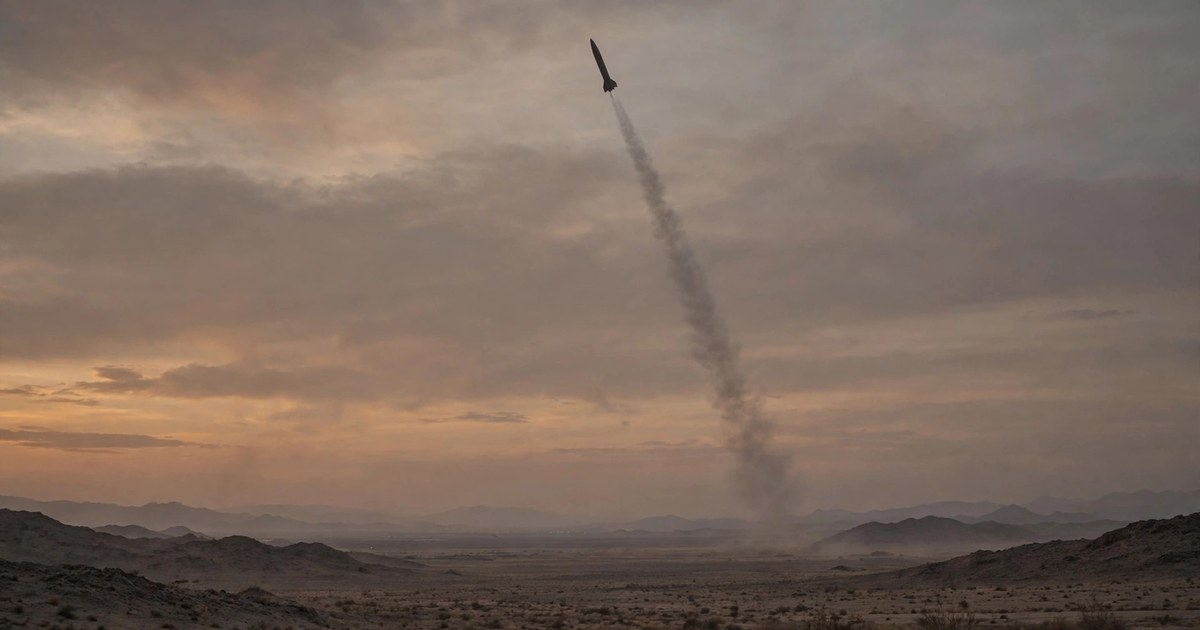
Iran has lifted the self-imposed limit on how far its ballistic missiles may fly. The announcement came on Saturday 7 November 2026, when the Islamic Revolutionary Guard Corps (IRGC) said the 2,000-kilometre ceiling that has shaped Iran's missile programme since 2017 no longer applies. The Iran missile range limit was a deliberate restraint, kept in place for nine years even as Tehran's arsenal grew. Its removal does not, on its own, give Iran a longer-range missile — no such weapon has been shown — but it takes away the last self-imposed barrier to building one, and it lands in the middle of the tensest weeks the Gulf has seen this year.
Brigadier General Hossein Mohebbi, the IRGC spokesman, made the announcement at a press conference in Tehran marking the force's Aerospace Week. Asked whether the supreme leader's directive meant Iran was no longer bound by the 2,000 km limit, he answered plainly: "This restriction has been lifted for us." He added a caution of his own — that Iran must demonstrate any new capability in practice rather than merely claim it. "We should not merely make statements beforehand," he said, according to Iran's ISNA news agency. "Our duty is to demonstrate our capabilities on the battlefield."
What the 2,000 km Iran missile range limit was
The cap was set in 2017 under the former supreme leader, Ali Khamenei, as a deliberate ceiling on Iran's ballistic missile programme. Two thousand kilometres — about 1,200 miles — was enough to reach Israel and American bases across the Middle East, but it stopped short of ranges that could reach deeper into Europe. That was the point. The limit let Tehran threaten its regional adversaries while giving Europe and the United States a reason to treat the programme as a regional problem rather than a direct one. Iran's foreign minister, Abbas Araghchi, later described the 2,000 km figure as a deliberate policy choice, according to Russia's RIA Novosti news agency.
For nine years the ceiling held, at least in public. Iranian officials repeated it whenever the missile programme came under pressure from sanctions talks or European diplomacy. In 2024, a senior defence official told the state IRNA news agency that Iran had "no intention of increasing the range" of its missiles, even while insisting there were no technological constraints on doing so. The message was consistent: the capability might exist, but the choice was restraint.
Why lifting the Iran missile range limit matters now
The timing is the story. The announcement followed warnings from the supreme leader, Mojtaba Khamenei, who ordered the armed forces to answer any threat with an immediate and effective response "without geographical limits" and to update the military's target lists to cover American and Israeli assets — physical and non-physical alike, according to Tasnim News Agency. Days earlier, American strikes had hit an Iranian air-defence installation near Qeshm Island, and Iranian military officials said a commercial tanker had struck a naval mine east of the Strait of Hormuz and caught fire — the latest in a series of mine incidents in the strait.
Iranian lawmaker Manouchehr Mottaki added a sharper warning of his own, telling RIA Novosti that Iran could target US bases in Europe if hostilities resumed. That was a separate statement, not the announcement of an attack — but it shows the direction of the rhetoric in Tehran. The conversation is no longer about whether Iran's missiles can reach Europe, but about whether they should.
What Iran can actually reach — and what it cannot yet
Here the announcement needs its most important qualifier: nothing Iran has shown so far proves it can fire a ballistic missile beyond 2,000 km today. Mohebbi himself cautioned against treating the statement as proof of a new operational capability, and the outlets that carried the announcement — Tasnim, Mehr and ISNA — reported no test, no new missile name and no range figure beyond the lifted cap. Iran International reported separately that Mohebbi said Iran was "continually working to extend its missile range" and would establish the readiness if the system decided to move in that direction. That is a programme in progress, not a finished weapon.
There are signs of that work. A BBC investigation published on 6 November, cited by Iran International, examined satellite imagery and found excavation or construction at two Iranian missile sites and signs of repair at at least 12 other military installations. The imagery shows activity; it does not show a missile that can fly 3,000 km. The gap between lifting the Iran missile range limit and demonstrating a weapon is where this story will be decided — in test launches, if they come, not in press conferences.
For Europe, the arithmetic is the point. At 2,000 km, Iran's missiles could already reach Israel and American bases across the Middle East. Missiles flying beyond that would begin to put parts of south-eastern Europe within reach — which is why European governments have treated the cap as a line that mattered, and why its removal will be read in Brussels and London as more than a speech.
What happens next
Three things are worth watching. First, a test: if Iran fires a missile beyond 2,000 km, the announcement becomes a capability and the argument changes overnight. Second, the response from Washington and Jerusalem, and from European capitals that have spent years treating 2,000 km as the line between a regional threat and a direct one. Third, the diplomacy: Iran and the United States held talks in Doha only days ago about reopening the Strait of Hormuz, and the missile announcement sits uneasily beside them — pressure and negotiation at the same time, which has become Tehran's pattern. The supreme leader's earlier order for retaliation without limits pointed in the same direction weeks ago.
For now, the facts are narrow and the implications are wide. The nine-year Iran missile range limit is gone. No new missile has been shown. And the next move — a test, a sanction, a strike or a talk — will say more about what the lifted limit means than the announcement itself did.
Sources: Associated Press; Tasnim News Agency; ISNA; Mehr News Agency; Iran International; RIA Novosti; BBC.