
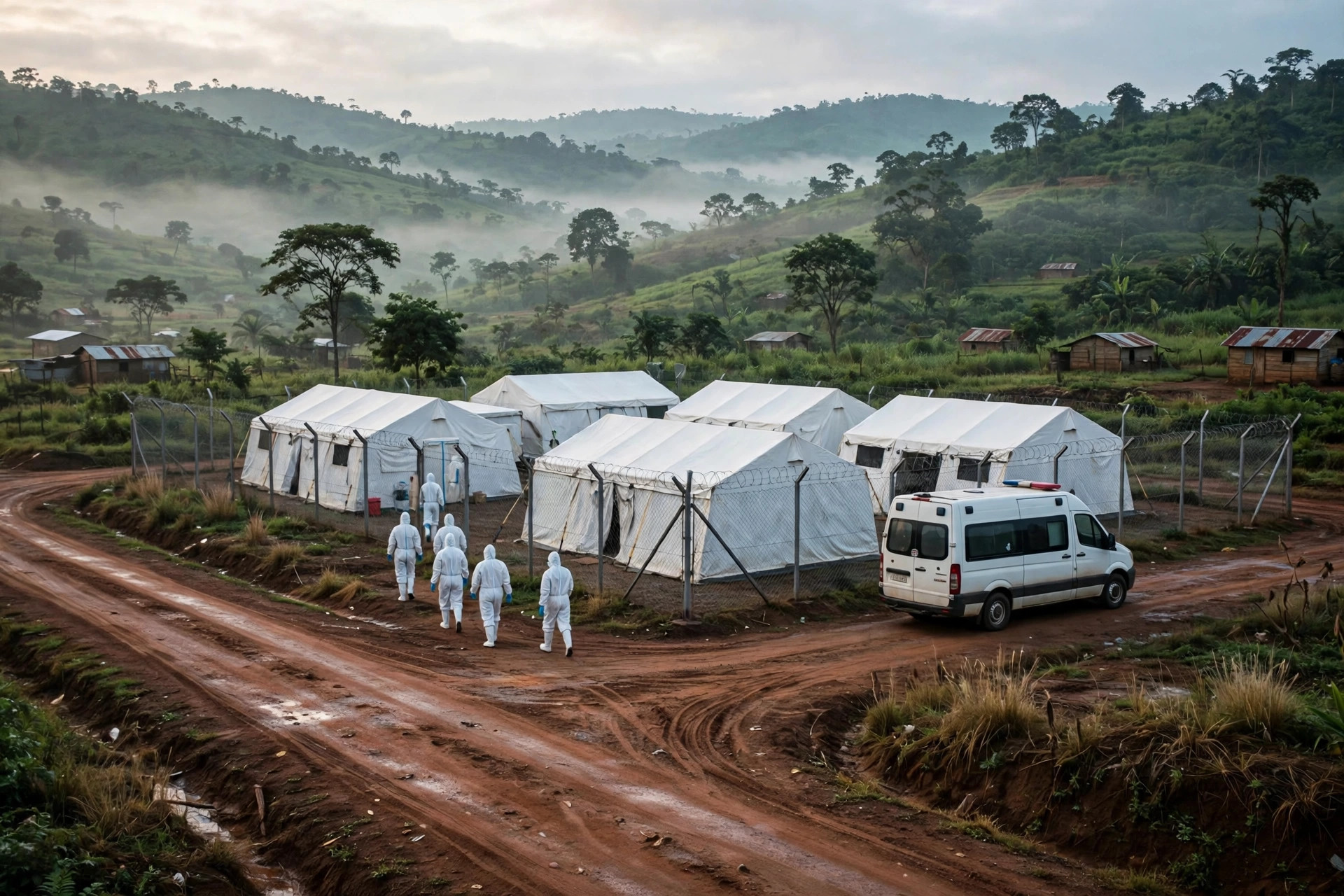
The Congo Ebola outbreak has passed 10,000 confirmed cases, after health authorities in the Democratic Republic of the Congo (DRC) reported 10,060 confirmed cases and 4,887 deaths as of 25 October 2026. The figures, released on Tuesday 27 October by the country's public health institute, put the case fatality rate at 48.6 percent — nearly one death for every two confirmed infections. The story is trending per news coverage, with Reuters, Xinhua and other international outlets reporting the grim milestone within hours of the data being published.
The milestone matters because of how quickly it was reached and how far the virus has travelled. The outbreak was declared on 15 May 2026 and is caused by the Bundibugyo virus, a rare Ebola strain for which no vaccine or specific treatment has been approved. It is already the largest and deadliest Ebola outbreak ever recorded in the DRC, and the second-largest Ebola outbreak on record worldwide, behind only the 2014–2016 West African epidemic. African health ministers were due to meet virtually on Wednesday 28 October to coordinate a continent-wide response, as officials warned that the response so far has not kept pace with transmission.
Congo Ebola Outbreak: What the 10,060 Cases Mean
The jump from 9,000 to more than 10,000 cases took less than two weeks. When the outbreak passed 9,000 cases in mid-October, officials had already recorded more than 4,300 deaths across seven provinces. The latest report adds roughly 1,000 confirmed cases and almost 600 deaths, and extends the spread to eight of the DRC's 26 provinces. The Associated Press has described this as the fastest-growing Ebola outbreak in history, noting that it has produced at least three times as many cases and deaths as the West African epidemic had over a comparable period after its declaration — although that epidemic remains far larger in final totals, with more than 28,600 cases and more than 11,000 deaths over about two years.
There is also a more hopeful figure inside the same data. At least 2,600 patients have recovered in Congo. A video circulated this week showed health workers in full protective gear dancing after the last two patients were discharged from a treatment centre in Mongbwalu, in Ituri province. World Health Organization (WHO) Director-General Tedros Adhanom Ghebreyesus said of the video: "The outbreak is far from over, but every life saved is worth celebrating." Recoveries matter, but they do not change the direction of the epidemic curve. The 10,060 figure counts only laboratory-confirmed cases. With most new cases appearing outside monitored contact lists, the true extent of the outbreak is not fully known.
Why the Congo Ebola Outbreak Is Still Growing
A report released last Wednesday by the WHO Regional Office for Africa found that infections rebounded in early October after falling in late September, describing what it called "renewed intensification of transmission." That rebound is the clearest sign that the outbreak is not yet under control, despite months of response work in the east of the country.
The most revealing numbers concern contact tracing. The Africa Centres for Disease Control and Prevention (Africa CDC) says about 80 percent of new cases in Congo are coming from outside monitored contacts — people who were not already being watched because they were known to have been exposed to someone infected. Wessam Mankoula, an Africa CDC official, told a briefing last Thursday that only about 12 percent of all confirmed cases in Congo had been identified among previously known contacts. Africa CDC says at least 95 percent of new cases must come from known contacts before an outbreak can be considered largely under control. The gap between 12 percent and 95 percent means many transmission chains are running undetected: health workers keep discovering infections only after people fall ill, rather than finding them early through monitoring.
Deaths are also happening too late to help. Congo's National Institute for Public Health said 40 of the 46 most recent deaths occurred in communities, not in Ebola treatment centres, and responders say at least half of all people who have died were never admitted for treatment. That is a sign that many people are still not reporting symptoms at all, or are not reaching care in time. Treatment centres in some health zones are overwhelmed, according to responders who spoke to the Associated Press. Health workers face mistrust and, at times, violence: a nurse was killed in Bafwasende while responding to an Ebola alert, and another health worker was seriously injured in the same attack. In the Nia Nia health zone in Ituri, responders including surveillance and community-engagement officers went on strike over bonuses unpaid since late August. In many zones, teams lack even basic items such as vehicles, and must persuade families to release relatives who are sick or who have died and need to be buried safely. "Some people still don't seem to understand the seriousness of the situation even though they are directly exposed to the risk," Sephora Bgosi, a member of an Ebola burial team in Ituri, told the Associated Press. "Ebola disease is extremely dangerous and can be deadly."
Conflict makes every part of that work harder. The outbreak has unfolded against a protracted armed conflict in eastern DRC, where years of violence and mass displacement have strained an overstretched health system. The WHO has warned that escalating insecurity, continued displacement and restricted humanitarian access are disrupting disease surveillance and response operations, raising the risk that infections go undetected.
How Far Has the Congo Ebola Outbreak Spread?
Inside the DRC, the disease has spread to 66 health zones across eight provinces, up from just three zones when the outbreak was declared in May. Ituri province in the east remains the epicentre, accounting for more than 70 percent of confirmed cases, according to Congolese health authorities. The latest infections were reported in Ituri, North Kivu and Tshopo provinces.
Beyond Congo's borders, cases linked to the outbreak have been recorded in Uganda, Kenya and Nigeria, and an imported case has also been reported in France, according to European health authorities. Uganda reported 20 cases in May and June, mostly imported from Congo, and the WHO declared the country Ebola-free in August; Uganda's health minister has now ordered a 21-day quarantine for citizens returning from Congo. Kenya has recorded nine cases in Kenya: the first patient was a Kenyan national living in Congo who travelled to Nairobi via Uganda and died on 5 October, and eight further cases were found among people already in quarantine. Kenya released 20 contacts from monitoring on Monday after they completed 21 days without symptoms. Nigeria became the fourth African country to report a case last week, in the wife of a Swiss diplomat who had not travelled to Congo and was believed to have contracted the virus in Uganda; she and her husband were flown to hospitals in Switzerland. Health officials are still seeking to establish exactly where and how she was infected.
The WHO's risk assessment, last set on 14 August and under revision, rated the risk as very high in the DRC, high in countries sharing its land borders, and low for the rest of the African region and globally. The WHO continues to advise against general restrictions on travel and trade with affected countries, while recommending stronger surveillance, laboratory readiness and rapid outbreak response instead.
Bundibugyo Ebola: Why There Is Still No Approved Vaccine
Part of the difficulty is biological. Bundibugyo virus is a different Ebola species from the Zaire virus behind the 2014–2016 West African epidemic and the DRC's 2018–2020 outbreak. Vaccines and treatments developed for Zaire Ebola do not automatically work against Bundibugyo, and no vaccine or specific treatment has been approved for Bundibugyo virus disease. Care is supportive: early treatment for symptoms such as fever, dehydration and organ problems can improve survival, but there is no approved drug that kills the virus itself.
That gap is why the TUMAINI vaccine trial matters. The first participant was vaccinated on 23 October in Bunia, the capital of Ituri province. Tumaini means "hope" in Swahili. The Phase 2/3 trial, co-led by Congo's National Institute for Biomedical Research and the University of Antwerp and funded by the Coalition for Epidemic Preparedness Innovations, will first test Ervebo, a vaccine licensed against Zaire Ebola, to see whether it offers any cross-protection against Bundibugyo — something that is not yet established in humans. Two vaccine candidates designed specifically for Bundibugyo, one from the University of Oxford and an mRNA candidate from Moderna, are expected to join the trial. Participants are reached through ring vaccination, which focuses on contacts of confirmed cases and the contacts of those contacts. "This trial will help us understand whether any of the vaccine candidates designed for Bundibugyo virus work," Tedros said. The trial will take time to produce answers, and it does not change the immediate need for tracing, isolation and safe burials.
For readers, the basic facts about transmission are worth stating plainly. Bundibugyo virus spreads through direct contact with the blood or other bodily fluids of an infected person, or with contaminated materials. Symptoms can appear two to 21 days after infection, and people do not transmit the disease before symptoms begin. Fever, fatigue, muscle pain, headache, vomiting, diarrhoea and, in severe cases, bleeding are among the symptoms described by the WHO. Anyone who develops such symptoms after contact with a known case, or after travel in an affected area, should seek care immediately and tell health workers about the possible exposure, rather than waiting at home.
What Happens Next in the Congo Ebola Outbreak?
The immediate test is political as well as medical. African health ministers meeting virtually on 28 October are expected to discuss faster coordination, shared surveillance and laboratory capacity, and support for frontline teams. "Our response must be faster, with stronger coordination, greater solidarity and decisive political leadership," Dr Jean Kaseya, the head of Africa CDC, has said. Whether the meeting produces concrete commitments — on funding, staffing, supplies and cross-border tracing — will matter more than its communique.
Three indicators will show whether the outbreak is turning. First, the share of new cases found among known contacts needs to climb sharply towards the Africa CDC's 95 percent benchmark; while it stays near 12 percent, hidden transmission is continuing. Second, deaths need to happen increasingly inside treatment centres rather than in communities, which would show that people are reaching care earlier. Third, the weekly situation reports need to show a sustained fall across Ituri, North Kivu and Tshopo, not just a brief dip followed by another rebound like the one seen in early October. Until those three move together, a single week's improvement will not be enough to call the outbreak under control.
The 10,000-case milestone is therefore a warning as much as a statistic. It shows an outbreak that has grown faster than any before it, in a region where conflict, displacement and mistrust all work in the virus's favour, and where the medical tools taken for granted in other Ebola outbreaks do not yet exist for this strain. The trial in Bunia offers a path to those tools, and the ministerial meeting offers a chance to close the coordination gaps. But the numbers released on 27 October show how much ground must still be recovered: 10,060 confirmed cases, 4,887 deaths, and transmission chains that health authorities still cannot see. The next situation report will show whether the response is finally catching up.
Sources: Reuters, via reporting on the DRC public health institute situation report; Xinhua / People's Daily; the World Health Organization Regional Office for Africa and WHO Disease Outbreak News; Africa CDC briefings; Associated Press reporting from Ituri province; and the European Centre for Disease Prevention and Control multi-country outbreak assessment.