
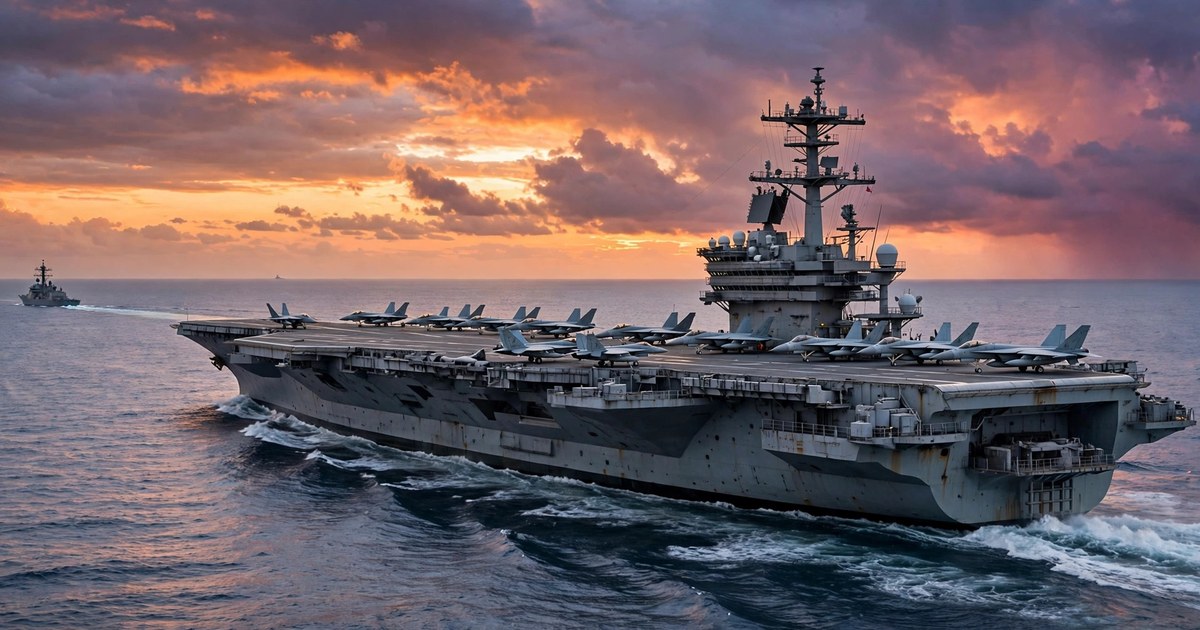
The USS Theodore Roosevelt has arrived in the Middle East as the third US aircraft carrier in the region, giving the United States three carriers there for the first time since April — and only the second time since the 2003 invasion of Iraq, according to the Associated Press and the New York Post. The nuclear-powered carrier entered US Central Command’s area of responsibility on Sunday, 15 November 2026, a US official confirmed on Monday, joining the USS George H.W. Bush and the USS George Washington as the war with Iran drags into its ninth month. The Pentagon and Central Command have not formally confirmed the arrival, and Central Command described the move on X as part of a scheduled deployment.
The arrival matters because of what three carriers can do that one cannot — and because of when it happened. The Roosevelt sailed into the region on the same weekend Iran launched drones at a US radar site in Bahrain, warned it would not wait to be attacked first, and pressed its claim that the Strait of Hormuz is closed to shipping it has not approved. President Donald Trump, meanwhile, has swung between threatening additional large-scale strikes on Iran and insisting the war is, in his words, “militarily… effectively over”.
What Happened: USS Theodore Roosevelt, the Third US Aircraft Carrier in the Middle East
The Roosevelt left San Diego on 27 September with around 5,000 sailors assigned to its strike group, according to the US Navy. The group includes Carrier Air Wing 11, the cruiser USS Chosin and the destroyers of Destroyer Squadron 23. It called at Singapore in early November and sailed west through the Strait of Malacca on 9 November before entering Central Command waters. The carrier, commissioned in October 1986, is the oldest of the three now in the region: the George Washington entered service in July 1992 and the George H.W. Bush in January 2009.
The Roosevelt was sent to relieve the George Washington, which has been operating in the region since August. But the Washington has not left, and the George H.W. Bush — in the region since April — is still there too. The result is three carrier strike groups operating together, something the Navy last did in April, when the Abraham Lincoln, the Gerald R. Ford and the George H.W. Bush overlapped. The Associated Press reported that the April grouping was the first time three carriers had been deployed together in the Middle East since 2003; the New York Post reported the Roosevelt’s arrival makes this only the second such occasion since the 2003 invasion of Iraq.
The carrier did not arrive alone. It is accompanied by the USS Makin Island amphibious ready group, including the landing ships USS John P. Murtha and USS Anchorage and around 2,000 Marines, the Associated Press reported. With the Roosevelt’s arrival, the flotilla in the Arabian Sea now includes 13 destroyers, two cruisers and a littoral combat ship, according to the Navy. More than 20 US Navy warships are enforcing the blockade of Iranian shipping, and the deployment adds an estimated 9,000 to 10,000 American troops to a regional presence press estimates put at more than 50,000 personnel.
Why the Third US Aircraft Carrier in the Middle East Matters
A single carrier can sustain an air campaign. A second can relieve the first, cover another task, or stand by if the first is damaged. A third changes the calculation: it suggests Washington is preparing for duration rather than a single punitive strike, and it gives a president far more options at once. Across the three air wings, the carriers carry up to 144 front-line strike fighters, former Royal Navy commander Tom Sharpe told The National. The Roosevelt alone carries F/A-18 Super Hornet strike fighters, F-35C Lightning II stealth fighters and EA-18G Growler jammers, according to the New York Post.
Analysts read the move in sharply different ways. Megan Sutcliffe, of the Sibylline intelligence firm, told The National that the deployment was “a major trigger for escalation”, adding: “The only time we see the US concentrating three aircraft carriers in one particular region is ahead of major combat operations.” Sharpe said three carriers give President Trump “a lot of strike options” and “a hell of a lot of firepower”. But Dr Lynette Nusbacher, a military analyst, told The National the deployment “should not be read as a sign of imminent combat commitment” — the Roosevelt was meant as a relief rotation, and three carriers can just as easily be a deterrent as a prelude.
The airpower now gathered near Iran is the largest the United States has assembled in the region since the Iraq War, according to TBS News, with more than 120 aircraft in the theatre including F-35 stealth fighters, F-22s and E-3 airborne warning and control aircraft. That scale is the point: whether the buildup ends in talks or in strikes, Washington wants Tehran to plan against several possible axes at once — and wants Gulf partners and shipping companies to believe the sea lanes can still be defended.
The Same Weekend: Drones Over Bahrain and Warnings From Tehran
The Roosevelt arrived on a weekend of fresh escalation. Early on Sunday, Iran’s Islamic Revolutionary Guard Corps said it launched six drones at a US air-defence radar at the Al-Riffa helicopter base in Bahrain — the second Iranian attack on the Gulf kingdom in three days, after US forces intercepted two Iranian drones headed for Bahrain on Friday. Reuters reported the Friday attack was the first against Gulf states hosting American bases since September. Bahrain’s military said its air defences intercepted the Sunday attack before the drones reached their targets, and no damage or casualties were reported. Neither the United States nor Bahrain has confirmed Iran’s claim that the radar was hit.
Tehran paired the attack with a warning. Deputy Foreign Minister Kazem Gharibabadi said in a televised interview that Iran was preparing for three scenarios — diplomacy, economic blockade and military aggression — and that Tehran “will not wait for the US to attack first”. Iran’s stated conditions for a settlement include an end to the US naval blockade, the lifting of sanctions, the release of frozen funds, a halt to fighting on all fronts and a formal end to the war, Al Jazeera reported.
The shipping war around the Strait of Hormuz is running in parallel. Iran’s navy said three tankers hit mines in the strait on Saturday, 14 November — a claim the United States dismissed as false and which has not been independently confirmed. The Revolutionary Guards’ navy has warned shipping companies against using the US-backed southern route through the strait, describing it as closed. US Central Command says it has redirected about 150 merchant vessels and disabled five since June, and the United Nations says 25 seafarers have been killed in or around the strait since the war began, according to Al Jazeera.
The blockade itself dates to 13 April, when the United States imposed it on commercial traffic entering or leaving Iranian ports after nuclear negotiations collapsed. The war began six weeks earlier, on 28 February, with US and Israeli strikes on Iran. A two-week ceasefire in April and a broader understanding in June both collapsed, and mediation efforts by Qatar and Pakistan have made little progress, Al Jazeera reported.
Is the US About to Attack Iran Again?
Nothing in the public record answers that question, and the signals point in both directions. President Trump has oscillated between threatening additional large-scale strikes and insisting the war is effectively over; on Sunday he told reporters that new strikes were “highly unlikely”. Secretary of State Marco Rubio condemned the Bahrain attacks in a call on Monday with Bahraini Foreign Minister Abdullatif bin Rashid Al Zayani and reaffirmed Washington’s commitment to the security of Bahrain and other Gulf partners.
The diplomacy is stalled, but it is not dead. Qatari and Pakistani mediators are still trying to reopen the Strait of Hormuz and secure a permanent end to the conflict, and President Trump is due to meet Chinese President Xi Jinping on Thursday — a meeting in which the war is expected to feature. What happens next will turn first on the most mundane question: whether the George Washington sails home in the coming days, leaving two carriers, or stays, keeping three. A relief rotation ending normally would signal deterrence. Three carriers staying put would signal something else.
Why It Matters
The Roosevelt’s arrival restores the largest concentration of American naval power in the Middle East since April, and it lands at a tense moment in the war: Bahrain attacked twice in three days, tankers burning in the Strait of Hormuz, and both capitals saying they will not move first. For Washington, three carriers mean options — sustained strikes, a defended blockade, or a show of force behind negotiations. For Tehran, they mean more targets to threaten and more reason to doubt that the war is winding down. For the Gulf states and the shipping lines that carry roughly a fifth of the world’s oil through the strait, they mean the standoff is not ending soon. The next move now belongs to whoever blinks first — or fires first.