
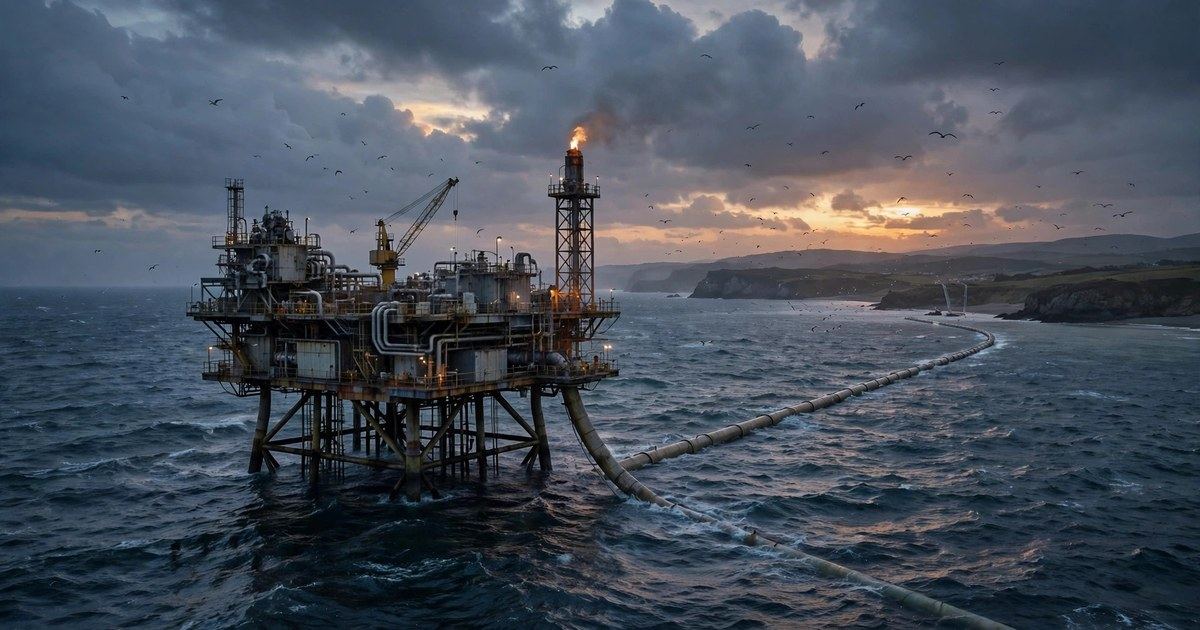
Britain has approved the long-delayed Jackdaw gas field in the North Sea, ending years of legal and political wrangling that pitted the Labour government's climate commitments against its push to bolster energy security. The decision, announced on October 21, 2026, clears the way for gas to start flowing to British homes and businesses as early as the end of this month.
The approval was granted by the North Sea Transition Authority (NSTA), the UK's offshore regulator, after Energy Secretary Miatta Fahnbulleh agreed that consent for production could be issued. It is the first approval of a new North Sea project since the Iran war and the closure of the Strait of Hormuz sent energy prices soaring — and it has immediately become one of the most politically charged energy decisions in recent British history.
What is the Jackdaw gas field?
Jackdaw is a gas-condensate field located about 150 miles (225 km) east of Aberdeen in the central North Sea. It is operated by Adura, a 50/50 joint venture formed by energy giants Shell UK and Equinor UK to combine their British offshore operations.
The field is no small prize. At peak production, Jackdaw is expected to produce up to 40,000 barrels of oil equivalent of natural gas per day — enough, according to Adura, to heat the equivalent of around 1.4 million UK homes. The government says the field will raise domestic gas production by about 6% at its peak, support hundreds of jobs, and add an estimated £2.9 billion ($3.8 billion) to the UK economy over its lifespan of up to 11 years. Wood Mackenzie estimates the field holds about 68 million barrels of oil equivalent, and Adura describes it as a £2.1-billion investment.
Crucially, most of the necessary infrastructure is already in place, which is why production could begin this winter — within weeks of the approval, according to both the government and Adura.
Why was it delayed?
Jackdaw was originally approved for development in 2022 by the previous Conservative government. But climate activists challenged the decision in court, alongside the approval for the even larger Rosebank oil and gas field west of Shetland. In 2025, a court barred operators from extracting oil or gas until they received fresh government consent that takes into account the emissions produced when the fields' hydrocarbons are eventually burned — so-called scope 3 emissions.
That ruling followed the UK Supreme Court's 2024 Finch decision, which requires developers to account for the climate impact of burning fossil fuels in their planning applications. The project had to undergo fresh environmental and regulatory reviews, led by the Offshore Petroleum Regulator for Environment and Decommissioning (OPRED), with public consultations closing in August 2026.
"Following careful consideration of all relevant factors I have agreed that the regulator can grant consent for gas to be produced at Jackdaw, which will begin to supply the UK with gas from this winter thanks to the highly skilled and vital North Sea workers," Fahnbulleh said. NSTA chief executive Stuart Payne said the project had faced "robust scrutiny" and would have an emissions intensity "well below the UK average."
The energy-security argument
The decision has taken on added significance since Prime Minister Andy Burnham took office in July. Britain's high energy costs for households and industry have weighed on the economy, and this year's energy crisis — triggered by the Iran war and the closure of the Strait of Hormuz — has intensified pressure on the government to approve Jackdaw to boost domestic supply.
"Recent events in the Middle East have triggered global energy shocks and pushed up bills for families across the country. At a time of global instability, homegrown energy can be a source of national strength," the UK government said in its statement. Burnham described the decision as "pragmatic," arguing that Britain will need oil and gas for decades even on an ambitious path to net zero by 2050.
US President Donald Trump, who has repeatedly urged Burnham to expand North Sea drilling to help lower prices, welcomed the decision on Truth Social: "The U.K. has started drilling in the North Sea, one of the greatest and most prosperous areas of OIL in the World. They should go FULL BLAST!!!"
The climate backlash
Environmental campaigners are furious. The decision has become a rallying point for activists who say approving new fossil fuel projects undermines Labour's green pledges — and it lands in the same week as a new UN climate report finding that overshooting the Paris Agreement's 1.5-degree Celsius warming target in the next few years is now, in the words reported by CNN, effectively unavoidable after a summer of record-breaking heat across Europe.
Campaign group Uplift forecasts that Jackdaw's contribution will equate to only about 2% of overall UK gas demand — far less than the government's headline figures suggest — and argues the field locks in fossil fuel dependence. Green voices in Parliament called the decision a "huge mistake," and legal challenges cannot be ruled out.
The government insists the approval is compatible with its legally binding climate commitments. Because the field was already licensed, ministers argue, the decision does not breach Labour's manifesto pledge to issue no new oil and gas exploration licences. "We remain resolute in ending new licences for oil and gas and achieving net zero by 2050," Fahnbulleh said.
What happens next
All eyes now turn to Rosebank, Britain's largest untapped oil field, whose original consent was struck down on the same environmental grounds. Adura and its partner Ithaca Oil & Gas hope Rosebank will also receive consent soon — but it faces an even steeper climb, as an oil field is harder to square with net-zero rhetoric than a gas field pitched as a bridge fuel.
For households, the practical question is whether Jackdaw's gas will actually lower bills. The UK's gas is sold into international markets, so domestic production does not directly set the price consumers pay — though greater supply can ease the supply-demand balance. For the government, the calculation is political as much as economic: energy security is now a national-security issue, and ministers have decided that the cost of saying no was higher than the cost of saying yes. Related reading: the supertanker explosion in the Strait of Hormuz, Gulf stocks falling on Houthi threats and the IMF warning, and Rubio's Jamnagar visit over Venezuelan oil refining. The decision also sits inside the bigger argument over fossil fuels and the climate — our explainer on what causes climate change sets out the science behind that debate.