
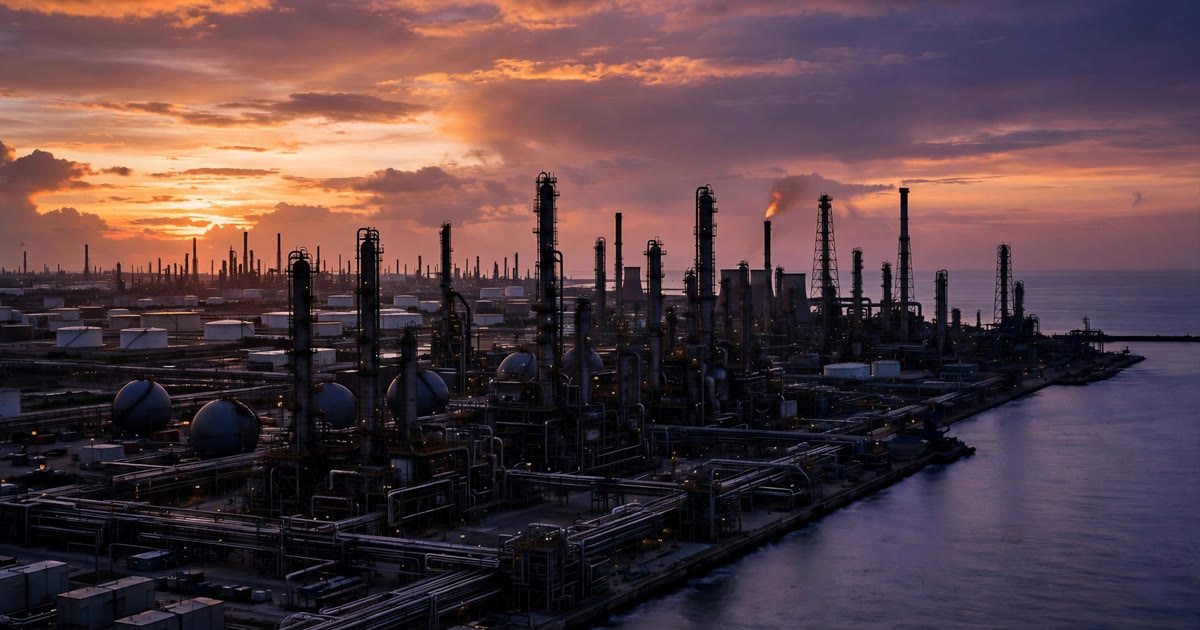
US Secretary of State Marco Rubio is spending Wednesday, October 21, in Jamnagar, Gujarat — home of the world’s largest single-site oil refinery complex — for a meeting with Reliance Industries chairman Mukesh Ambani that is trending per news coverage across Indian and international outlets. The subject on the table, as Rubio put it himself to reporters in Mumbai on Tuesday: getting Reliance to refine more Venezuelan crude.
“They can, and we’ll talk about that tomorrow with Reliance,” Rubio said when asked whether India could take more Venezuelan oil. “They’ve done so in the past. They have the capability to refine heavy crude.”
It is an unusual itinerary for America’s top diplomat — skipping New Delhi entirely in favor of a refinery town on the Gujarat coast — and that is precisely the point. The United States is grappling with record diesel prices, fuel-shortage fears that Indian business-press coverage ties to the war with Iran, and midterm elections less than two weeks away on November 3. Venezuelan oil is flowing back onto world markets, and very few companies anywhere can turn its heavy, sulfurous crude into usable fuel at scale. Reliance’s Jamnagar complex is one of them.
What is happening in Jamnagar today
Rubio is in India from October 20 to 21 at the invitation of External Affairs Minister S. Jaishankar, his second visit to the country this year after a trip to New Delhi in May. Tuesday was spent in Mumbai, where he attended a Freedom 250 reception at the Jio World Convention Centre and spoke to reporters and to Network 18 — itself owned by Reliance.
Wednesday belongs to Jamnagar. Rubio is touring Reliance’s twin refineries, whose combined capacity of about 1.4 million barrels a day makes the complex the largest single-site refinery in the world, and meeting Ambani — the 69-year-old chairman and managing director of Reliance, India’s richest person, worth an estimated $79 billion. The Times of India reported that the two would dine at the Vantara centre and that Rubio, after a last-minute schedule change, would spend the night in Jamnagar rather than returning to Mumbai as originally planned.
In his Network 18 interview, Rubio framed the trip as commercial diplomacy. The US wants to “work together more closely” with Reliance on refining energy from the Western Hemisphere, he said — “I think that’s helpful to India, but it’s also helpful to us.” US Ambassador to India Sergio Gor said the Jamnagar stop was scheduled in light of Reliance’s “incredible” investment in a US refinery project, adding of Ambani: “Given Ambani runs Reliance, I’d imagine he’d be there.”
Why Venezuelan crude needs Jamnagar
Venezuela sits on some of the world’s largest oil reserves, but its crude is ultra-heavy, waxy and high in sulfur — the kind of oil that only complex, sophisticated refineries can process. Most of the world’s refineries are built for lighter grades and cannot handle it at all.
Jamnagar can. Reliance’s two refineries were purpose-built to crack exactly these difficult crudes, which is why the company has long been one of the biggest foreign buyers of Venezuelan oil. When Rubio called India a “refining powerhouse” this week, this is what he meant: the industrial capability to take the hemisphere’s heaviest barrels and turn them into diesel, gasoline and jet fuel.
Venezuela cannot easily do this itself. After years of underinvestment, its domestic refining infrastructure is aging and poorly maintained, which is why — even as production ramps up under the country’s new interim authorities — Washington has struggled to take full advantage of the oil now flowing from fields the US says it controls. According to the White House, those interim authorities have granted the privately held North American Blue Energy Partners a 100-year concession covering 17 oil fields, with US officials saying America has secured majority control of more than 65 billion barrels of proven reserves since longtime president Nicolás Maduro was captured and extradited earlier this year.
That backstory matters because it explains the urgency. The oil exists and is increasingly available; the bottleneck is turning it into fuel.
Why Washington needs the fuel
The American end of the equation is about prices and politics. Diesel in the United States has pushed past $6 a gallon — record territory that is squeezing truckers, farmers and freight operators — and the International Energy Agency has warned that constraints on the diesel market will likely keep prices elevated into next year. Indian business-press reporting ties the shortage fears directly to the war with Iran and disruptions around the Strait of Hormuz, through which a large share of the world’s oil still moves.
With the November 3 midterms approaching, the Trump administration has been reaching for every available lever. Earlier this month Trump paused sanctions on Russia to let more of Moscow’s supplies into the global market, and on October 19 he announced a $8 billion harvest fuel relief plan aimed at American farmers facing soaring diesel and fertilizer costs. Experts quoted by CNBC described Rubio’s India trip as deliberately focused on business deals rather than policy and politics, with American voters’ economic anxiety as the backdrop.
Diesel is the pressure point because it moves almost everything — freight, food, farming — and its price feeds quickly into inflation. A new, large source of refined diesel supply would be political gold two weeks before an election. Jamnagar’s export-oriented capacity is exactly that kind of source.
The Reliance–Venezuela backstory
Reliance and Venezuelan crude go back years. The company stopped buying in early 2025 under pressure from US sanctions, applied for American approval in January 2026, and won a US license in February that lets it buy Venezuelan crude directly — purchasing 2 million barrels from trader Vitol that same month.
Since then it has become the indispensable buyer. According to global trade intelligence firm Kpler, India imported about 257,000 barrels a day of Venezuelan oil in September, and Reliance bought 76% of it — making the company the biggest buyer of Venezuelan crude outside the United States as of the end of September. Trump has been publicly pushing India to buy more Venezuelan oil as a replacement for Russian barrels, and while India’s state-owned refiners have made only opportunistic purchases, Reliance has been the primary buyer.
Rubio also raised a bigger possibility on Tuesday: Reliance resuming oil production inside Venezuela itself. The company had a presence in the country in the past, and Rubio said the idea had been discussed before. “We’re gonna go see what the hold-up is and what opportunities exist,” he told reporters. The context is worth noting: earlier this year the US not only captured Maduro but has since pursued Maduro-linked bribery networks, signaling how thoroughly Washington intends to reshape the country’s oil economy.
The bigger US-India picture
The refinery visit is also a signal about where the US-India relationship is heading. Rubio said trade negotiations between the two countries are nearing completion, with discussions down to technical details — and he expressed hope that outstanding issues would be resolved in the coming weeks. That follows Trump’s recent decision to waive potential tariffs linked to India’s purchases of Russian oil, a move that drew criticism from some American lawmakers but cleared the way for exactly this kind of energy cooperation.
For Reliance, the meeting caps a month in which the conglomerate has found itself at the center of geopolitics well beyond its usual business headlines. And there is a Texas-sized subplot: multiple outlets report that Reliance is associated with plans for a major new refinery in Brownsville, Texas — which would be the first new refinery built in the United States in 50 years. Neither the company nor the State Department has confirmed details, and the reports should be read as plans rather than done deals, but the Jamnagar visit is widely seen as connected to that ambition.
What to watch next
No commercial agreement has been announced — the reporting so far describes a planned visit and discussion, not a signed deal — so this remains a developing story. The things to watch: whether the US-India trade agreement lands in the coming weeks as Rubio suggested, whether Reliance commits to larger Venezuelan volumes or a return to oil production in Venezuela, and how quickly Venezuelan output actually ramps up given the state of its infrastructure.
For now, the image of the day is a US Secretary of State touring an Indian refinery and dining with the country’s richest man — a measure of how energy, elections and geopolitics have converged on a single stretch of Gujarat coastline.