
On Wednesday, 14 October 2026, United States President Donald Trump said that large-scale oil, gas and mineral exploration is getting ready to begin in Greenland — a claim that is trending per news coverage across CNN, Reuters, AFP and other outlets. The announcement came in a post on his Truth Social platform just after midnight. It was sweeping in tone and short on specifics: no project names, no companies, no licences, no timelines and no permits were mentioned. That gap between the scale of the claim and the absence of detail is the central fact of this story, and it is why the announcement deserves careful reading rather than instant acceptance.
Trump described the coming activity as massive and said experts believe the amount of easily available oil in Greenland is far greater than that of almost any land anywhere in the world. He also framed the island as second to none for the security of the United States and Europe, arguing that any future attack on the US would have to come across Greenland, where American defences would be positioned to intercept drones, missiles and weapons not yet conceived. He added that Greenland gives the US time, location and sightline like nowhere else in the world. The post followed a campaign event in Alaska, where he had also made a separate energy announcement about Taiwan and the Alaska LNG project, covered in our earlier explainer Trump Says Taiwan Agreed to Buy 30% of Alaska LNG for 20 Years: Deal Explained.
What Trump actually announced — and what he did not
What is confirmed is that the president made the claim. What is not confirmed is almost everything else. Trump did not identify any operator, any exploration block, any agreement or any start date. He did not say whether the activity he referred to involves American companies, Greenlandic or Danish licence-holders, or work already under way. Reporting by CNN and the Associated Press noted that it was not immediately clear what exploration or developments he was referring to.
The wording itself matters. Exploration is not production. Exploration means surveys, mapping, seismic work, sampling and, at most, test drilling to establish whether resources can be found and recovered economically. Even where exploration begins, years of appraisal, permitting, financing and construction usually follow before any oil, gas or mineral reaches a market. A claim that exploration is getting ready to begin is therefore a long way from a claim that Greenland is about to become a major energy or mining producer — even if the claim proves accurate.
What the September deal actually says
Trump’s comments came less than a month after the United States, Denmark and Greenland signed an agreement intended to ease months of tension over his repeated threats to take control of the strategically located island. The roughly 10-page pact expanded the American military footprint in Greenland, paving the way for two new bases — at Narsarsuaq in the south and Mestersvig in the east — in addition to the Pituffik base the US already operates in the north. It also opened the door to the proposed Golden Dome missile-defence system.
At the same time, the deal begins with an acknowledgment of Danish sovereignty and of Greenlanders’ right to self-determination, and it would still apply if Greenland eventually chooses independence. It refers to minerals cooperation and cooperation on economic development and business promotion, but it contains no explicit mention of oil or gas. Crucially, reporting on the agreement is clear that it does not grant the United States any special exploration rights, though it does place some limits on investment by non-NATO countries in strategic sectors. Greenland remains a self-governing territory of Denmark — not part of the United States — whatever the phrasing of a social-media post suggests.
Why Greenland matters so much
Greenland’s importance is real, and it explains why the island keeps returning to the centre of global strategy. It lies on the shortest route for missiles between Russia and the United States, which is why it is prized as a location for early warning and missile defence. It holds deposits of rare-earth minerals used in everything from smartphones and computers to batteries, wind turbines, electric vehicles, fighter jets and medical scanners. China currently dominates the world’s supply of those critical minerals, and the Trump administration has been seeking ways to loosen that grip. Melting polar ice is also gradually opening new Arctic shipping routes, adding a commercial dimension to the island’s military value. Governments worldwide are racing to secure energy and mineral supply chains, a trend also visible in Japan Approves 3 Energy Bills to Bypass Strait of Hormuz.
The scale of the resources is often described in striking terms. Estimates cited in reporting put Greenland’s rare-earth holdings at around 1.5 million tonnes, and the island is said to host 25 of the 34 minerals the European Commission classes as critical raw materials. The US Geological Survey has identified major potential offshore deposits of oil and natural gas. Those figures, however, describe what may lie underground — not what can be profitably extracted. The distance between a geological estimate and a working mine or oilfield is where Greenland’s story becomes complicated.
Why extraction in Greenland is so difficult
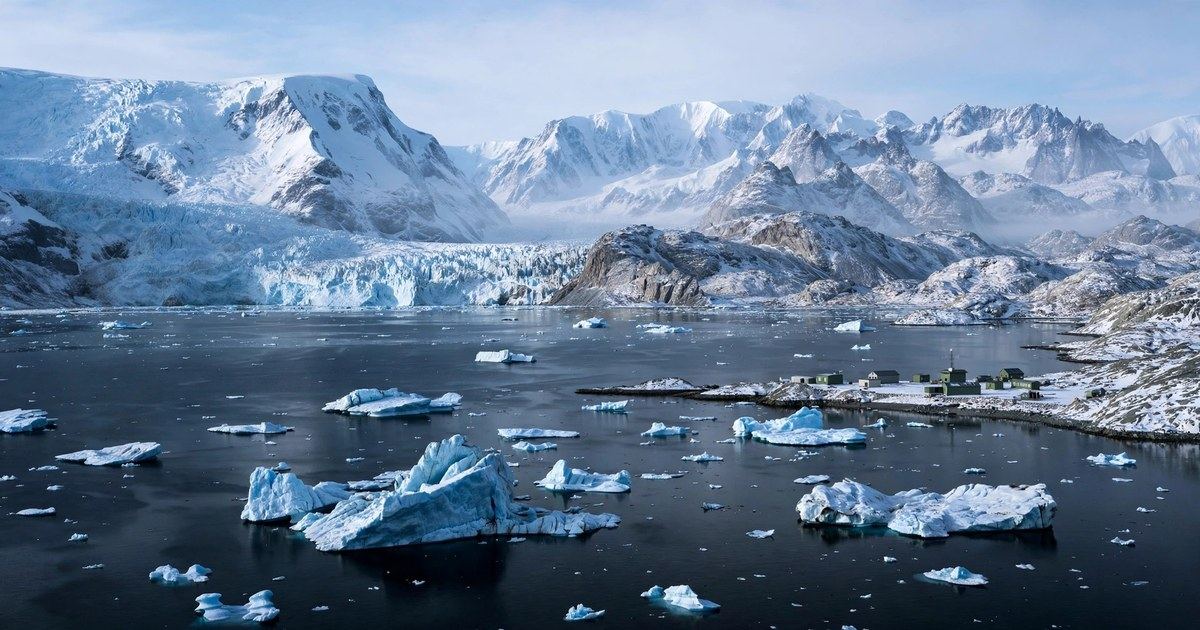
About 80 per cent of Greenland is covered in ice, in places a mile thick, and darkness reigns for much of the year in the far north. Many mineral deposits sit in remote areas above the Arctic Circle, far from roads, railways, ports and power lines. Even in the inhabited south, infrastructure is thin: projects typically need to generate their own power, import skilled workers and build access from scratch. Northern sites may be operable for only about six months of the year, and equipment must withstand extreme winter conditions. Analysts estimate that mining in the Arctic can cost five to ten times more than in other parts of the world.
The geology adds another layer of difficulty. Greenland’s rare earths are often locked in complex rock for which no fully profitable extraction process yet exists, while offshore oil and gas deposits lie beneath Arctic ice. Previous efforts to develop rare-earth minerals, oil and gas in Greenland have never progressed beyond the exploratory stage. In August, media reports of preparatory operations by a US oil company in a remote region of eastern Greenland left locals and authorities on the island uneasy — a reminder that even early-stage activity is politically sensitive. One Arctic researcher has described the idea of turning Greenland into a rare-earth factory as science fiction, while a mining-industry analyst has warned that any Greenland minerals venture means billions of dollars and an extremely long timeline before anything comes out. As with other recent energy announcements, the test of this one will be documentation: licences, companies and permits, as seen in the verification questions around Trump Announces ‘Energy Ceasefire’ Between Russia and Ukraine — What We Actually Know.
Market reaction: shares jumped, but that proves little
Markets reacted quickly. Shares in 80 Mile, an exploration and development firm that describes itself as the custodian of the three largest commodity projects in Greenland — covering titanium, nickel, copper, lead, zinc and platinum-group metals — rose about 23 per cent in London trading after Trump’s post. That kind of move is a familiar pattern: thinly traded resource stocks can swing sharply on geopolitical headlines. A rising share price is a measure of investor excitement, not evidence that a new exploration programme exists. Until a company names a project, a licence and a timetable, market reaction should be read as speculation, not confirmation.
What Denmark and Greenland have said
Representatives of the leaders of Denmark and Greenland did not immediately respond to requests for comment on Wednesday, according to Associated Press reporting. The longer record, however, is clear. Greenland’s leaders have repeatedly said the island is not for sale, while also saying for years that Greenland is open to business and foreign investment on its own terms. Denmark has categorically rejected any discussion of selling its autonomous territory. Welcoming investment is not the same as accepting American control, and the September agreement was written to reflect exactly that distinction: deeper security cooperation, Danish sovereignty intact, Greenlanders’ future in their own hands.
What to watch next
The story now turns on evidence. Watch for any statement from Nuuk or Copenhagen responding to the claim, any naming of companies or exploration licences, any permit filings, and any detail from the US administration about what activity it believes is beginning. Also watch for whether the exploration Trump described turns out to refer to work already licensed and under way, rather than something new. If weeks pass with no names, no licences and no filings, that silence will itself be informative. If documentation appears, the questions will shift to scale, ownership, environmental review and how Greenlanders themselves judge the trade-offs.
The bottom line is straightforward. Confirmed: Trump said massive oil, gas and mineral exploration is getting ready to begin in Greenland; a September deal expanded US security cooperation with Denmark and Greenland; Greenland holds significant mineral and energy potential. Not confirmed: any specific exploration project, timeline, operator or American role. Until the paperwork appears, this is an announcement to track — not activity to assume. Sources: CNN; Reuters; AFP; Associated Press; Morningstar (per news coverage, 14 October 2026).
Disputed territory and the energy riches around it are also at the heart of Argentina's decision to take its Falklands oil fight to the ITLOS maritime tribunal.
It fits a pattern of bold territorial pronouncements: Trump has also demanded that New Mexico rename itself 'New America'.