
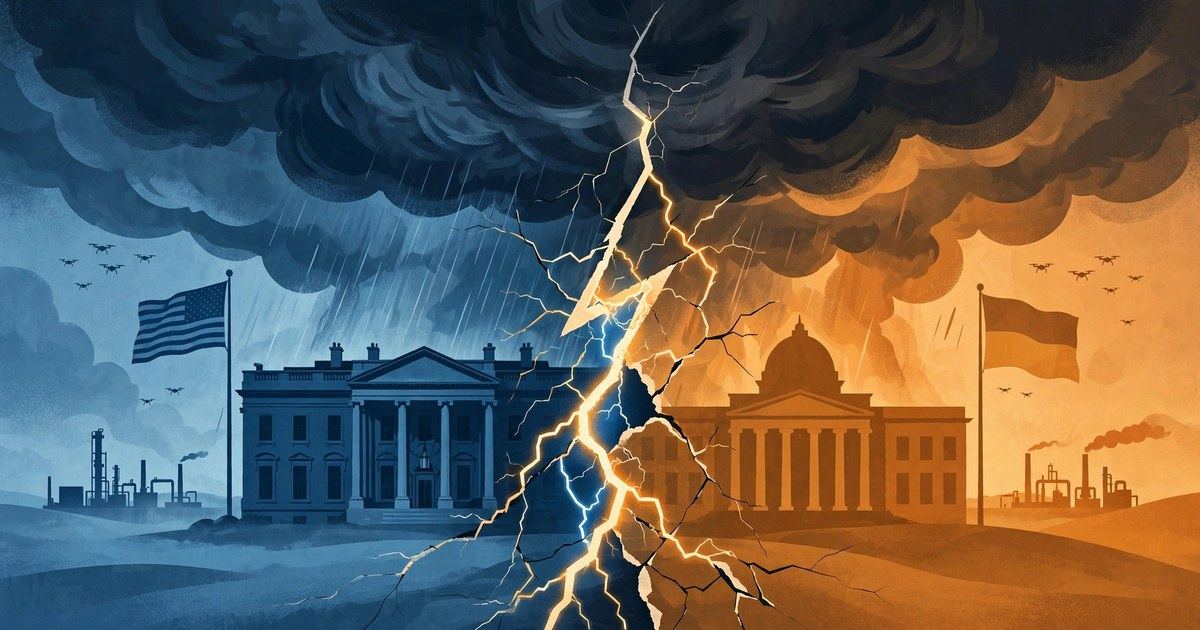
US President Donald Trump has publicly accused Ukrainian President Volodymyr Zelensky of prolonging the war with Russia, saying the Ukrainian leader "doesn't want to end this war, and probably never did." The extraordinary broadside — aimed at the leader of a country the United States has armed for nearly five years — came in a post on Trump's Truth Social platform on Sunday, and it is trending per news coverage.
"My decision on Russia is a very simple one. I am in the process of negotiating Peace in the war between Russia and Ukraine, and don't want to do anything that will drive, foolishly, Russia away from the bargaining table," Trump wrote. He continued: "Zelensky doesn't care, and frankly, with all of the money that Europe is famously giving him, and that Crooked Joe Biden gave him in the past, he doesn't want to end this war, and probably never did."
The post was Trump's defence of one of the most consequential decisions of his Ukraine policy so far: an executive order signed late Friday that waives sweeping new sanctions on Russia — sanctions Congress had passed only weeks earlier in legislation named for the late Senator Lindsey Graham, a staunch supporter of Ukraine's defence. Days before the measures were due to take effect, Trump put them on hold.
Why Trump waived the Russia sanctions
The Lindsey O. Graham Sanctioning Russia and Iran Act of 2026 was designed to impose broad new economic measures on Russia and on foreign entities linked to its energy trade. Trump argued that activating the sanctions now would sabotage his diplomacy. "I am in the process of negotiating Peace," he wrote, adding that he did not want to do anything that would "drive, foolishly, Russia away from the bargaining table."
But there was a second, more domestic reason. Trump also temporarily eased sanctions on Russian diesel, allowing Russian fuel back into global markets — a move his team says is aimed at lowering fuel prices ahead of the US midterm elections on 3 November. Opinion polls suggest Republicans could face significant losses, and voters have grown frustrated as fuel prices surged in the wake of the Iran conflict that began in late February. Most economists doubt the diesel deal will meaningfully move US pump prices, but the political logic is plain.
Trump's defence was confirmed by multiple outlets, including DW and France 24, which verified both the sanctions waiver and the accusation against Zelensky.
The accusation: Ukraine's refinery strikes are political
Trump's charge against Zelensky was not just that Kyiv rejects peace — it was specific. He accused Ukraine of striking Russian oil refineries and energy facilities to hurt Republicans at the ballot box. According to Trump, Ukraine is targeting Russian diesel refineries knowing that the disruption ripples through global fuel markets, and that American farmers, ranchers and businesses are paying the price.
This is a direct attack on one of Ukraine's most effective military campaigns. In recent months Kyiv has systematically degraded Russia's oil refining capacity with long-range drone strikes — including one of its largest such attacks this year, which set a St Petersburg oil terminal and depot on fire this week, killing one person. Ukraine argues the campaign is legitimate warfare against the industry that funds Russia's invasion. Trump, by contrast, has framed it as a political operation aimed at American voters.
The dispute intensified the same weekend Ukraine launched what reports describe as one of its biggest drone barrages of the war — more than 1,000 drones, according to Russian officials — even as Russian strikes continued to kill civilians in Kyiv. The energy war between the two countries, which both sides had briefly paused under a fragile "energy ceasefire," has fully reignited.
How Kyiv responded: crisis diplomacy on Sunday
Kyiv's response to the sanctions waiver was sharp. Zelensky argued that the diesel deal would send money straight to Moscow and help fund Putin's war, and he criticised the sanctions pause as weakening the pressure that might force Russia to negotiate. He also warned, in remarks reported by DW, that Ukraine would not prevail if the United States effectively switched sides.
Behind the public exchanges, crisis diplomacy got underway fast. On Sunday, Zelensky met with US envoys Steve Witkoff and Jared Kushner in an effort to de-escalate the standoff. The meeting signalled how seriously Kyiv is taking the breach: with American military aid, intelligence and diplomatic cover all potentially at stake, a rupture with Washington is the one outcome Ukraine can least afford.
The timing is brutal. The row comes just days after Zelensky disclosed that Washington had briefly suspended missile-warning intelligence to Ukraine for three days — a blackout covered in detail earlier this week — and amid the already-controversial waiver of the Graham Act sanctions. Each episode has tightened the same vise: the United States has more leverage over Kyiv than ever, and it is using it.
The Putin-Xi meeting proposal
While Washington and Kyiv traded blows, a potentially explosive diplomatic development surfaced: the Wall Street Journal reported that Russian President Vladimir Putin had proposed a meeting next month with Trump and Chinese President Xi Jinping to discuss ending the war. The idea of a great-power summit on Ukraine's fate — potentially held without Ukraine at the table — is the nightmare scenario for Kyiv, which has long insisted on the principle of nothing about Ukraine without Ukraine.
The proposal, if it materialises, would crystallise Zelensky's fear: that Washington is now willing to negotiate Ukraine's future bilaterally with Moscow (and Beijing), treating Kyiv as an obstacle rather than a partner. Trump's claim that "great progress is being made" toward a peace agreement — coupled with his accusation that Zelensky is the blocker — reads in Kyiv as a warning shot: accept the terms being negotiated, or lose American support.
The Starlink subplot
Lurking beneath the public feud is the continuing fight over the technology that keeps Ukraine's war machine running. Zelensky has alleged that restrictions on SpaceX's Starlink and Starshield satellite networks in Ukraine were imposed as a deliberate pressure tactic — claims that have prompted US senators to demand an investigation. Trump's administration denies ordering any restrictions; Treasury Secretary Scott Bessent has called Zelensky's claims reckless.
On a related front, Lithuania's prime minister said Russia was likely behind an attempted arson attack on a company hosting Starlink equipment — a claim that has not been independently confirmed but, if true, would mean Ukraine's satellite lifeline is under attack from both directions.
What this means for the war
Step back, and the pattern of the last week is unmistakable. In a matter of days, the Trump administration has: declared and then watched collapse an "energy ceasefire"; announced a diesel deal with Moscow; waived the landmark Graham Act sanctions just before they took effect; briefly cut missile-warning intelligence to Kyiv; and now publicly accused Ukraine's president of wanting the war to continue.
The question is what leverage is for. If the pressure is meant to push Zelensky toward a negotiated settlement, it may work — or it may backfire, hardening Ukrainian resolve while signalling to Moscow that American patience with Kyiv has limits. Putin, for his part, has shown no sign of softening: Russian strikes on Ukrainian energy infrastructure continue, and the Kremlin has every incentive to pocket the sanctions relief while offering little in return.
For Ukraine, the stakes are existential and immediate. With winter approaching, Russia still hammering its energy grid, and Washington openly questioning Kyiv's commitment to peace, Zelensky faces the most difficult diplomatic position of his presidency. The envoy meeting on Sunday bought time. Whether it bought understanding is another question entirely.
Sources: DW English (19 October 2026); France 24 (19 October 2026); The Business Standard (19 October 2026); Livemint (19 October 2026); KRATKO.news (19 October 2026); Reuters (18 October 2026); The Wall Street Journal via reports (18 October 2026).