
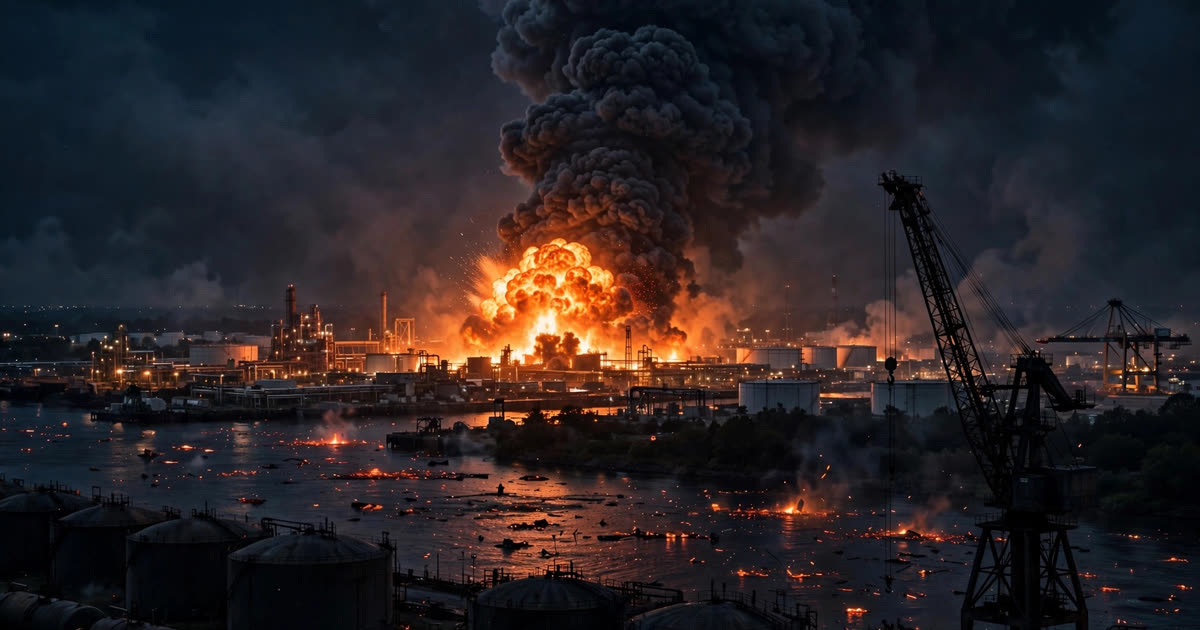
Overnight between Saturday and Sunday, October 18, 2026, Ukraine launched one of its largest aerial bombardments of the war: more than 1,000 drones across 15 Russian regions, Crimea and the Black Sea, with Russia's second city — St Petersburg — taking some of the heaviest hits. Fires broke out at the St Petersburg oil terminal, the Ruchi oil depot and industrial warehouses, and one person was killed with 15 injured, according to local authorities.
What happened overnight
Russian air defence units said they downed 1,015 Ukrainian drones overnight, the Russian Defence Ministry announced on Sunday morning. The barrage struck deep inside Russia, more than 1,500 kilometres from the front lines in eastern Ukraine. St Petersburg governor Alexander Beglov confirmed that fires had erupted at the Petersburg Oil Terminal — a major oil export facility — along with the Ruchi oil depot and several industrial warehouses.
Video footage circulating on Sunday showed a massive fireball and towering columns of black smoke rising over the city, the kind of scene more associated with frontline oil strikes than with a city better known as Russia's cultural capital. Emergency services worked through the night to contain the blazes at the terminal and surrounding industrial sites.
The targets: oil, logistics and data
What makes this attack distinctive is the breadth of its targets. It was not only energy infrastructure that was hit. Russian e-commerce company Ozon confirmed that its logistics hub in St Petersburg was on fire. The internet company VK — often described as Russia's answer to Facebook — said that its data centre in the Leningrad region had been attacked by drones, though it added that services remained available to users as normal.
A Ukrainian drone manufacturer, Fire Point, said on Sunday that the Ukrainian military had struck the VK data centre near St Petersburg, an unusual claim of responsibility-by-proxy that underscores how Ukraine's drone industry and its military operations have become intertwined.
The strategy appears designed to hit Russia where it hurts on multiple fronts at once: energy export revenues, civilian logistics chains, and digital infrastructure. Ukraine has been steadily expanding its long-range drone campaign against Russian oil refineries and terminals through 2026, and this barrage represents its most ambitious strike on Russian energy assets yet — echoing the logic of the mass drone exchanges both sides have been conducting against each other's power grids.
Casualties and damage on the ground
One person was killed and 15 were injured in the St Petersburg and Leningrad region strikes, according to local authorities cited by Reuters. The injuries ranged across the affected industrial areas, where fires at the oil terminal and warehouses made rescue work difficult through the night.
The Ozon logistics fire disrupted operations at one of Russia's largest e-commerce fulfilment centres, a sign that Ukraine's targeting doctrine now extends beyond purely military or energy targets into the commercial infrastructure that underpins daily life in Russian cities. VK, whose services remained running, nevertheless had one of its physical data facilities directly targeted — a potential preview of how cyber and kinetic strikes could converge in future attacks.
Kremlin response: Peskov's warning
Russia's response was swift in rhetoric. Kremlin spokesman Dmitry Peskov said on Sunday that Russia was "constantly responding" to Ukrainian attacks with systematic, large-scale strikes, according to the TASS news agency. When asked how Russia might respond specifically to the attack on St Petersburg, Peskov said: "The Kyiv regime is resisting. But this cannot change the course of events."
The phrasing suggested Moscow intends to frame the attack as a futile gesture rather than a turning point — but the scale of the barrage, reaching a city that has largely been spared the war's direct effects, complicates that narrative. Just days earlier, Russia struck Ukraine's power grid, underscoring the cycle of retaliation both sides are locked into as winter approaches.
The Trump angle: pressure from Washington
The St Petersburg attack lands in the middle of deepening tensions between Ukraine and Washington. US President Donald Trump has publicly criticised Kyiv for its strikes on Russian oil infrastructure, even as his administration navigates the ongoing peace diplomacy that included Trump's recent "energy ceasefire" claims between the two countries.
The friction matters because Ukraine's long-range drone campaign depends on a complex web of Western intelligence support, components and diplomatic tolerance. A Ukrainian decision to escalate its strikes on Russian energy assets — the day after a major Russian assault on Ukraine's grid — tests how much latitude Kyiv retains under American scrutiny. The 1,015-drone figure, if accurate, signals that Ukraine has not only retained that latitude but has dramatically expanded its production and launch capacity.
The other side of the war: Zaporizhzhia
While the world's attention fixed on St Petersburg, the war's human cost continued elsewhere. Russia launched two attacks on the southern Ukrainian city of Zaporizhzhia, local officials said. A woman died and at least two other people were wounded, including a six-year-old girl, after strikes damaged two apartment buildings, 18 cars and an educational institution, according to the head of the Zaporizhzhia regional military administration.
The parallel tragedies — a drone-war casualty in St Petersburg, a missile-war casualty in Zaporizhzhia — capture the grinding, two-sided attrition the war has settled into, even as the technologies being used on both sides keep getting more sophisticated.
Why St Petersburg matters
St Petersburg has been largely shielded from the war's direct violence, which is exactly what makes this attack strategically significant. The city is Russia's second-largest, its window to the West, home to the Baltic oil export trade and to some of the country's most important commercial infrastructure. A successful large-scale drone strike there tells three stories at once.
First, it demonstrates the reach of Ukraine's long-range drone fleet: if St Petersburg is vulnerable, few places in European Russia are truly safe. Second, it attacks the economics of the war — every terminal disrupted, every depot burned, dents the oil revenues that fund Russia's military machine. Third, it sends a psychological message to Russia's urban population and elite: the war can reach you.
Ukraine's strikes on Russian oil infrastructure have already drawn criticism from Washington for their potential to roil global energy markets. A strike of this scale on an export terminal will inevitably raise fresh questions about energy prices, shipping insurance in the Baltic, and the spillover effects on global markets.
What happens next
Russia has promised systematic retaliation, and the pattern of the past month suggests that retaliation will land on Ukraine's energy infrastructure — likely timed to maximise damage as temperatures fall. Ukraine, meanwhile, appears to be in a race to scale its drone production faster than Russia can scale its air defences, with the 1,015-drone overnight figure marking a new high-water mark.
The diplomatic dimension is the wildcard. With Trump criticising Ukraine's oil strikes while simultaneously pursuing ceasefire diplomacy, Kyiv faces a tightening set of constraints — and yet chose this weekend to launch one of its biggest attacks of the war. Whether that was defiance, leverage, or simply military logic will shape the next phase of both the war and the negotiations. What is certain is that the overnight barrage has opened a new chapter in the drone war: the war has come, unmistakably, to St Petersburg.
Drones are reshaping the war in other ways too, including Ukraine's world-first aerial drone evacuation of a wounded soldier from the front line.