
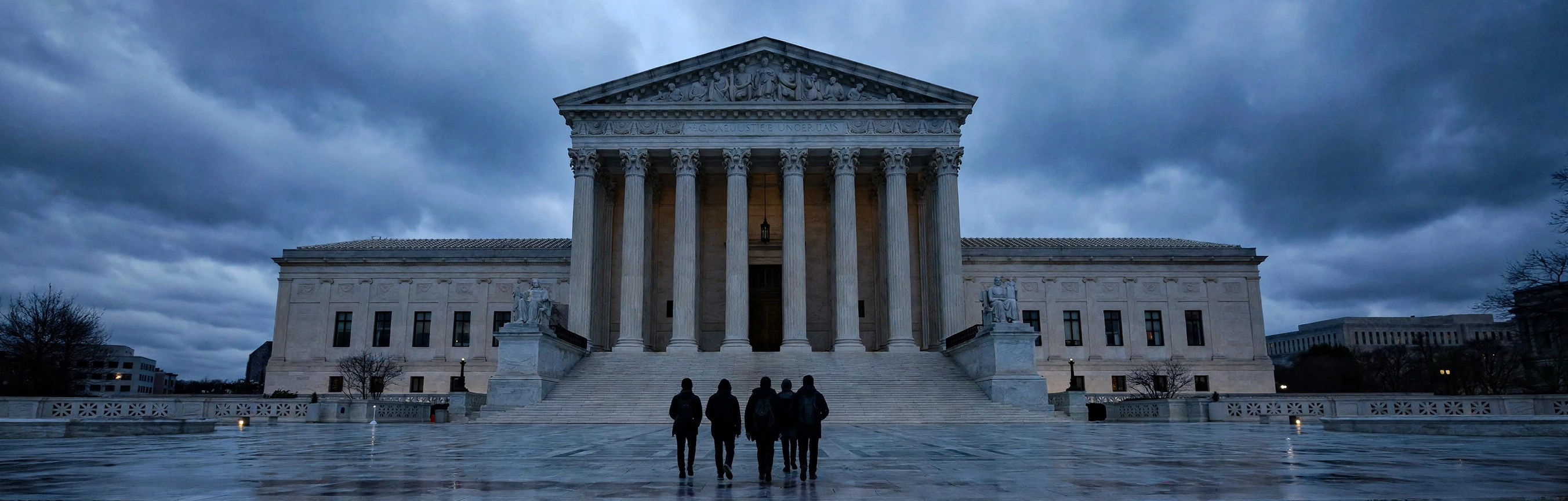
The Supreme Court Trump asylum restrictions case reached the justices on 13 November 2026, when the court agreed to decide whether President Donald Trump's order cutting off asylum at the southern border is lawful. Trump signed the order, Proclamation 10888, within hours of starting his second term on 20 January 2025, and it has barred people who cross the border outside official ports of entry from applying for asylum ever since. The court's decision to hear the case settles nothing yet. It sets up oral arguments expected in spring 2027 and a ruling expected by the end of June 2027 that will fix the limits of a president's power to close off asylum by proclamation.
What Are the Supreme Court Trump Asylum Restrictions?
The Supreme Court Trump asylum restrictions at issue in the case come from a single document. Proclamation 10888 is titled "Guaranteeing the States Protection Against Invasion". It relies on Sections 212(f) and 215(a) of the Immigration and Nationality Act, which give the president power to suspend the entry of groups of noncitizens when their entry would harm United States interests. Trump described crossings at the southern border as an "invasion" and used that finding to suspend the entry of people crossing between official ports of entry. The guidance from the Department of Homeland Security that put the proclamation into effect went further: it barred those people from invoking asylum and other legal protections that could let them stay, and it set up fast-track removal without the usual chance to make a claim. The proclamation states that the restrictions stay in place until the president determines that the "invasion at the southern border" has ended.
That design, at the heart of the Supreme Court Trump asylum restrictions dispute, runs against the text of federal asylum law. Section 208 of the Immigration and Nationality Act, at 8 U.S.C. 1158, allows any person who is physically present in the United States or who arrives at a port of entry to apply for asylum, whatever their immigration status. The administration's answer, put to the Supreme Court by Solicitor General D. John Sauer, is that the power to suspend entry includes the power to shut off the protections that depend on entry. The administration has called the policy the "most important and effective" part of its drive to secure the southern border, a description reported by USA Today. The challengers, led by the American Civil Liberties Union and the Refugee and Immigrant Center for Education and Legal Services (RAICES), argue that Congress wrote the right to seek asylum into law and that a proclamation cannot erase it.
How the Supreme Court Trump Asylum Restrictions Case Reached the Justices
The Supreme Court Trump asylum restrictions case began soon after the proclamation, when the lawsuit was filed. The ACLU, RAICES, the National Immigrant Justice Center, the Center for Gender and Refugee Studies, the Texas Civil Rights Project and two other legal groups sued on behalf of a nationwide group of people barred from seeking protection under the order, along with three immigrant legal service providers. On 2 July 2025, US District Judge Randolph Moss in Washington, D.C., ruled for the challengers and set aside the restrictions in large part, entering relief that covered the whole affected group rather than only the named plaintiffs. A separate October 2026 ruling blocking an asylum policy affecting children shows the same courts have been asked to judge more than one part of the administration's asylum policy; read it here: judge blocks Trump asylum policy for children.
The administration appealed, and on 24 April 2026 a divided three-judge panel of the US Court of Appeals for the District of Columbia Circuit upheld Judge Moss. The panel, made up of Judges Cornelia Pillard, Justin Walker and J. Michelle Childs, found that the proclamation and the related guidance exceeded presidential authority. The full court refused a rehearing on 23 July 2026 and held its mandate while the government asked the Supreme Court to step in. A partial stay has been in place since August 2025, which is why the restrictions have stayed in force through the whole appeal even though two courts have ruled against them. The Supreme Court Trump asylum restrictions petition was filed on 24 August 2026, and the justices took the case up at their conference on 13 November 2026.
The Two Questions the Justices Agreed to Answer
The court granted review "limited to Questions 1 and 2 presented by the petition". The case is listed as No. 26-239, Mullin v. Refugee and Immigrant Center for Education and Legal Services. The first question asks whether Proclamation 10888 and the guidance carrying it out are lawful. The second asks whether 8 U.S.C. 1252(f)(1), a provision of federal immigration law, bars the classwide relief Judge Moss ordered. The government had asked a third question, whether the definition of the affected group met the requirements of Article III of the Constitution and Rule 23 of the Federal Rules of Civil Procedure. The justices did not take that question up, and the order gave no reasons, so nothing should be read into the omission.
The Supreme Court Trump asylum restrictions ruling on this second question could reach well beyond this one policy. If the court reads 1252(f)(1) as a ban on classwide relief in immigration cases, future challenges to enforcement policies would have to be brought person by person, which would slow them down and make broad court orders far harder to obtain. If the court reads the provision narrowly, the classwide order in this case stays live as a question for the ruling on the merits. That is why lawyers on both sides treat the Supreme Court Trump asylum restrictions case as a test of courtroom procedure as much as a test of border policy.
What the Supreme Court Trump Asylum Restrictions Ruling Could Change
If the administration wins, the proclamation stands, and the ruling would confirm a broad presidential power to suspend entry and cut off asylum for people who cross outside ports of entry. That would shape how future presidents use Section 212(f) in border emergencies. If the challengers win the Supreme Court Trump asylum restrictions case, the restrictions fall and people covered by the proclamation regain the chance to apply for asylum, though the ruling could be written narrowly, for example turning only on the classwide relief question, which would leave parts of the fight open. The court has also been asked to rule on the border wall in a separate November 2026 case: Supreme Court border wall ruling.
Either way, the Supreme Court Trump asylum restrictions dispute is one of three major immigration cases the court will hear this term. USA Today reported that the justices will also decide whether the administration can detain millions of immigrants without a chance to seek bond, and whether it can deport immigrants to countries other than their own without letting them argue they could face persecution or torture there. A 2026 deportation case that ended with a man sent to the wrong country shows how high the stakes run in practice: Moussa Diawara deportation case.
Nothing changes at the border while the Supreme Court Trump asylum restrictions case is pending. The partial stay from August 2025 remains in force, so the asylum bar for covered border crossers continues. Reuters noted that the court, which has a 6-3 conservative majority, has been largely deferential to Trump in his second term in challenges to his immigration policies, but a grant of review is not a ruling and the justices have not signalled how they will vote.
Five Key Questions About the Case, Answered
Readers following the Supreme Court Trump asylum restrictions case tend to ask the same five questions, and the answers are all in the record so far.
- Does the Supreme Court's decision change anything now? No. The grant of review only opens the case. The restrictions remain in force under the partial stay from August 2025, and no asylum seeker gains or loses a right because the court agreed to hear the appeal.
- When will the court hear arguments? No date has been set yet. The ACLU, which represents the challengers, expects argument in spring 2027, and Reuters reported that arguments are expected in the coming months.
- When will the ruling come? A decision is expected by the end of June 2027, when the court's term ends. That timetable comes from Reuters reporting on the grant.
- What happens to people crossing the border meanwhile? People covered by the proclamation remain barred from applying for asylum while the case is pending, because the partial stay keeps the policy in effect.
- What other immigration cases is the court hearing this term? The justices will also rule on detention without bond and on deportations to third countries, according to USA Today, so the asylum case is part of a wider set of rulings on the administration's immigration programme.
What Happens Next
The briefing schedule has not been set yet. Once the government and the challengers file their written arguments, the court will set a date for oral argument, which the ACLU expects in spring 2027. A decision is expected by the end of June 2027. Until then, the Supreme Court Trump asylum restrictions stay in force, the lower court rulings stand as the last word on the merits, and the argument over presidential power at the border waits for the nine justices to settle it. The Supreme Court Trump asylum restrictions ruling, when it lands, will answer a question Congress left open for decades: whether a president's power to keep people out also lets him take away their right to ask for protection once they are here.