
The Supreme Court Big Bend border wall dispute reached a turning point on Monday 9 November 2026, when the justices allowed the Trump administration to restart construction of barriers and roads across the Big Bend region of West Texas while a legal challenge to the project continues. In an unsigned opinion in Mullin v. Friends of the Ruidosa Church, the court lifted a federal judge's order that had stopped the work in October, handing the administration a practical win without deciding whether the underlying waivers were lawful. The case turns on how far a 1996 immigration law lets the homeland security secretary set aside other federal laws to build border barriers quickly, a question that reaches well beyond one stretch of desert. For the park, the river communities and the landowners along the Rio Grande, the order means work can return before the courts have finished answering that question.
What the Supreme Court Big Bend border wall order actually decided
The order, in case No. 26A560, stayed a preliminary injunction issued on 2 October by US District Judge Kathleen Cardone of the Western District of Texas in El Paso. Cardone had barred the Department of Homeland Security from continuing construction until it complied with environmental and other applicable laws. That Supreme Court Big Bend border wall order lifts the bar while the case moves forward. Justice Ketanji Brown Jackson was the only justice noted as wanting to deny the government's request, making the effective split 8-1, according to the Wall Street Journal and USA Today. The court turned down a separate administration request to summarily reverse Cardone's ruling outright, SCOTUSblog reported, so the lower court's reasoning has not been overturned. It has only been put on hold. The stay remains in place while the government asks the Supreme Court to take up the case in full, and if the justices decline to hear it, the stay ends automatically. At the centre of the court's reasoning was a 1996 statute, Section 102 of the Illegal Immigration Reform and Immigrant Responsibility Act, which lets the homeland security secretary waive laws that stand in the way of barrier construction and limits court challenges to claims that a waiver violates the Constitution. Cardone had ruled that the waivers lacked clear congressional authorisation and breached the major-questions doctrine, the principle that agencies need clear direction from Congress for decisions of vast significance. The justices said the government was exceedingly likely to show that this framing was wrong: the major-questions doctrine is a tool for reading statutes, not a constitutional claim in itself, so it cannot open the door that Section 102 keeps shut. The court also weighed the balance of harms in the Supreme Court Big Bend border wall case, writing that Congress has expressed a "clear preference for expeditious border construction" that outweighs "any aesthetic, recreational, and environmental harm" the challengers face. It cited a Customs and Border Protection declaration that the injunction was costing the government nearly half a million dollars a day, money it said could not be recovered.
The waivers and the lawsuit behind the Supreme Court Big Bend border wall case
The Supreme Court Big Bend border wall dispute began with three waivers issued between February and July 2026, one by former Homeland Security Secretary Kristi Noem and two by her successor, Secretary Markwayne Mullin. Under Section 102 of the 1996 law, the waivers set aside a range of environmental and conservation laws to speed up construction of barriers and patrol roads across what Customs and Border Protection calls the Big Bend Sector. The sector covers 517 miles of Rio Grande riverfront, almost a quarter of the entire southwest border, and the administration said most of the planned construction, spanning more than 300 miles, would take place on privately owned land. The lawsuit was brought by the Center for Biological Diversity, a Big Bend-area river guide and landowner, and Friends of the Ruidosa Church, a group working to preserve a historic adobe church in Ruidosa, Texas, that the challengers say is threatened by the construction. Reuters reported that the group argues the fragile adobe structure could be damaged by heavy building work nearby. The challengers said the waivers were issued without the clear congressional authorisation the law requires, because the statute permits fast-track construction only in areas of high illegal entry. Judge Cardone agreed in part, finding that the Big Bend sector has the lowest number of apprehensions of any southwest border sector, according to USA Today, and that a temporary halt was needed because construction could cause permanent loss of protected wilderness that benefits tourism, recreation, farming, ranching and education. Work had already started near Santa Elena Canyon on 6 August, the Center for Biological Diversity said, before the administration paused construction on 17 August after the project drew bipartisan criticism over its effect on the park's landscape and wildlife. Cardone's injunction followed on 2 October. The administration then asked the Supreme Court to intervene on an emergency basis in the Supreme Court Big Bend border wall case, and the justices acted on 9 November. The episode sits in a wider pattern of border enforcement disputes: the administration has made barrier construction a central part of its immigration policy, and its deportation policy has already become a political flashpoint after the midterm losses.
Why the Supreme Court Big Bend border wall case is not over yet
A stay is not a ruling on the merits, and the Supreme Court Big Bend border wall order does not say the waivers are lawful. The underlying lawsuit stays alive, and the challengers can still press their claims in the district court on a full record, a point the Center for Biological Diversity made in its statement after the ruling. The government's next step is to file a petition asking the Supreme Court to hear the case in full. If the court grants that petition, the stay ends when the court issues its judgment. If it declines, the stay ends automatically and Cardone's injunction would return to force, unless the lower courts have ruled by then. A second front has also opened. On 14 September, six landowners and a group called Conserve Big Bend, which says it represents about 230 more landowners, filed a separate suit in Washington, D.C., arguing that the waivers were improperly issued and that owners' Fifth Amendment due process rights are being violated. That case is distinct from the Ruidosa Church suit and could produce its own rulings on the waivers. For now, though, the practical effect is clear: the administration can build while both cases proceed. The legal question the justices flagged in the Supreme Court Big Bend border wall case, whether a challenge framed around the major-questions doctrine counts as a constitutional claim under Section 102, will matter for future waiver cases as well. Courts hearing similar challenges will read the unsigned opinion closely, since it signals that the current court reads the 1996 law's limit on judicial review narrowly. The same kind of procedural question has shaped other recent court fights, including the Chagos islanders' High Court challenge to a territory transfer, where who can bring a claim mattered as much as the claim itself.
What the ruling means for Big Bend National Park
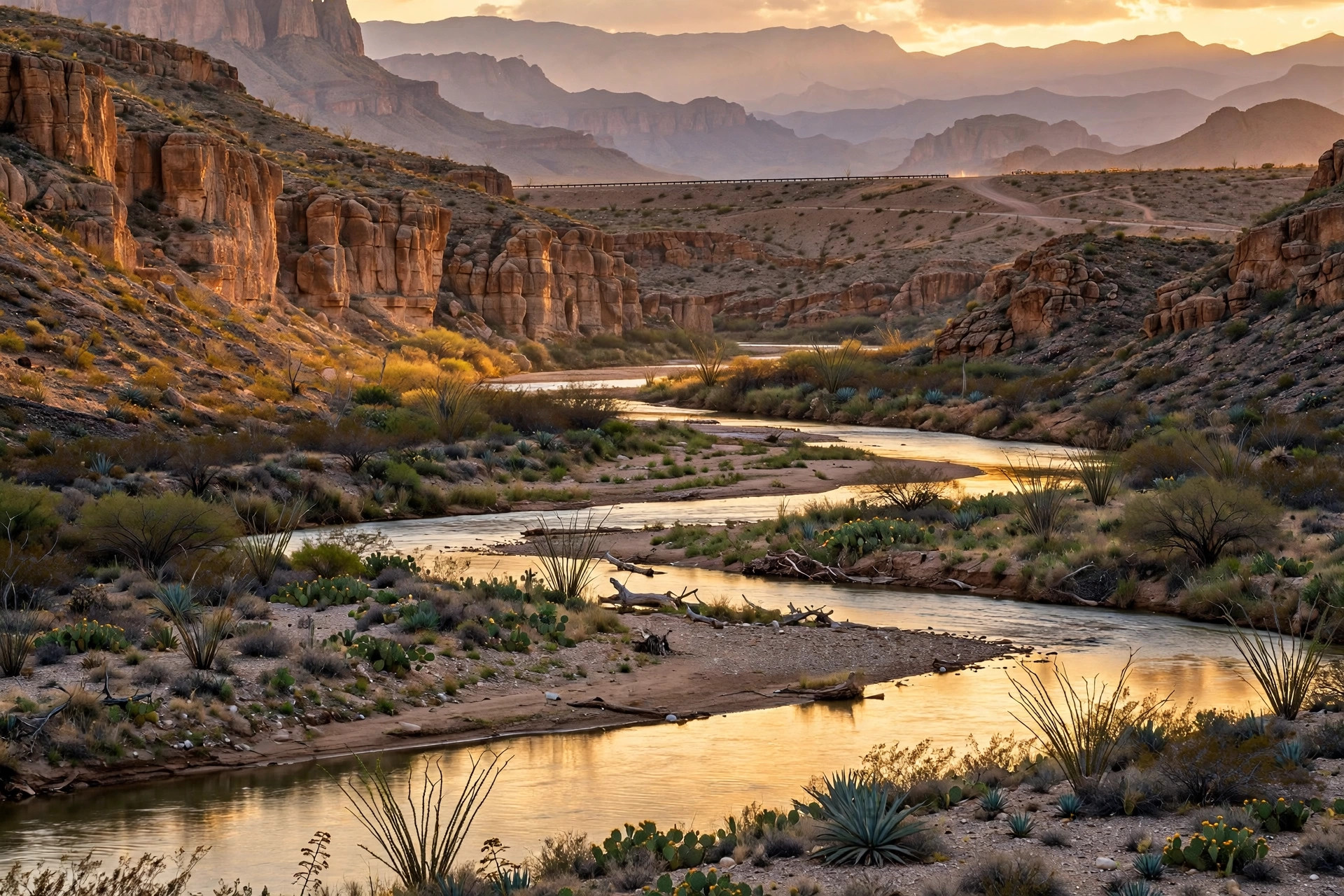
Big Bend National Park sits at the heart of the Supreme Court Big Bend border wall argument, even though the administration says most construction will happen outside it. Reuters reported that the park would receive a 17-mile noncontiguous vehicle barrier system, rather than the 30-foot pedestrian barrier planned for other areas. Vehicle barriers are lower structures designed to stop cars and trucks while allowing wildlife to pass more easily, but conservation groups say roads, cameras, sensors and patrol traffic still change a landscape that has remained largely undeveloped. The park covers desert, canyons and part of the Rio Grande, and its remoteness is part of its draw for visitors. The challengers argued that the environmental harm is not only about the walls themselves but about the access roads and staging areas that come with them, and Judge Cardone accepted that construction could permanently alter protected wilderness. The administration's position, which the Supreme Court accepted for now, is that Congress wanted barrier building to move fast and that the security need along the border outweighs those harms. The balance the court struck in the Supreme Court Big Bend border wall case will be tested on the ground: if construction resumes quickly, some of the changes the challengers warned about may be hard to undo even if they later win in court. That irreversibility argument was central to Cardone's decision to halt the work in the first place. Environmental questions of this kind are also on the agenda at COP31 in Antalya, where governments are debating how far development and conservation can be reconciled.
What happens next
Construction crews can now return to the Big Bend sector under the Supreme Court Big Bend border wall order, and the pace of that work will be the first visible sign of what the ruling changes. The government must file its petition for full Supreme Court review, and the justices' decision on whether to take the case will determine whether the stay hardens into a longer pause on the injunction. The district court case continues in the meantime, and the separate Washington, D.C., landowner suit may add new rulings on the waivers. Watch for three things: the date of the government's petition and the court's response, any new construction activity near Santa Elena Canyon and inside the park boundary, and statements from the Center for Biological Diversity and Friends of the Ruidosa Church about their next legal steps. The case is a reminder that emergency orders at the Supreme Court often decide what happens on the ground long before the underlying legal question is settled. For the communities along the Rio Grande, the Supreme Court Big Bend border wall order means barriers and roads may be built while judges are still deciding whether the waivers that authorised them were lawful at all.