
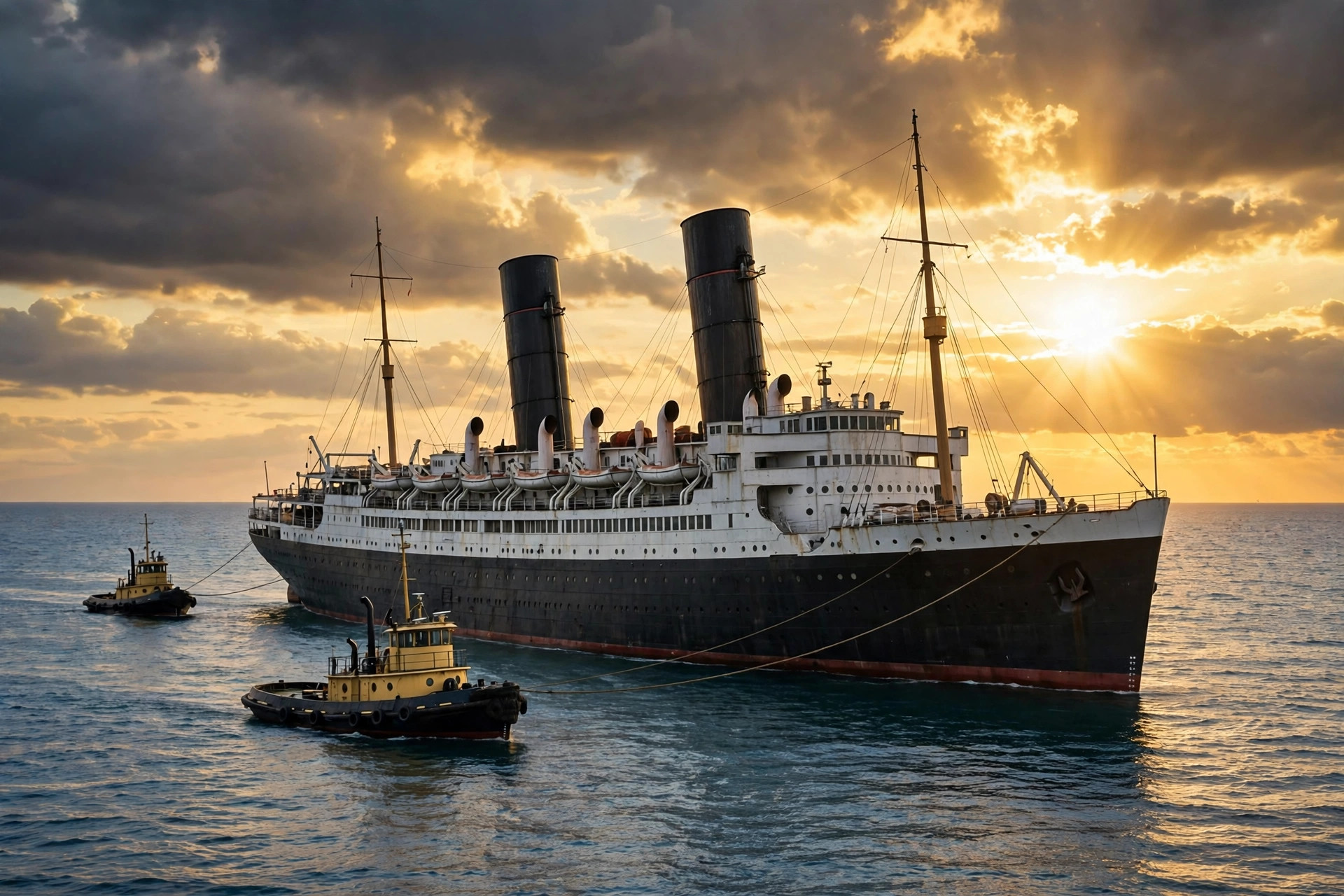
The SS United States sank off Florida on Wednesday 11 November 2026, giving the retired ocean liner a second life on the floor of the Gulf of Mexico. Okaloosa County, Florida, scuttled the 990-foot ship about 22 nautical miles southwest of Destin, where it settled on the seabed 180 feet down and became the world's largest artificial reef. Crews began flooding the ship at about 2:40 p.m. ET; it was fully flooded and had started to sink by 5:47 p.m., and it settled on the seabed at 9:59 p.m. ET, according to USA Today. The date had been moved up by a day from 12 November after forecasters warned of heavy winds. For a ship that once carried presidents and royalty across the Atlantic at record speed, the sinking is the end of one career and the start of another — as a home for marine life and a destination for divers.
SS United States artificial reef sinking: how it happened on 11 November
Tugboats began moving the ship away from its berth in Mobile, Alabama, on the morning of 9 November, and the vessel left Mobile at about 9 a.m. that day, according to USA Today. The tow to the deployment site, roughly 22 nautical miles southwest of Destin and 32 nautical miles southeast of Pensacola, took the ship to a patch of Gulf water where the seabed lies 180 feet below the surface. Once the ship was in position, valves were opened to let seawater in, and the liner settled on the seabed with its upper decks about 60 feet below the surface — shallow enough for recreational divers to reach. The precise resting place is recorded as 30° 07.148′ N, 86° 46.755′ W, according to the Delaware Online report. The plan was for the ship to settle upright, and officials will confirm its final orientation after surveying the wreck.
The timetable changed at the last minute. Okaloosa County had planned to sink the vessel on Thursday 12 November, but forecast heavy winds and unsafe weather forced the operation forward by a day to Wednesday 11 November, Veterans Day. Crews began flooding the ship at about 2:40 p.m. ET (1:40 p.m. CST), and the sendoff ceremony planned for 1:30 p.m. had been cancelled, the county said in a news release reported by USA Today. The move to Veterans Day was not lost on the ship's admirers: the United States was built with US Navy support and was considered a military asset as well as a luxury liner, according to the Naval Historical Foundation, cited by CNN — and its final voyage fell on the day America honours its veterans.
From speed record to scrap threat: a short history
The SS United States was delivered in 1952 after construction began in 1950, and its cost of more than $70 million was divided among the Transportation Department's Maritime Administration, the US Navy and the commercial United States Lines, according to the Naval Historical Foundation, cited by CNN. At 990 feet she was 100 feet longer than the RMS Titanic, and on her maiden voyage in 1952 she crossed the Atlantic from New York to Europe in just under three days and 11 hours at about 42 mph — a speed record that still stands. Her top speed on sea trials reached 44 mph, and her average of 35.59 knots on the maiden crossing made her the fastest ocean liner in the world. She was listed on the National Register of Historic Places in 1999.
Her working life was short. She was retired from service in 1969, after less than two decades carrying passengers, and spent nearly three decades laid up in Philadelphia. There she rusted quietly while preservationists argued over her future, her black-and-red paint fading in the sun. In 2024, facing eviction from the Philadelphia shipyard where she had been tied up for 30 years, her owners faced a choice: sell her for scrap or sell her to become a reef. Okaloosa County, Florida, stepped in with a $1 million bid to buy her, according to the county's website cited by CNN. On 19 February 2025 she left the Delaware River under tow, and after an 1,800-mile journey she arrived in Mobile, Alabama, on 3 March, where the long work of preparing her for the seabed began.
How do you sink a 990-foot liner on purpose?
Sinking a ship this size takes more than opening the seacocks. Workers in Mobile spent months on remediation — stripping out hazardous materials that could harm the marine environment — before regulators would allow the sinking to go ahead. Engineers from Coleen Marine, a Mobile-based maritime company that has turned ships into artificial reefs on the Gulf and Atlantic coasts, worked with about 30 contractors on specific tasks, Alex Fogg, Okaloosa County's chief of natural resources, told USA Today. With remediation complete, officials inspected the ship to check that environmental standards had been met, and Okaloosa County obtained approvals from the US Army Corps of Engineers and the Environmental Protection Agency.
The SS United States artificial reef sinking will be controlled rather than violent. CNN reports that a series of valves will be opened in the hull to let seawater in, while other reports describe controlled explosions opening holes so water and air can move through the structure as she descends. Remarkably, the hull retains about 90% of its original structural integrity, according to the SS United States Conservancy, which is one reason officials expect her to land on the seabed upright, with her keel down and her decks level — the ideal position for a dive site. Preparing the ship cost about $13 million on top of the $1 million purchase price, according to CBS News. The ocean itself is changing around wrecks like this one: October 2026 was the warmest October on record, and warmer seas shape which species colonise a new reef first.
SS United States artificial reef sinking: what divers and marine life can expect
Once she is down, the United States is set to become the world's largest artificial reef and the 21st and largest vessel on the Florida Panhandle Shipwreck Trail, a roughly 150-mile chain of wrecks from Pensacola to Port St. Joe. The trail, with shipwrecks dating back to 1942, was established in 2012 to boost tourism after the 2010 Deepwater Horizon oil spill, and it has become a haven for marine life and recreational divers, CNN reports. At 180 feet down, with upper decks about 60 feet from the surface, the wreck will suit experienced divers, while fish, coral and other marine life are expected to colonise the steel over the coming months and years.
The project was funded through tourism revenues and contributions from project partners, according to gCaptain, and the county's bet is that a world-record reef will repay that spending many times over in dive tourism. A museum is also planned, featuring the ship's two massive funnels and other fixtures, which were removed before the tow so they can be displayed on land. The funnels are the most recognisable part of the ship's silhouette, and keeping them ashore means visitors who never dive will still be able to stand beside a piece of her. Climate talks may shape the seas these reefs sit in: COP31 opened in Antalya in November 2026 with the ocean and warming high on the agenda. And the Gulf coast knows how quickly weather can close a dive window, as Storm Bruna's disruption across the Atlantic showed this month.
The legal challenge that failed
Not everyone wanted the sinking to go ahead. The SS United States Preservation Foundation sued the US Army Corps of Engineers and Okaloosa County, arguing that environmental and historic preservation reviews had been inadequate and raising concerns about hexavalent chromium in some of the ship's coatings, which the group said could contaminate marine organisms, ocean sediment and the Gulf food chain. On 7 November, a federal judge in Florida denied the foundation's request for an emergency restraining order to halt the sinking, and 6abc reported that the latest legal challenge had been dismissed. Okaloosa County has said the project remains on schedule, and the county's position is that remediation and regulatory approvals have dealt with the environmental concerns. The foundation's defeat cleared the last legal obstacle to the SS United States artificial reef sinking before the tow from Mobile began on 9 November.
What happens next
With the SS United States on the seabed, Okaloosa County will survey the wreck, checking that it sits upright and stable at 180 feet — the final orientation is yet to be confirmed. The ship is then expected to open as a dive attraction, with access details published on the project's official site, thessus.com. Marine biologists will watch the colonisation closely: a steel structure this large is effectively a new neighbourhood on a sandy seabed, and the species that arrive first will shape the reef for years. Researchers from the Woods Hole Oceanographic Institution will study how marine life colonises the wreck. And on land, the planned museum will carry the other half of the story — the record-breaking liner, the presidents and royalty she carried, and the 74 years between her launch and her sinking. The sinking is a farewell, but it is also a deliberate act of preservation: the ship survives by becoming something else.