
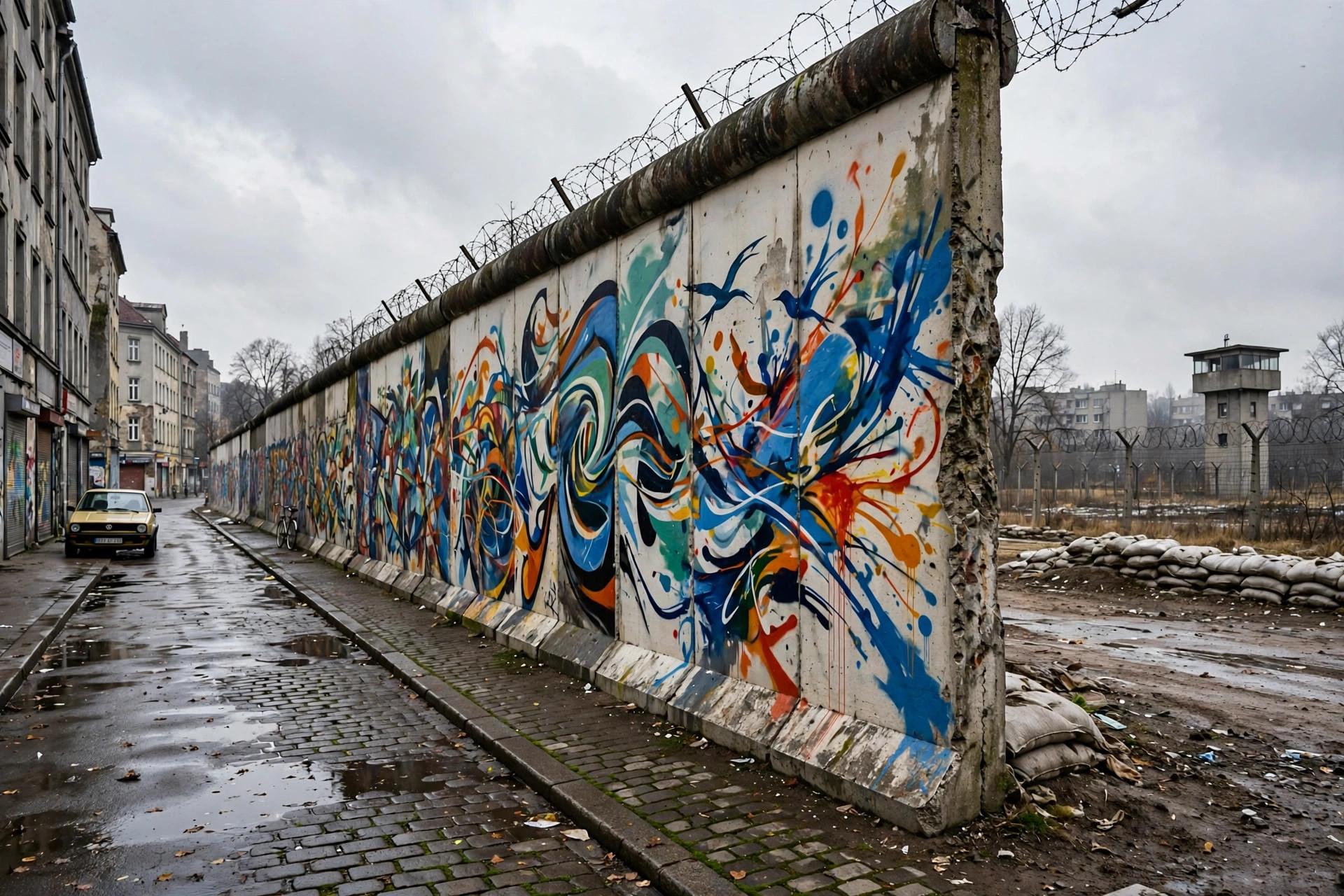
On the night of November 9, 1989, thousands of East Germans streamed through checkpoints in the Berlin Wall, climbing on top of it, hugging strangers, and weeping with joy. Within a year, Germany was reunified and the Cold War was effectively over. But the wall that fell that night had stood for 28 years as the most potent symbol of a divided world. To understand why it was built — and why it fell — you have to start with the ruins of World War II.
A Country Split in Two
When Nazi Germany surrendered in 1945, the victorious Allies divided the country into four occupation zones: American, British, French, and Soviet. The capital, Berlin, sat deep inside the Soviet zone but was itself divided into four sectors. This arrangement was supposed to be temporary. It was not.
As relations between the Soviet Union and the Western Allies deteriorated into the Cold War, the zones hardened into two separate states. In 1949, the three western zones merged to form the Federal Republic of Germany (West Germany), a capitalist democracy aligned with the United States. The Soviet zone became the German Democratic Republic (East Germany), a communist state aligned with Moscow. Berlin remained divided: West Berlin became a democratic enclave entirely surrounded by East German territory, while East Berlin became the East German capital.
The Great Escape: Why East Germans Fled West
Life in East Germany was difficult. The communist government controlled the economy, restricted free speech, and maintained an extensive secret police, the Stasi, which spied on ordinary citizens. Consumer goods were scarce, wages were low, and political dissent was punished.
West Germany, meanwhile, was experiencing an economic miracle. Jobs were plentiful and living standards rose rapidly. For East Germans, the contrast was visible every day — especially in Berlin, where the border between East and West was still relatively open. Between 1949 and 1961, an estimated 2.7 million East Germans fled to the West, most of them through Berlin. They were disproportionately young, skilled, and educated: doctors, engineers, teachers. East Germany was bleeding the very people it needed most.
For the East German leadership, this was an existential crisis. As Walter Ulbricht, the country's leader, reportedly put it, the exodus threatened the state's survival. Something had to be done to stop it.
August 13, 1961: The Wall Goes Up
In the early hours of Sunday, August 13, 1961, East German soldiers and workers began tearing up streets, stringing barbed wire, and blocking the border crossings between East and West Berlin. Berliners woke to find their city physically divided. Families, friends, and coworkers were suddenly cut off from one another.
The East German government called it the Antifaschistischer Schutzwall — the Anti-Fascist Protection Rampart — claiming it would protect East Germans from Western aggression. Nobody believed this. Its real purpose was obvious: to stop East Germans from leaving.
Over the following years, the makeshift barrier was replaced by a sophisticated fortification: two concrete walls with a heavily guarded strip between them — the Todesstreifen, or death strip — complete with watchtowers, floodlights, guard dogs, trip wires, and orders to shoot anyone attempting to cross. The full border system eventually stretched 96 miles around West Berlin. Explore more turning points of the modern era in our History category.
Life in the Shadow of the Wall
The wall became the defining fact of life in Berlin. In the West, it was a grim reminder of communist oppression, and West Berliners built viewing platforms so visitors could peer over it. In the East, it was a constant warning: the state would use lethal force to keep its own citizens in.
Despite the danger, thousands attempted to escape. Some dug tunnels — at least 70 tunnels were built under the wall. Others hid in car trunks, swam canals, flew homemade hot-air balloons, or simply sprinted across under gunfire. At least 140 people died at the Berlin Wall, shot by guards or killed by mines and traps. Each death was a reminder of what the wall really was.
The wall also became a canvas. On the western side, artists covered it in colorful graffiti and murals — an explosion of free expression facing a gray symbol of repression. The eastern side remained blank, freshly whitewashed, a fitting metaphor.
Cracks in the Concrete: The 1980s
By the 1980s, the pressures that would bring down the wall were building. The Soviet Union's new leader, Mikhail Gorbachev, introduced reforms — glasnost (openness) and perestroika (restructuring) — and signaled that Moscow would no longer use military force to prop up Eastern European communist regimes. This removed the fear that had kept dissent in check.
Across Eastern Europe, protest movements gained strength: Solidarity in Poland, reformers in Hungary. In the summer of 1989, Hungary opened its border with Austria, and thousands of East Germans vacationing in Hungary poured through to the West. Protests in East German cities, especially the Monday demonstrations in Leipzig, grew from hundreds to hundreds of thousands. The regime was losing control.
Meanwhile, President Ronald Reagan's famous 1987 speech at the Brandenburg Gate — Mr. Gorbachev, tear down this wall! — had crystallized Western opposition to the division of Germany. The wall that had once seemed permanent was beginning to look like a relic.
November 9, 1989: The Night the Wall Fell
The end came through a bureaucratic blunder. On the evening of November 9, 1989, an East German spokesman, Günter Schabowski, announced new travel regulations at a press conference. Flustered by a reporter's question about when the rules took effect, he improvised: immediately, without delay. In fact, the rules were not meant to take effect that night, and they did not fully open the border — but that is how it was reported.
East Berliners heard the news on television and rushed to the border crossings. Confused and outnumbered, the border guards had received no clear orders. As crowds swelled into the thousands, the guards at the Bornholmer Strasse crossing finally opened the gates. People flooded through, cheering, crying, and climbing onto the wall itself. West Berliners rushed to greet them with champagne and flowers. It was one of the most joyful nights of the 20th century.
The fall was not planned by any government — it was forced by ordinary people who simply stopped obeying. For another story of how great powers collapse from within, read how the Roman Empire fell.
Aftermath: Reunification and Legacy
The wall's fall set off a chain reaction. Within weeks, the East German government collapsed. On October 3, 1990, East and West Germany were formally reunified. The Cold War, which had defined global politics for 45 years, was effectively over; the Soviet Union itself dissolved in 1991.
Reunification was not easy. The East's economy was far weaker than the West's, and integrating the two societies took decades and trillions of dollars. Even today, economic and cultural differences between eastern and western Germany persist.
The Berlin Wall's legacy endures as a warning about what happens when states treat their own citizens as prisoners — and as proof that walls built to contain people ultimately fail. Sections of the wall remain as memorials, including the East Side Gallery, a 0.8-mile stretch covered in murals. Every November 9, Berliners remember the night their city became whole again.