
More than 400 people, most of them children under the age of four, have fallen ill with gastrointestinal sickness east of Pretoria, South Africa, after the City of Tshwane supplied unchlorinated tap water for three weeks without warning residents. Trending per news coverage by the BBC, Business Day and several South African outlets, the crisis has triggered a high-level government response — and a rare public admission of negligence from the city's mayor.
Here is what we know about the outbreak, how the water became contaminated, what officials are doing about it, and why this is only the latest chapter in South Africa's long-running water-infrastructure crisis.
What happened: 408 cases, mostly toddlers
Between 7 and 18 October 2026, health facilities in Tshwane's Region 7 — the communities of Zithobeni, Bronkhorstspruit, Dark City, Rethabiseng and Sokhulumi — recorded 408 cases of acute gastrointestinal illness. Patients arrived at hospitals and local clinics with stomach cramps, vomiting and diarrhoea, and most were children younger than four. The daily peak came on 13 October, when 72 new cases were reported in a single day, overwhelming local clinics and Bronkhorstspruit Hospital in north-eastern Gauteng.
As of the government's 19 October update, no deaths had been reported. But officials have stopped short of formally declaring an outbreak, saying further laboratory testing is needed to confirm whether other harmful contaminants are present in the water. Water and Sanitation Minister Pemmy Majodina told a high-level media briefing in Pretoria late on Monday that mixed pathogens in the samples and the rapid spread pointed to a common water supply as the likely source of the illness.
How the water became contaminated
The investigation points to a single, avoidable failure: the Bronkhorstspruit Water Treatment Works ran out of chlorine. According to Tshwane's executive mayor, Dr Nasiphi Moya, the city's chlorine supplier quadrupled its prices; negotiations collapsed and the plant was left without disinfectant from 24 September to 14 October 2026 — roughly three weeks. Crucially, officials failed to warn either residents or the city's own leadership that the water was going untreated.
The untreated water was especially dangerous because of where it comes from. The treatment works draws raw water from the Bronkhorstspruit River, which is heavily polluted by sewage from a failing municipal wastewater works and broken Tshwane sewage pump stations. Without chlorination, faecally contaminated source water flowed straight into the distribution network.
Water quality tests conducted by the Department of Water and Sanitation on 14 October found extremely high levels of E. coli and total coliforms — bacteria that signal faecal contamination — in water from the treatment works and in reservoirs near Dark City and Zithobeni. Stool samples analysed by the National Institute for Communicable Diseases contained norovirus, campylobacter and shigella, all of which cause severe diarrhoea. No cholera bacteria was found in the samples, officials said.
The government's response: negligence admitted
The scale of the crisis forced a show of official urgency. The Monday briefing in Pretoria was attended by Gauteng Premier Panyaza Lesufi, Health Minister Aaron Motsoaledi, Water and Sanitation Minister Majodina and her deputies, and Mayor Moya herself — an unusually senior turnout that underlined how seriously the crisis is being taken. Public-health specialists note that rapid, coordinated responses are what separate contained incidents from wider epidemics — a lesson reinforced by outbreaks elsewhere in Africa, including the imported Ebola case in Kenya and the ongoing Ebola outbreak in Congo.
Moya publicly admitted municipal negligence — a striking concession in South African politics. She said the city became aware of rising diarrhoea cases around 7 October, that officials had failed to tell city leadership about the chlorine shortage, and that disciplinary action could follow. Earlier this month, residents had already been complaining to the investigative outlet GroundUp about discoloured tap water and suspected illness; one Zithobeni mother said she and her one-year-old had no choice but to drink the discoloured water, which left them both with diarrhoea and stomach pains.
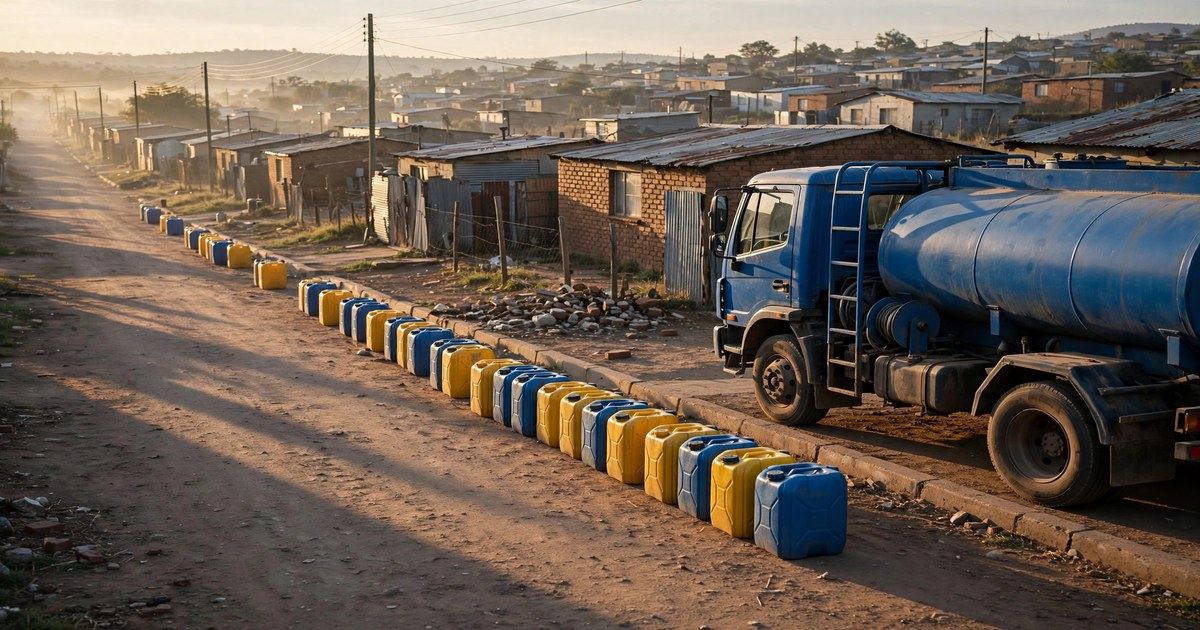
To ease the emergency, the municipality deployed a fleet of 36 water tankers carrying safe drinking water sourced from the Cullinan Water Treatment Works, and rapid response teams were dispatched to treat patients at hospitals and clinics.
What residents have been told to do
Authorities have declared the municipal supply unfit for human consumption and warned residents not to use tap water at all — not for drinking or cooking, and not even for bathing, brushing teeth or washing food — until further notice. The water may currently be used only for flushing toilets. Officials advised residents to discard previously stored water and to disinfect containers with household bleach, and warned that even boiling is not enough of a safeguard given the contamination.
Background: a recurring crisis, not a one-off
This is not the first time Tshwane's water has made people sick. In 2023, a cholera outbreak in Hammanskraal, a township just outside Pretoria, killed 29 people and was linked to substandard water purification practices. In 2025, officials confirmed 48 typhoid cases in the same eastern region now affected, and the source of that outbreak was never clearly identified. Water-infrastructure failures are a global pattern, not just a South African one — from contamination scandals to flood damage overwhelming treatment systems, as seen in the recent record flooding in Istanbul.
Water and Sanitation Minister Majodina has previously said South Africa needs an estimated R400 billion to repair and upgrade water infrastructure across 107 municipalities facing critical water supply failures. The Bronkhorstspruit episode is a case study in what happens when that maintenance backlog meets municipal dysfunction: a pricing dispute with a single supplier, a failure to escalate the problem, and a failure to warn the public turned a manageable shortage into a public-health emergency affecting hundreds of small children.
Why this story matters
Safe drinking water is one of the most basic services a city provides, and its failure cascades fast — into clinics, childcare, household finances and public trust in local government. The Bronkhorstspruit crisis is trending per news coverage not only because of its scale, but because of the admission at its centre: the city knew, or should have known, and said nothing for three weeks. Whether the government's promise of disciplinary action turns into real accountability — and whether the long-promised infrastructure investment finally arrives — will determine whether this is a wake-up call or just the latest entry in a familiar South African pattern.
Sources: BBC; Business Day (South Africa); GroundUp via Swisher Post; Newsnote; Ubuntu Times; Salaamedia; ImNews Africa; joint statements by the South African departments of health and water and sanitation; City of Tshwane executive mayor Dr Nasiphi Moya; Water and Sanitation Minister Pemmy Majodina.
Aid agencies warn of a still larger crisis abroad, where the UN says 19 million Afghans face acute hunger this winter.
The pressures behind the Tshwane crisis are not South Africa's only flashpoint: in Durban, a foreign national was beaten to death by a mob during an anti-migrant march, in an attack that has sharpened the national debate over xenophobia.