
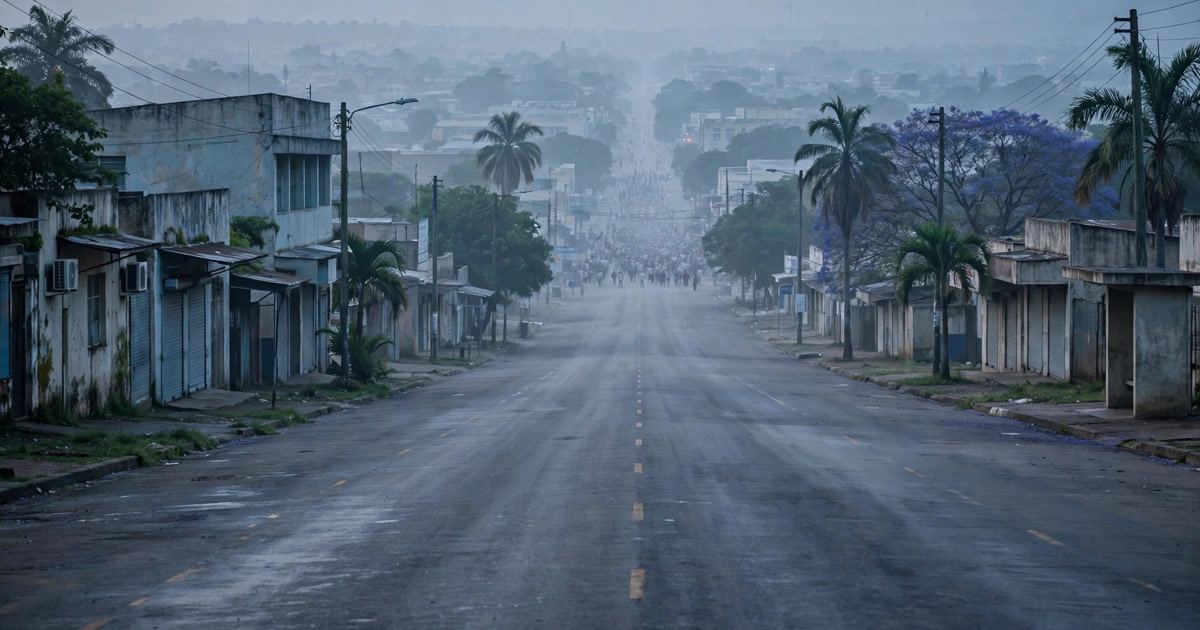
A foreign national was beaten to death by a crowd of about 50 people in the central business district of Durban on Thursday morning, in the deadliest escalation yet of South Africa's months-long wave of anti-migrant protests, according to Reuters reporting on 22 October 2026.
The South African Police Service (SAPS) said in a post on X that the victim, believed to be in his late 30s or early 40s, was attacked on Dr Pixley kaSeme Street while a group was marching towards Maud Mfusi Street in central Durban. He was declared dead at the scene. Police have opened a murder investigation and said they are following several leads, using all available investigative tools to identify the suspects.
KwaZulu-Natal police spokesperson Colonel Robert Netshiunda said two men broke away from the marching crowd and approached a man standing by the roadside, after which the crowd of roughly 50 people assaulted him. Police did not disclose the victim's nationality and said the motive for the killing remains unknown. Netshiunda cautioned the public against spreading unverified information while the investigation continues.
The killing came one day after the anti-illegal-immigration group March and March staged a motorcade through Durban, bringing e-hailing drivers, vehicle owners and supporters of the campaign onto the city's streets in a route that began at Berea Centre, an area where many foreign nationals live. Local reporting also described a separate assault on Wednesday afternoon on the sidelines of that protest; the condition of that victim remains unclear. On Wednesday night, March and March leader Jacinta Ngobese-Zuma told supporters the group was threatening a shutdown on 10 November over the government's handling of asylum applications.
Thursday's killing is the latest flashpoint in months of anti-migrant protests across South Africa that have drawn international criticism. Reuters notes that earlier this month, anti-migrant protests in Durban and Johannesburg's Soweto township turned violent, with foreign-owned businesses looted and vehicles set alight after demonstrations against the processing of asylum applications at a refugee reception centre. Thousands of migrants from elsewhere in Africa have fled affected communities in recent weeks, and the violence has pushed South Africa's strained relationship with its migrant population into the global headlines.
Durban has been a particular flashpoint. Two weeks ago, soldiers were deployed to central Durban after two days of rioting linked to the March and March anti-illegal-immigration movement. And Thursday's killing is not the first fatal attack during such protests in KwaZulu-Natal province this year: in June, a 29-year-old Malawian man was reportedly stoned to death after a group broke away from a march in Pietermaritzburg and entered the Jika Joe informal settlement.
The pattern echoes South Africa's long and painful history of xenophobic violence. The country has suffered repeated waves of attacks on foreign nationals, most notably in 2008 when more than 60 people were killed in coordinated attacks across the country, and again in 2015 and 2019. Successive governments have condemned the violence and promised action, but root causes — high unemployment, competition for informal-sector work and housing, and political rhetoric blaming migrants for crime and service failures — have never been resolved. Unemployment remains officially above 30 percent, and municipal services are buckling under pressure, as seen in South Africa's recent <LINK1>. Against that backdrop of scarcity and frustration, anti-migrant sentiment has once again become a potent political force, and organised groups like March and March have channelled it into recurring mass action.
The South African government has so far framed the unrest primarily as a policing and public-order problem, and it is unclear whether Thursday's killing will force a broader policy response. Human-rights groups have long warned that crackdowns on migrants and permissive policing of anti-migrant marches can embolden the violence. International criticism is growing too: the African Union and several neighbouring governments have previously pressed Pretoria over the safety of their citizens, and the images and reports from Durban risk further straining those ties. Diplomatic fallout has followed earlier waves of violence, when countries including Nigeria and Zimbabwe raised formal complaints about the treatment of their nationals, and similar pressure can be expected now that a foreign national has been killed on camera-phone footage that is already circulating online.
Comparisons with protest movements elsewhere underline how quickly anti-immigration demonstrations can harden into sustained unrest. In Europe, <LINK2> and <LINK3> show how grievances can move from street protests to wider instability when governments lose control of the narrative. South Africa's anti-migrant movement has similar dynamics: organised groups, identifiable leaders, social-media mobilisation and a rhythm of recurring demonstrations that keeps the pressure on. Analysts note that such movements often escalate when marches pass through neighbourhoods with large migrant populations, which is exactly the flashpoint seen on Dr Pixley kaSeme Street and on Berea Centre's surrounding streets this week.
SAPS said officers are using footage and witness accounts to identify the suspects, and urged anyone with information to come forward. Under South African law, mob killings are treated as murder, and prosecutors in past xenophobic-violence cases have pursued charges of murder, assault and public violence. But convictions have been rare relative to the scale of the violence: rights groups have repeatedly criticised slow investigations and low prosecution rates, which they say embolden mobs. Analysts have also warned that the growth of anti-migrant movements with identifiable leadership structures — March and March being the most prominent current example — mirrors the early-2000s formation of community street groups that later turned violent. With the 10 November shutdown threat now on the table, the coming weeks will test whether police can keep marches away from migrant-heavy areas and whether prosecutors move quickly enough to deter copycat attacks.\n\nFor now, the immediate question is whether the police investigation leads to arrests — and whether authorities move to restrict the March and March demonstrations before further violence erupts. The 10 November shutdown threat looms over the next few weeks, and with national elections approaching in South Africa's political calendar, immigration is likely to remain one of the country's most explosive issues. What is clear, trending per news coverage, is that a problem South Africa has failed to fix for nearly two decades is once again at the top of the world's news agenda.
<LINK1>||Tshwane water crisis with hundreds of residents falling ill in South Africa'sTshwane water crisis that left 408 people illnear Pretoria<TAG1> violent protests that prompted localised curfews in France cost-of-living protests spreading across Europe
Sources: Reuters, South African Police Service (KwaZulu-Natal), The West Afrikan Post, InsidePolitic.co.za, ABC News.