
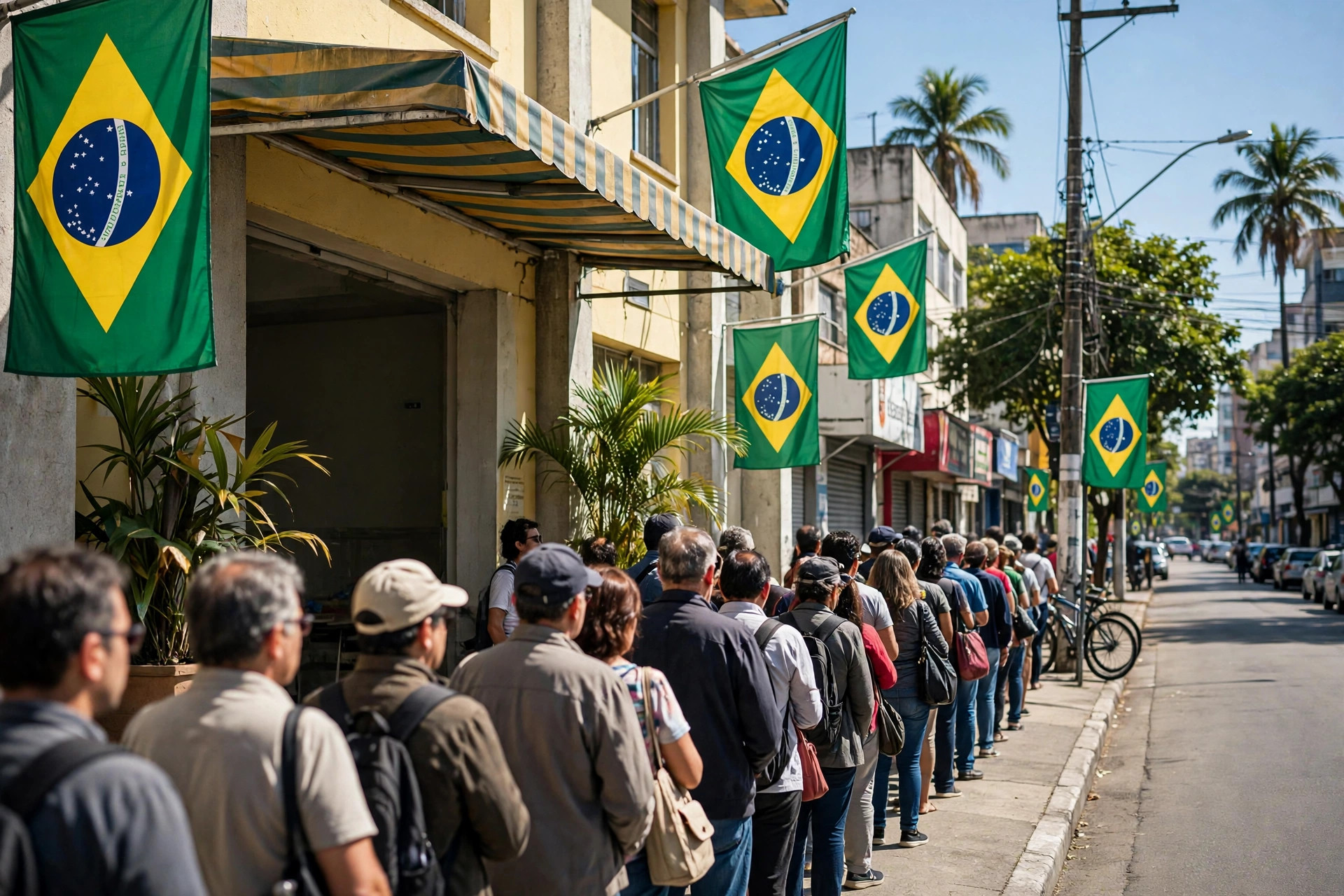
The Brazil presidential runoff 2026 reaches voting day on Sunday, 25 October 2026, as Brazilians choose between incumbent President Luiz Inácio Lula da Silva and challenger Flávio Bolsonaro in the second and decisive round of the presidential election. After a first round in which neither candidate passed 50 percent of valid votes, the runoff has become a straight head-to-head contest, and the result will determine who leads Latin America's largest country for the next four years. With around 159 million voters eligible to take part, the scale of the vote alone makes it one of the most consequential democratic exercises anywhere in the world this year, and its outcome will shape Brazil's economy, its social policies, its institutions and its place in global affairs.
Background: how Brazil reached the Brazil presidential runoff 2026
Brazil elects its president through a two-round system. If no candidate wins more than half of the valid votes in the first round, the top two candidates advance to a runoff, where the candidate with the most votes wins. That is what happened in 2026. In the first round on 4 October, Flávio Bolsonaro finished with about 47 percent and Lula with about 45 percent, according to the figures supplied for this article. Neither crossed the 50 percent threshold, so a second round was required. The closeness of that first-round result set the tone for everything that followed: neither side could claim a comfortable lead, and both campaigns spent the weeks between rounds trying to win over voters who had backed eliminated candidates, as well as voters who had abstained or cast blank or invalid votes.
The contest carries a particular historical weight because of the family and political history behind one of the candidates. Flávio Bolsonaro is the son of former President Jair Bolsonaro, and much of the campaign debate has turned on questions of continuity and change. Lula, meanwhile, is seeking to extend his current period in office after returning to the presidency in a previous election cycle. Supporters of each candidate tend to describe the choice in very different terms, which is why the campaign has often felt less like a routine policy debate and more like a referendum on Brazil's recent political direction. For voters, however, the practical questions have remained familiar ones: jobs, prices, public services, public safety and the credibility of government promises.
The final stretch of the campaign included a televised debate on Friday on Globo, one of Brazil's major broadcasters. Debates in a runoff matter because they are one of the few moments when both candidates appear side by side, under the same questions, before a very large audience. They also give undecided voters a final chance to compare tone and substance before polling day. Reports ahead of voting day described the race as tightening to a near tie, with some polling showing the candidates level at around 50-50, while betting-market indicators such as Polymarket were reported to favour Bolsonaro. Polls and markets measure different things and neither is a vote count, so those signals should be read as a picture of a close race rather than as a prediction of the result.
Brazil presidential runoff 2026 voting day: what happened in the campaign
On the policy front, the two campaigns have put forward sharply different emphases. Bolsonaro has pledged a fiscal adjustment of R$200 billion, a large programme of budget restraint that his campaign presents as a way to restore confidence in public finances. He has also expressed support for ending the six-day workweek, a proposal with direct relevance to millions of workers and employers. At the same time, he is under a corruption investigation, a fact that his opponents have raised repeatedly and that his supporters have dismissed as politically motivated. In reporting on an investigation, it is important to distinguish between an allegation or inquiry and a proven finding, and voters have heard both characterisations during the campaign.
Lula, for his part, has pledged to prevent a return to power by the Bolsonaro family, framing the election as a defence of democratic institutions and of the policy direction of his government. His campaign has also rolled out measures aimed at microentrepreneurs, small business owners whose livelihoods depend on credit, simplified rules and stable demand. Those measures speak to a large and politically important constituency in Brazil, where small enterprises provide a significant share of jobs. The contrast between the two platforms is therefore not only about personalities: it is also about how each side proposes to handle public spending, work, small business and the role of the state in the economy.
Voting day itself follows Brazil's well-established electoral routines. Voting is conducted electronically in most of the country, results are typically reported relatively quickly after polls close, and the electoral authorities publish totals as they are counted. Because the electorate is so large and spread across many time zones and regions, from the Amazon to the southern states, the national picture emerges gradually through the evening. Close races can narrow further as results arrive from different regions, so early partial totals should not be mistaken for a final result. The winner, once confirmed, will serve a four-year term, the standard length for a Brazilian presidential mandate.
Why the Brazil presidential runoff 2026 matters
The result matters first for Brazil itself. A four-year term gives the winner time to shape the federal budget, to appoint senior officials, to influence regulation and to set the direction of major programmes in health, education, infrastructure and social protection. The fiscal question is central: a promised adjustment of the scale proposed by Bolsonaro would involve difficult choices about spending and revenue, while Lula's approach emphasises continuity of existing programmes and targeted support for smaller enterprises. Either path will be felt in household budgets, in business planning and in the cost of borrowing for the government, and both will be tested by economic conditions that no campaign can fully control.
The result also matters beyond Brazil's borders. Brazil is a major agricultural exporter, an important energy producer and a significant voice in debates about climate, trade and regional cooperation in South America. Its stance on environmental protection in the Amazon, on trade relationships with the United States, China and the European Union, and on cooperation with neighbouring countries can affect markets and diplomacy well beyond the region. For that reason, governments, investors and international organisations follow Brazilian elections closely, not out of curiosity about domestic politics alone, but because the outcome can shift the terms of wider regional and global discussions.
There is also a democratic dimension that voters themselves have highlighted. Elections in large, diverse democracies are tests of institutional trust: whether voters accept the count, whether campaigns respect the process, and whether the losing side acknowledges the result. Brazil's electoral system has been the subject of intense debate in recent years, and the conduct of the runoff, including the speed and transparency of counting and the statements of the candidates after the result, will be watched as closely as the numbers themselves. A clear, accepted result strengthens that trust; a contested or ambiguous aftermath would have consequences that last longer than a single news cycle.
Key facts about the Brazil presidential runoff 2026
- Voting day: Sunday, 25 October 2026, the second round of the presidential election.
- First round: 4 October 2026 — Flávio Bolsonaro about 47 percent, Lula about 45 percent, neither over 50 percent.
- Final debate: Friday before voting day, broadcast on Globo.
- Polling picture: Race tightened to a near tie, with some polling at about 50-50; Polymarket was reported to favour Bolsonaro.
- Electorate: Around 159 million voters.
- Bolsonaro pledges reported: R$200 billion fiscal adjustment; support for ending the six-day workweek; he is under a corruption investigation.
- Lula pledges reported: To prevent a Bolsonaro family return; microentrepreneur measures rolled out during the campaign.
- Term: The winner serves a four-year term.
Readers following the election may also find background in related coverage. For context on the eve of the vote, see the eve-of-vote guide, and for a broader explainer on how the runoff came about, see the runoff explained. Both help explain why a second round was needed and what is at stake in the final vote.
What happens next after the Brazil presidential runoff 2026
After polls close, attention turns to the count and to the formal declaration of the winner. The successful candidate will then move into a transition period, assembling a government team, setting priorities for the first months in office and preparing a budget approach that reflects campaign promises. The promises made during the runoff will now be measured against the realities of Congress, where the president must build support for legislation, and against economic data that will shape what is possible. A fiscal adjustment, if pursued, would require detailed proposals and legislative backing. Support for small businesses, if expanded, would require funding and administrative delivery. Neither can be achieved by a campaign pledge alone.
For voters, the period after the election is also a time to watch how the winning side governs and how the losing side responds. Opposition parties play an important role in holding a government to account, and the closeness of this race suggests that neither side will disappear from public life after voting day. Brazil's political debate is likely to remain intense, with the next electoral cycle, regional elections and policy battles already on the horizon. What the runoff decides, above all, is who gets the first opportunity to turn promises into policy over the next four years, and under what constraints. That is why, even after a long campaign, voting day itself remains the decisive moment — the point at which opinion, polling and debate give way to a counted result that will shape Brazil's direction until the next presidential election.
Update: Lula won the runoff on 25 October and was re-elected — see the results coverage.