
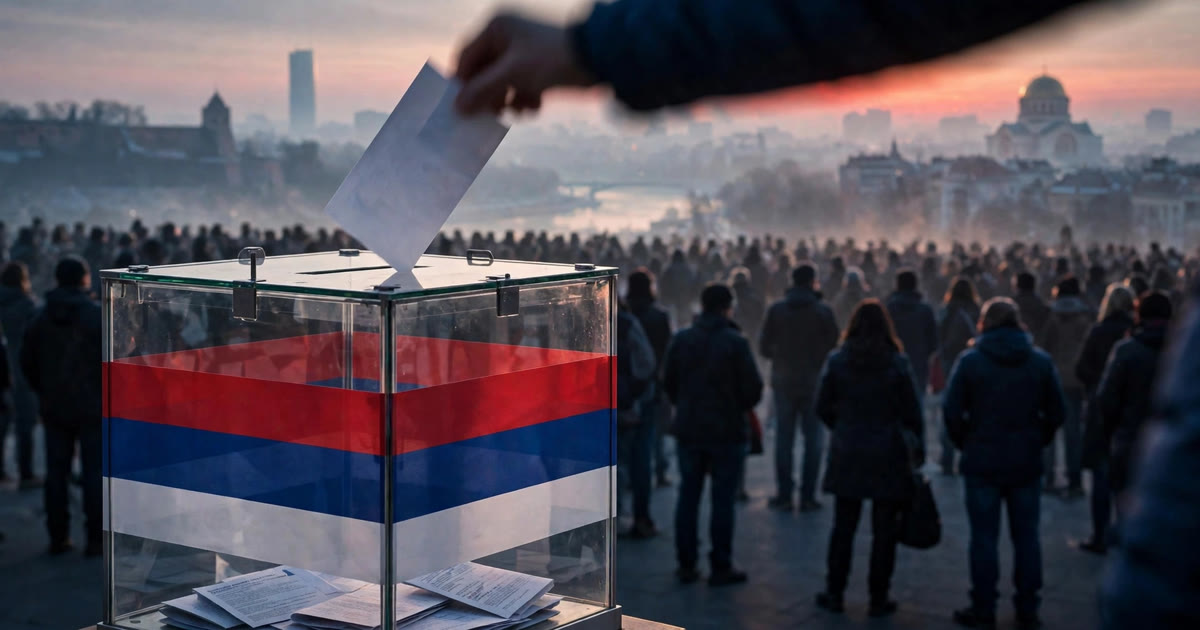
Serbia goes to the polls on Sunday, October 25
Serbia will hold snap parliamentary elections on Sunday, October 25, 2026, in what has become the most closely watched vote in the Balkans in years. According to news coverage across European and international outlets, a student-led electoral list has taken former president Aleksandar Vučić to the wire, with final polls showing the two camps essentially tied — and one independent survey placing the students ahead for the first time in more than a decade.
Vučić, whose Serbian Progressive Party (SNS) has dominated the country's politics since 2012, resigned as president on September 27 to stand as the lead candidate of his "Aleksandar Vučić – Ujedinjena Srbija" (United Serbia) list for prime minister. Now he faces the most serious electoral challenge of his 12 years in power: the "Student List – Students Win" coalition, born from nearly two years of anti-corruption protests that began after a deadly railway station canopy collapse in Novi Sad.
How a protest movement became an election machine
The story of this election begins with tragedy. A canopy collapse at Novi Sad's railway station killed 16 people and ignited a student-led protest movement demanding accountability, transparency, and an end to corruption. What started as campus demonstrations grew into the largest protest movement in Serbia's modern history, with marches that repeatedly filled Belgrade's streets.
Over time, the movement organized into an electoral force. Its 250-candidate "Students Win" list was assembled through student plenary sessions rather than back-room party deals, and it deliberately contains no current students — instead fielding university professors, doctors, engineers, actors, farmers, and even a popular rapper. The list is headed by Ilija Srdanović, a cardiology professor, though the movement says that does not automatically mean he would become prime minister if the list wins.
The platform is centered on eradicating corruption, reforming the media, increasing institutional transparency, breaking the state's patronage networks, and overhauling education. "The protests changed the society. It showed people they are not alone," Florian Bieber, professor of Southeast European history and politics at the University of Graz, told Reuters. The BBC reported lead candidate Srdanović declaring at the final campaign rally: "The energy is unstoppable."
What the final polls show
Polling for Sunday's vote paints a divided picture, and pollsters themselves disagree. A survey by independent pollster New Serbian Political Thought (NSPM), published October 20, put the Student List at 44.5 percent against 42.7 percent for Vučić's SNS-led list — the first time an opposition list has led a national poll in over a decade. NSPM researcher Đorđe Vukadinović described a "referendum atmosphere" developing around the vote.
By contrast, an Ipsos Strategic Marketing survey published October 22 gave Vučić's list 47.4 percent and the Student List 40.0 percent — but Ipsos itself disclosed that this research was commissioned by the electoral list "Aleksandar Vučić – Ujedinjena Srbija," which is essential context for interpreting the gap. Earlier polling from Faktor Plus had also shown the governing coalition ahead, while a CRTA survey leaned toward the students. Analysts caution that different fieldwork dates, methods, and sponsors make direct comparisons hazardous.
Betting markets, meanwhile, continued to favor Vučić even as the polls tightened — a pattern that has held through the final week of campaigning.
A campaign fought on television and TikTok
Vučić has campaigned with characteristic intensity. He logged 129 live television appearances in August alone, drove himself to rallies in a Škoda, and posted TikTok videos featuring folk songs and comedy skits in which he plays a waiter. His message has been one of stability: warning that an untested movement would bring chaos to the country's economy and its delicate international position.
The students countered with what observers describe as a sophisticated social media operation, out-organizing the ruling party among younger voters. Their final campaign rally on October 22 in central Belgrade drew an estimated 150,000 people, according to the independent Archive of Public Gatherings, as reported by AFP — a striking show of force just three days before the vote.
How Serbia's electoral system works
Serbia's parliament, the National Assembly, has 250 seats, and 126 are needed for an outright majority. A 3 percent electoral threshold applies (national minority lists have special rules), which means smaller parties that fall short win nothing. According to the NSPM poll, the lists led by the Socialists (2.9 percent), European Serbia (2.7 percent), and the Authentic Right (2.5 percent) all sat below the threshold — making the smaller parties' performance potentially decisive for government formation.
Turnout could be the deciding factor. In the NSPM survey, 79.8 percent of respondents said they would definitely vote, though analysts note that stated intentions do not always translate into actual turnout. If youth turnout surges, pollsters suggest the students benefit; if it doesn't, the SNS machine's organizational depth — built over 14 years in power — could carry the day.
What's at stake: Europe's balancing act in the Balkans
The election matters well beyond Serbia's borders. Vučić is one of Europe's most significant political figures precisely because of his balancing act: cultivating closer ties with China as a major investor, maintaining Serbia's traditional relationship with Russia as its principal gas supplier, while keeping the door open to European Union membership even as the accession process stalls. It is an arrangement few leaders have managed for this long, and it gives Belgrade unusual leverage in the region.
An opposition-led government would inherit that balancing act with an unknown at the helm. The consultancy Teneo noted in an analyst briefing that "a (student-led) government would pursue broad reforms to tackle corruption, overhaul key public institutions and companies, and dismantle patronage networks," but warned that "strong bureaucratic resistance could generate short-term institutional instability." Critics of the students also point to their silence on EU accession, on Kosovo, and on whether Serbia would introduce sanctions on Russia — questions their platform largely sidesteps.
Vučić's supporters argue that continuity keeps Serbia's foreign-policy flexibility intact at a moment of continental tension. His opponents argue that the patronage system itself is the obstacle to EU integration and that only a break with the SNS machine can unlock real reform.
Three scenarios for Monday morning
An SNS victory. If the governing list holds its ground, Vučić returns as prime minister with a mandate he can claim directly from voters — and a free hand to continue his balancing act between Brussels, Moscow, and Beijing. The student movement would remain a powerful opposition force, but its momentum would face its first real test in defeat.
A student win. An outright or near-outright victory for the Student List would be the most consequential political change in the Balkans in a generation — a protest movement walking straight into government with almost no governing experience. The transition would be the story: who becomes prime minister, how the EU and Russia respond, and whether the movement's reform promises survive contact with Serbia's entrenched bureaucracy.
A hung parliament. With the two leading lists potentially separated by only a point or two, and smaller lists hovering at the threshold, Serbia could wake up Monday with no clear winner. Coalition negotiations would then decide the country's direction — and the parties currently polling below 3 percent would suddenly become kingmakers.
Sunday's vote will answer the question that has hung over Serbian politics for two years: whether a movement born in the streets can convert protest energy into governing power. Polls close in the evening, and the first results are expected late Sunday night. As analysts noted in coverage trending per news outlets worldwide, whatever the outcome, the era of uncontested SNS dominance appears to be over.
For broader context on political turbulence in Europe this month, read our coverage of France's curfews as riots escalated in Paris, and for how great-power balancing shapes smaller nations' elections, see the US-China trade framework reached in Kuala Lumpur and the US request for European tariffs on Russian-oil trade.
Sources: Reuters; BBC; Associated Press; Agence France-Presse; Ipsos Strategic Marketing; New Serbian Political Thought (NSPM); Teneo; the Archive of Public Gatherings.