
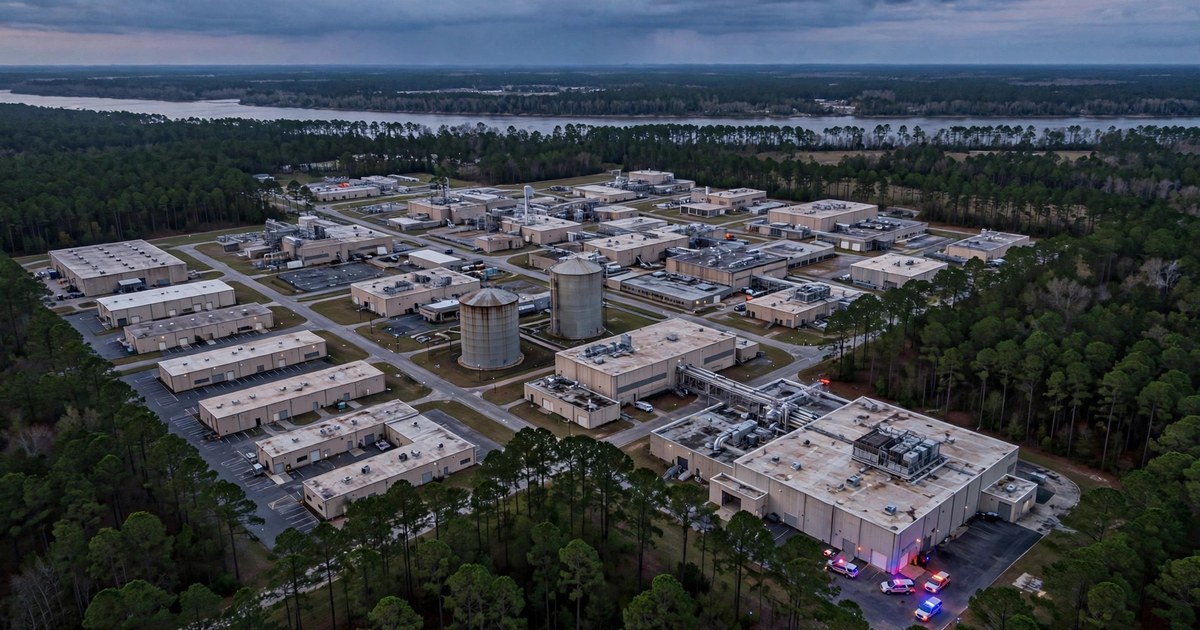
The Savannah River Site fire began on the evening of Wednesday, 28 October 2026, when a fire was reported in a single room at the Savannah River National Laboratory near Aiken, South Carolina. Site officials declared a Site Area Emergency at 5:39 p.m. local time, and the fire was extinguished within about two hours. The incident quickly drew attention trending per news coverage, because any fire described alongside a radiological release at a United States nuclear site raises an immediate question: what happened, and was anyone outside the site at risk? The confirmed picture, as officials described it on the night, was narrower than the alarm suggested. Officials reported no contamination outside the affected facility, and no indication of consequences beyond the boundaries of the 310-square-mile site. At the same time, important details were not yet established, including what caused the fire, whether anyone was injured, and the nature and amount of any material involved in the reported release. This article sets out what was confirmed, what was reported by local media citing site officials, and what remained unknown.
What Happened During the Savannah River Site Fire?
According to the Savannah River Site Emergency Response Organization, a fire was reported at the Savannah River National Laboratory and a Site Area Emergency was declared at 5:39 p.m. on 28 October 2026. In its second news release, issued at 7:30 p.m., the site said the fire had since been extinguished and that no contamination had been reported outside the affected facility. News reports based on official statements put the time from the fire being reported to it being put out at roughly two hours. The fire was confined, in the accounts available, to a single room inside the laboratory, in the part of the site known as Area A. That detail matters, because it distinguishes a room fire inside a laboratory building from a fire spreading across the wider site. Officials did not, in the information reviewed, identify the room, the equipment involved, or the materials present there, and readers should treat any more specific claim about the room as unconfirmed unless the site itself publishes it.
The response around the laboratory was immediate and precautionary. Employees in the affected areas who were not involved in emergency response or shutdown operations were directed to shelter in place. Local station WRDW reported that employees in the Area A laboratory area sheltered behind barricades for about 30 minutes, were later allowed to leave, and that other people were then not allowed to enter the area. Site entrances were closed to incoming traffic, with barricades put in place as a precaution. Rail, river and air traffic in the vicinity of the site were also restricted while the response continued. The Federal Aviation Administration issued a temporary flight restriction, described in reporting as citing a United States government “nuclear incident” at the site. Taken together, those steps are the visible part of an emergency plan working as designed: limit movement, keep people who are not needed for the response away from the affected building, and keep the airspace and nearby transport routes clear while responders assess the scene.
Why the Savannah River Site Fire Triggered a Site Area Emergency
A Site Area Emergency is the middle category in the three-level emergency classification used at the Savannah River Site, sitting between an Alert and a General Emergency, in increasing order of severity. The site’s community preparedness material describes a Site Area Emergency as a more serious event than an Alert, in which small amounts of hazardous material may be released into areas of the site beyond the incident facility. Government officials are notified and prepare to assist, and may take precautionary action to protect people near the site. The wider Department of Energy framework describes Site Area Emergencies as events involving actual or likely major failures of facility safety or safeguards systems needed to protect onsite personnel, the public, the environment or national security, with the potential to affect workers at nearby facilities or members of the public nearby, so notification of and coordination with local authorities is required. A General Emergency, by contrast, is the highest category, expected to produce consequences requiring protective actions for workers and the public. The declaration on 28 October therefore signalled a serious onsite event requiring coordinated response, not by itself a finding that the public outside the site was in danger.
Emergency classifications of this kind exist precisely so that responders do not have to wait for complete information before acting. A fire inside a laboratory that handles nuclear and radiological materials is classified on the basis of what could happen and what systems may have been affected, as well as what is known to have happened. That is why shelter-in-place directions, entrance closures and transport restrictions can be imposed even when officials later report no contamination outside the affected facility. The classification also explains why state and local government agencies were notified and why residents were advised to listen to local radio and television stations, where state officials would announce any action residents might need to take. No evacuation order was reported in the sources reviewed for this article. The absence of an evacuation order, on its own, is not proof about conditions inside the laboratory; it is one of several indications, alongside the official statement about contamination, that the assessed risk beyond the facility did not, at that stage, call for residents to leave their homes.
What the Reported Radiological Release in the Savannah River Site Fire Means
The phrase that caused the most concern in early reporting was “unfiltered ground-level radiological release.” Local broadcaster WRDW reported that site officials had told the station there had been such a release, and other news reports repeated that wording, citing WRDW and the Savannah River Site. The site’s own second news release, as published, did not use that phrase. It said that no contamination had been reported outside the affected facility. That distinction is important and should not be blurred. The release wording comes from local reporting citing site officials and an emergency dispatch, while the no-contamination statement comes directly from the site’s published release. Both can be reported accurately only if the source of each statement is kept clear.
In plain terms, a radiological release means radioactive material has left its normal containment. “Ground-level” describes where the material entered the air, at or near the ground rather than through a tall stack, and “unfiltered” means it did not pass through the filters that would normally capture particles before air leaves a building. None of those words, on their own, states how much material was involved, which material it was, how far it travelled, or whether anyone was exposed. Those are the questions that monitoring inside and outside the facility is meant to answer, and the nature and amount of material released had not been established in the available reports. Readers should therefore be cautious about any early claim that puts a number on the release, names a specific isotope, or estimates a dose. The verified position on the night was limited: a release of this kind was reported, officials said no contamination had been reported outside the affected facility, and there was no indication of consequences beyond the site’s boundaries. Anything beyond that awaited the site’s investigation and monitoring results.
What Is the Savannah River Site?
The Savannah River Site is a United States Department of Energy complex of about 310 square miles along the South Carolina–Georgia border, near Aiken and across Aiken, Barnwell and Allendale counties in South Carolina. It was built in the early 1950s, during the Cold War, to produce plutonium and tritium for the American nuclear weapons programme. Plutonium-239 and tritium were among the materials produced there. Its work today is different in emphasis but still closely connected to nuclear materials: nuclear materials management, environmental cleanup, and research, including tritium processing, nuclear materials storage, environmental remediation and the treatment of high-level radioactive waste. The Savannah River National Laboratory, where the fire occurred, conducts research supporting nuclear security, environmental cleanup and related technologies. Understanding that history helps explain both the scale of the site and the seriousness with which the Savannah River Site fire was treated. A 310-square-mile reservation is not a single building, and an emergency in one laboratory room does not, by itself, mean the whole site is affected. It also means that the site holds substantial quantities of nuclear materials and radioactive waste accumulated over decades, so monitoring, containment and a tested emergency plan are central to its daily operation.
The site’s dual character, as both a cleanup project and an active centre for national security and nuclear science, is part of why the story travelled widely. The laboratory’s research role connects it to questions the public reasonably asks after any incident: how materials are contained, how quickly a fire can be detected and put out, and how officials decide when to tell nearby residents to take action. The international debate over nuclear weapons and the joint nuclear emergency drill held by the United Kingdom and France show how much attention governments pay to nuclear safety and preparedness, and an incident at a major American nuclear site naturally draws the same kind of scrutiny. Scrutiny, however, is not the same as a confirmed hazard. The facts available on the night pointed to a contained laboratory fire with a precautionary emergency response, not to a wider incident, and the article’s conclusions must stay within that evidence.
Is the Public at Risk?
On the evidence published on the night of 28 October, officials gave a reassuring answer about the area outside the affected facility, while leaving the position inside the laboratory open. The site said no contamination had been reported outside the affected facility, and reporting citing the site added that there was no indication of consequences beyond the site’s boundaries. Residents were not told to evacuate, and were instead advised to stay tuned to local radio and television stations for instructions from state officials. Those are the statements on which a reader outside the site could reasonably rely at that stage. They do not answer every question. They do not state what monitoring found inside the laboratory, whether any worker was exposed, or whether any contamination was found inside the affected facility itself. A statement that nothing was reported outside a facility is a statement about a boundary, and it should be read exactly that way.
People living near Aiken and in the surrounding counties had a practical reason to keep following official updates about the Savannah River Site fire rather than social media speculation. Emergency responses at nuclear sites generate a large amount of unofficial information quickly, including dispatch audio, flight-tracking maps and reused photographs, and not all of it is reliable. The most useful habit in such a situation is to check the site’s own releases, the statements of state and local agencies, and established local broadcasters, and to note the time of each update. An update issued at 7:30 p.m. describes the position as known then; it does not guarantee the position hours later. If monitoring later found anything different, the site and the state agencies would be expected to say so in a further release. Until then, the honest summary is that the public risk, as officially assessed on the night, was described as absent beyond the affected facility, with the investigation continuing.
What Remains Unknown After the Savannah River Site Fire
Three questions remained unanswered in the reporting reviewed, and each of them is a proper subject for the investigation that follows an incident of this kind. First, what caused the fire? The cause had not been established, and no account in the reviewed sources identified an ignition source, a piece of equipment, or a sequence of events inside the room. Second, was anyone injured or exposed? Whether anyone was injured had not been immediately established, and no information had been published about exposure or medical assessment. Third, what exactly was released, if anything beyond the laboratory room, and what did monitoring detect? The nature and amount of material involved in the reported radiological release had not been established, and no detailed measurements had been published in the information reviewed. A fourth question follows from the first three: whether laboratory operations would face a prolonged shutdown, and what repairs, inspections or safety reviews would be required before the affected area returned to normal use. None of those questions can be answered responsibly by speculation.
What happens next, in practical terms, is an investigation and a sequence of official updates. Site officials were directing the response and had notified the appropriate state and local government agencies. The next important developments will be the findings of that investigation, any additional information about the reported release and monitoring, and any statement about the cause and about when the affected laboratory area can safely resume work. If the investigation identifies a failure in equipment, procedure or containment, the site would be expected to explain what will change. If monitoring confirms that nothing left the affected facility, that finding will matter just as much, because it will close the gap between the alarming phrase in early reporting and the reassuring boundary statement in the official release. For now, the Savannah River Site fire stands as a reminder of how emergency systems at a nuclear site are meant to work: declare early, restrict movement, shelter workers, notify authorities, and keep the public informed through official channels while the facts are established.
Sources: Savannah River Site Emergency Response Organization News Release #2, 28 October 2026; WRDW reporting cited by the New York Post and WFB News, October 2026; Fox News, October 2026; Savannah River Site community preparedness material on emergency classifications.