
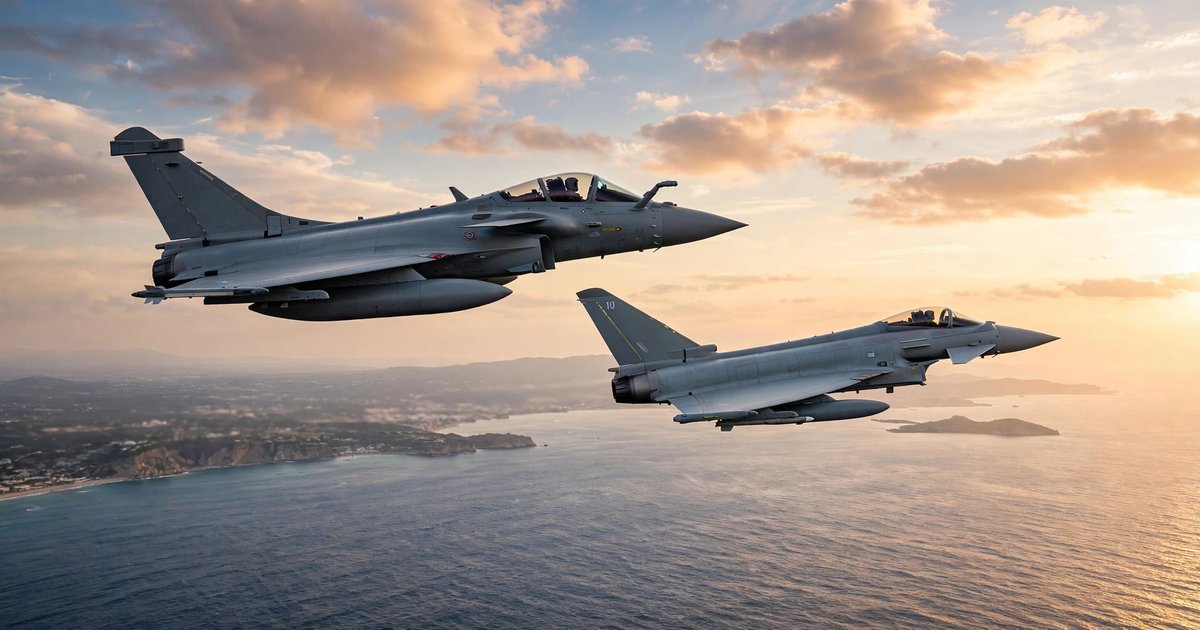
For the first time in history, British warplanes have flown inside a French nuclear strike exercise. On Friday, the French Armed Forces Ministry and the UK government announced that RAF Typhoon fighters escorted French Rafale jets — the aircraft that carry France's air-launched nuclear missiles — on a simulated long-range nuclear strike mission over France and the Mediterranean. The operation, codenamed Exercise Rummy, is the first time British jets have ever joined a French airborne nuclear drill. The UK-France joint nuclear drill, announced on 23 October 2026 and trending per news coverage across Reuters, Defense News and major international outlets, breaks a taboo that stood for six decades: France's airborne nuclear force has operated in complete autonomy since its creation in the 1960s. Here is what happened, what it means, and why it matters for European security.
What Happened in the UK-France Joint Nuclear Drill
According to the joint statement released on Friday, the exercise took place on the evening of Tuesday, 20 October 2026. French Rafale jets took off from the Saint-Dizier air base in northeastern France — home to the frontline Rafale squadrons of the French Strategic Air Forces (forces aériennes stratégiques), the arm of the military responsible for the airborne part of France's nuclear deterrent.
The Rafales, flying a simulated nuclear strike sortie, were escorted by RAF Typhoon fighters in what specialists describe as a defensive counter-air (DCA) role: the British jets protected the would-be nuclear-armed Rafales while they prosecuted the mission over France and the Mediterranean. Both sides stressed that the exercise followed robust safety and security arrangements and involved no actual nuclear weapons. "Exercise Rummy" continues the French tradition of naming nuclear exercises after card games, similar to the regular Exercise Poker.
French Armed Forces Minister Catherine Vautrin said: "Our nuclear cooperation with the United Kingdom continues to deepen: on Tuesday evening, British Typhoons took part for the very first time in a French nuclear exercise alongside Rafales." Her central message: "Having independent nuclear forces does not preclude coordination."
UK Defence Secretary Wes Streeting said the exercise "marks a new chapter in the defence nuclear relationship between the United Kingdom and France." The joint statement added: "In an increasingly dangerous world, our adversaries should be in no doubt: the United Kingdom and France stand together in their commitment to European security and to maintaining the deterrence that has helped preserve peace for generations."
Why the UK-France Joint Nuclear Drill Is a Historic First
To grasp the scale of the moment, it helps to understand how France's airborne deterrent has worked until now. Since the 1960s, France's Strategic Air Forces have operated in total autonomy — the doctrine of an independent deterrent, free of any allied command, has been a cornerstone of French defence policy under every president since Charles de Gaulle. Until Exercise Rummy, no foreign aircraft had ever flown inside a French airborne nuclear exercise.
The drill is also notable because it is asymmetric: France is the only one of the two countries with an airborne nuclear component. Its Rafale jets carry the ASMP nuclear-tipped cruise missile — the standard visible loadout is the missile on the aircraft's central pylon, flanked by external fuel tanks and MICA air-to-air missiles for self-defence. Britain, by contrast, relies entirely on its submarine-based deterrent (the Dreadnought programme) for its nuclear weapons and is only now adding an airborne contribution by acquiring 12 F-35A aircraft to join NATO's nuclear mission.
There had been a hint of this direction: in the summer of 2026, two French Rafale B aircraft from the same Strategic Air Forces conducted a joint exercise with two German Eurofighters — the first crack in six decades of airborne-deterrent autonomy, before the British joined properly in October.
The Northwood Declaration: The Deal Behind the Drill
Exercise Rummy did not come out of nowhere. In July 2025, the United Kingdom and France agreed to reinforce cooperation over their nuclear arsenals, in response to growing threats to Europe and uncertainty over their American ally. That agreement — the Northwood Declaration — opened the way to operational cooperation in the field of nuclear deterrence, and Friday's drill is its first concrete military expression.
The declaration sits alongside a bigger French push. In March 2026, President Emmanuel Macron said Paris would expand its nuclear arsenal and launched an initiative offering European partners joint exercises and the possible short-term deployment of French nuclear-capable assets on their territory. France is also working with several European allies on a concept of "forward deterrence" — extending the reach of its nuclear umbrella at a time when US security guarantees for Europe are being questioned.
France vs UK vs Russia: The Nuclear Numbers
The two European nuclear powers are significant — but dwarfed by the superpowers:
- France: roughly 290 submarine- and air-launched weapons, the world's fourth-largest arsenal, at a maintenance cost of about €5.6 billion ($6.04 billion) a year.
- United Kingdom: 225 nuclear warheads. Britain is investing £63 billion over the next four years to strengthen its deterrent, funding the Dreadnought and SSN-AUKUS submarines and a new warhead, plus the 12 F-35A aircraft for NATO's nuclear mission.
- Russia and the United States: more than 5,000 nuclear weapons each.
In other words, even combined, the UK and French arsenals are about one-tenth of Russia's — which is precisely why coordination between London and Paris is strategically meaningful. Together, and credibly coordinated, they present a much more serious deterrent than either alone.
Why Now: Ukraine, Russia and Doubts Over America
The timing is not accidental. The exercise comes with tensions remaining high between NATO powers and nuclear-armed Russia some four-and-a-half years into Moscow's full-scale invasion of Ukraine. At the same time, European capitals are openly questioning whether US security guarantees can be relied on — a debate sharpened by Trump's fresh ultimatum about the US leaving Europe.
The drill also fits a pattern of European defence activity this autumn. NATO is running a wargame in Poland with 1,500 European troops rehearsing a postwar Ukraine deployment, and NATO's top commander has warned Russia that any attack would prove "utterly futile". Against that backdrop, Exercise Rummy is both a military rehearsal and a political signal — primarily aimed at Moscow, and secondarily at Washington.
Reactions from analysts and officials so far underline the "new chapter" framing rather than an alarmist one: the drill demonstrated readiness and interoperability, not a change in nuclear posture. France keeps its independent decision-making; coordination simply means the two deterrents now practice operating side by side.
What Happens Next
If the Northwood Declaration's logic holds, Exercise Rummy will be the first of many. Expect more joint UK-France nuclear exercises, deeper integration of the two countries' nuclear planning staffs, and — under Macron's March initiative — the possible short-term deployment of French nuclear-capable assets on allied European territory. France's forward-deterrence concept could eventually bring other European partners, like Germany, into similar exercises.
For Russia, the message is deterrence: Europe's two nuclear powers are now visibly coordinating their deterrents. For the rest of Europe, the message is reassurance: a European nuclear safety net is being woven even as transatlantic guarantees look less certain. And for defence watchers, Exercise Rummy marks the end of an era — the moment France's solitary airborne deterrent finally gained a wingman.
Sources: Reuters ("British jets join French nuclear exercise for first time, France says", 23 Oct 2026); Defense News ("France, UK carry out joint airborne nuclear-strike exercise for first time", 23 Oct 2026); UK Government official statement ("UK-France deepen nuclear defence ties in first joint exercise", 23 Oct 2026); The Aviationist ("British Typhoons Escort French Rafales in First Joint Nuclear Strike Drill", 23 Oct 2026); Alliance News/AFP via Morningstar ("France and Britain stage first joint nuclear air strike simulation", 23 Oct 2026).