
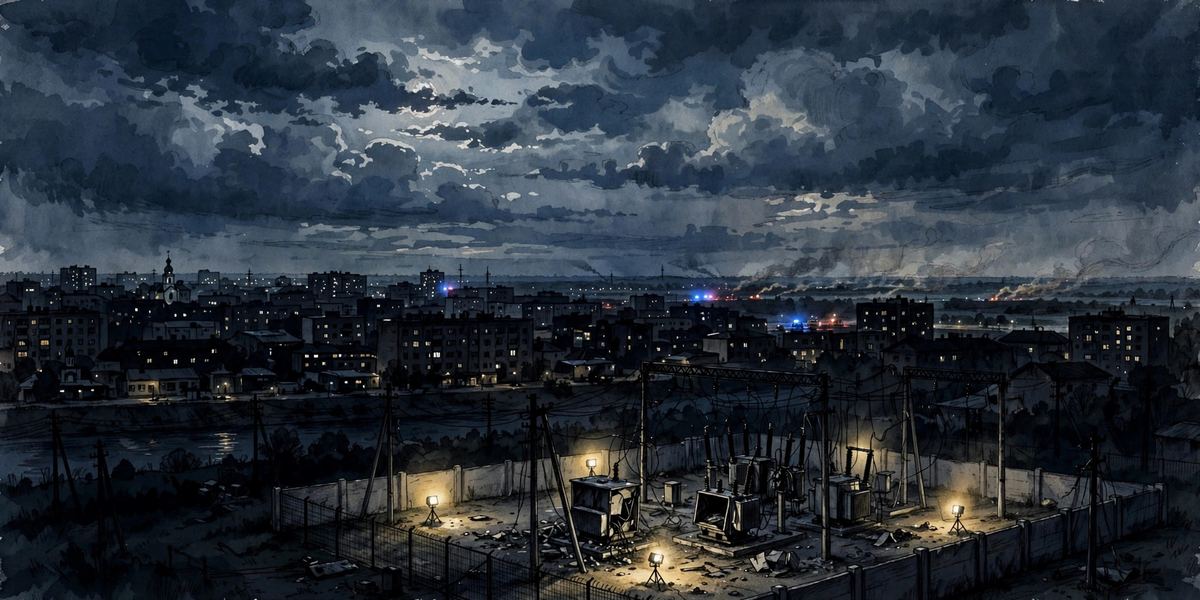
Early on Friday 16 October 2026, waves of Russian drones struck cities and energy infrastructure across Ukraine, killing at least eight people and injuring 60 across nine regions, and knocking out power to more than a million people nationwide. In the north-western Volyn region, about 370,000 consumers lost power at the morning peak. Shopping centres were hit in two cities, a food-processing facility was struck near the Polish border, and repair crews spent the morning racing to restore electricity. Shopping centres were hit in two cities, a food-processing facility was struck near the Polish border, and repair crews spent the morning racing to restore electricity. The barrage landed on the same day European Union leaders hosted Ukrainian President Volodymyr Zelensky in Brussels, and it underlined a grim pattern: as winter approaches, Ukraine’s power grid — and the air defences that protect it — are under growing strain. The story is trending per news coverage across international outlets.
What happened overnight
According to Reuters, which cited regional officials, the attacks killed at least eight people across Ukraine, injured 60, and hit two shopping centres. The details, region by region, show how wide the barrage was. The details, region by region, show how wide the barrage was.
In Kharkiv, in eastern Ukraine, two people were killed and 12 more were wounded in attacks on three districts, according to Governor Oleh Syniehubov. The governor had earlier put the death toll higher, a reminder that casualty figures in fast-moving attacks are often revised as rescue teams reach damaged sites and hospitals confirm admissions.
In Volyn, the north-western region that borders Poland, a drone strike on a food-processing facility killed one person and wounded eight others, according to Governor Roman Romaniuk. Regional officials described a barrage of about 20 jet-powered Shahed-type drones hitting the region overnight. By the morning, roughly 370,000 consumers in Volyn were without electricity. Crews had reconnected about 100,000 people by later in the morning, but the blackout could last at least 24 hours in the regional capital, Lutsk, according to Mayor Andriy Razumovskyi. Drones also hit a customs terminal in the town of Kovel, setting fire to about 10 trucks, Governor Romaniuk said.
Further strikes hit civilian commercial sites. In the northern city of Sumy, which sits close to the front line, a shopping centre was hit; pictures released by emergency services showed damage to the centre’s entrance. In the neighbouring Rivne region, drones hit a major shopping centre and other sites, killing one person and wounding seven, according to regional governor Oleksandr Koval. Reuters described the shopping-centre strikes as the latest in a spate of Russian assaults on malls and markets.
Elsewhere, police said drones hit a residential apartment block in Uman, in central Ukraine, injuring five people. Private electricity provider DTEK said emergency electricity cuts were imposed in Kyiv as the strikes unfolded. The Polish armed forces said Poland scrambled fighter aircraft to safeguard its airspace during the attacks and later reported that the country’s airspace had not been violated.
These figures come from officials and agencies quoted in Friday’s reporting. They may be updated as authorities complete their assessments, and where accounts differ — for example on exact casualty counts — this article reports what officials said rather than treating any single early number as final.
Why the power grid is the target
The Volyn outage is the most telling part of Friday’s attacks. Knocking out electricity for hundreds of thousands of people does not just darken homes: it disrupts water pumping, heating, hospitals, mobile networks, and the repair workshops and logistics that a country at war depends on. With winter approaching, each grid strike lands harder, because the same infrastructure will soon be needed to keep homes heated through freezing months.
Ukraine has faced repeated large barrages since late September that combined missiles, loitering munitions, and attack drones. The pattern matters because it is designed to stretch air defences: waves of relatively cheap drones can force defenders to spend scarce interceptor missiles, reveal the positions of air-defence batteries, and wear down crews who must stay alert through the night. Even when most incoming drones are shot down, the ones that get through can hit substations, transformers, and other nodes that take far longer to repair than they do to damage.
Russia has described its strikes as aimed at military and logistical targets linked to Ukraine’s war effort. Kyiv and Western officials say the repeated hits on shopping centres, apartment blocks, and civilian businesses show that civilian life is bearing much of the cost. Readers should treat both characterisations as the two sides’ stated positions; the verified facts on Friday are the locations hit, the casualties officials reported, and the scale of the power outage.
Air defences under strain: the Patriot shortage
Friday’s barrage arrived alongside alarming reports about the state of Ukraine’s air defences. The Washington Post reported on Friday, citing a Ukrainian official and another person familiar with the matter, that Ukraine had just two Patriot interceptor missiles remaining for its US-made Patriot air-defence systems. CNN separately reported, citing a source familiar with the situation, that Ukraine had effectively run out of the missiles. Another account said Ukraine had ten interceptors left on 7 October and that most had since been used. The exact remaining count could not be independently verified, but the direction of all three accounts is the same: stocks are critically low.
Patriot systems matter because they are among the few weapons Ukraine has that can reliably intercept Russian ballistic missiles. The shortage became stark during a Russian attack overnight into Wednesday, when ballistic missiles struck three power plants in Kyiv and targeted energy infrastructure in Kharkiv. Four people were killed and 25 injured in Kyiv on that day, according to the reporting. Ukraine’s Air Force said it intercepted four Russian ballistic missiles during that attack — a figure that suggested only a small number of interceptors remained available.
Kyiv has warned about this shortage for months. In August, Ukrainian officials told CNN during a visit to a Patriot battery that interceptor supplies were nearly exhausted, and Zelensky said at the time that Ukraine had only around one-tenth of the interceptors it urgently needed. In September, he said Kyiv would obtain a US licence to manufacture Patriot missiles, but no licence followed. The missiles are expensive and in short global supply, as conflicts in Ukraine and the Middle East have burned through stockpiles and manufacturers struggle to keep pace with orders from multiple governments.
The air-defence strain has coincided with a separate disruption to Ukraine’s battlefield connectivity. US senators have demanded a probe into Starlink and Starshield outages that they say left Ukraine exposed during Russian attacks, after military-grade satellite links were throttled and then partially restored. Together, the interceptor shortage and the connectivity problems describe a country whose defensive shield is being squeezed on more than one front at once.
The diplomatic backdrop: Brussels, Washington, and a collapsed energy truce
The timing of Friday’s barrage sharpened its political message. EU leaders hosted Zelensky in Brussels on Friday, at what Reuters described as one of the most difficult moments for Ukraine, with missiles and drones raining down on Ukrainian cities and fears that the United States could pull back intelligence sharing and weapons support. Arriving at the summit, Zelensky said Ukraine had to prepare for winter and that the winter package was “not only energy, it’s also air defence and funding.” He said he would discuss Ukraine’s needs for the rest of this year and for 2027.
Relations between Kyiv and Washington have grown openly strained. Trump blindsided Zelensky last weekend by announcing that Ukraine and Russia had agreed not to target each other’s energy facilities. Ukraine paused strikes on Russian oil refineries for three days; Zelensky then said Russia did not reciprocate, and Ukraine resumed strikes on Russian refineries, including a facility in the Ryazan region. Trump called Ukraine’s resumption of refinery strikes a “disgrace” in an interview, arguing that the strikes push up world oil prices. He has also faced criticism in Kyiv over a White House deal to import Russian diesel, which Zelensky said left him feeling betrayed.
That dispute is not abstract. Facing US midterm elections in November, Trump has blamed Ukrainian strikes on Russian refineries for pushing up energy prices that could cost him at the ballot box, according to Reuters. For Ukraine, the practical question is whether allied funding and weapons deliveries — including any future Patriot interceptors — keep flowing. European leaders have been meeting on energy prices, Ukraine support, and competition from China, and Friday’s summit was a test of whether Europe can fill gaps if American support wavers.
What to watch next
First, the repair effort: Ukraine's Energy Ministry said repair crews had restored power to more than a million people who lost it on Friday, though it was unclear how many remained without electricity; in Volyn, about 100,000 of the 370,000 had been reconnected by later in the morning, and Lutsk's blackout could last at least 24 hours, according to the mayor. Second, whether the barrage continues in the coming nights, and whether Russian strikes keep concentrating on the grid as temperatures fall. Third, what the Brussels summit produces in concrete terms — funding, energy assistance, and air-defence commitments — rather than statements of support. And fourth, whether the United States and its allies move to replenish Ukraine’s interceptor stocks, because without them each new wave of ballistic missiles will be harder to stop.
Friday’s attacks did not change the front lines. What they did was demonstrate, in a single night, the three pressures converging on Ukraine this autumn: a power grid being systematically targeted, air defences running low on the missiles that protect it, and an alliance debate over how much support will continue. That combination, more than any single strike, is what makes this story significant as winter approaches.
Amid the barrage, Ukraine's forces have also pioneered a new use for heavy drones: the world's first aerial drone evacuation of a wounded soldier.
Sources
Reporting by Reuters, CNN, The Washington Post (via secondary reports), and Ukrainian regional officials, 16 October 2026. This article summarises those reports; claims that could not be independently verified are identified as such.