
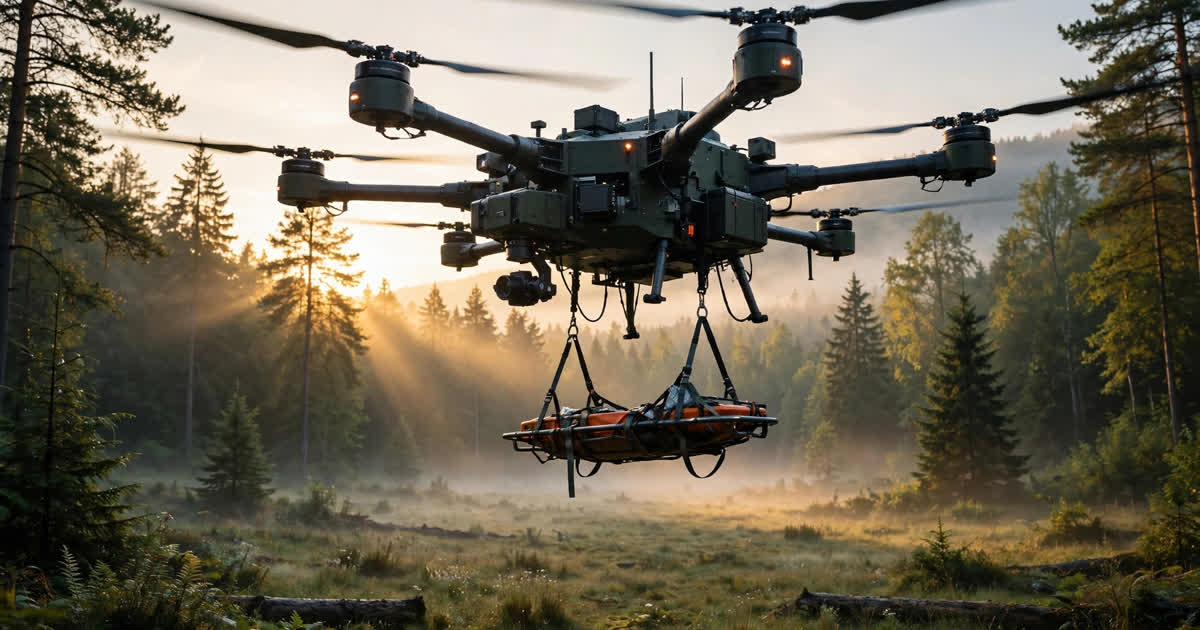
Ukrainian troops have pulled off something never done before in the history of warfare: they airlifted a wounded soldier off the front line with a drone. The 92nd Separate Assault Brigade says its unmanned systems specialists evacuated an infantryman of the 30th Separate Mechanized Brigade using a modified heavy six-rotor drone, in what the unit calls the world's first aerial evacuation of a casualty from a battlefield — a story now being covered by news outlets across the world.
The soldier, an infantryman identified only as Kostiantyn, had been holding an observation post on the Kupiansk front in the Kharkiv region when he was wounded. According to reports, he had been manning the position alone after his comrade was killed in a Russian strike. With the ground around him mined and Russian drones watching the area constantly, no medic, vehicle or robot could reach him. So his rescuers did the unthinkable: they flew a drone to him, strapped him in, and flew him 38 miles to safety.
A position no one could reach
The evacuation became necessary because every conventional rescue option had failed. The wounded soldier's position could not be reached by armored vehicles or medics — the ground was littered with mines, and Russian surveillance drones hovered over the area, making any movement potentially lethal. Even Ukraine's uncrewed ground vehicles, which its forces now routinely use to pull wounded troops out of dangerous areas, could not get through.
While waiting, Kostiantyn was kept alive by drone. His unit used small drones to drop food, water, antibiotics and painkillers to his position — a tactic that has become standard practice in a war where the "golden hour" of battlefield medicine, the idea that a wounded soldier should reach a field hospital within 60 minutes of being hit, has been destroyed by persistent drone surveillance. As The Times reported this week, casualties in the drone era can now remain stranded on the battlefield for hours — in some cases, as long as 36 hours.
How the rescue worked
The breakthrough came when the 92nd Brigade's unmanned ground systems company adapted a heavy six-rotor drone — a hexacopter built by the Ukrainian manufacturer Gurzuf Defence, which the company supplied free of charge — that was originally configured as a bomber. Engineers fitted it with special rigging, carabiners and a winch system capable of carrying a person.
First, a drone delivered the strap-in equipment to Kostiantyn. Then, according to reports, his rescuers sent him a video tutorial showing him how to fasten himself to the drone — an extraordinary moment of remote instruction in the middle of a kill zone. The flight was monitored by live video call, and friendly drone units provided cover against Russian attacks during the operation.
The journey itself took 1 hour and 14 minutes, flying 38 miles at low altitude over forested terrain before the drone set the wounded man down gently. Video released by the brigade on Monday shows the moment of landing, as a remote operator greets the soldier with the words "Welcome back to the ground!" — and the control room erupts in applause.
At the Kharkiv military hospital, doctors treated injuries severe enough that both of the soldier's legs were amputated — but he survived, is recovering, and his life is no longer in danger, according to the reports. One detail, reported by The Sun, underlines how long he had been out there: he is said to have spent nearly 500 days alone at his post.
Why military experts are paying attention
"This is a historic event, at least for our unit," said Napalm, a commander with the 92nd Brigade's unmanned ground systems company, in remarks carried by news coverage. "This is the next stage that we will all eventually reach. We are already ready. An extremely complicated operation, but a successful one... It will go down in history."
The brigade itself framed the mission as proof of a broader trend: "This mission proves once again that Ukrainian service members, working in tandem with Ukrainian manufacturers, are setting global trends in the conduct of warfare."
The claim is not hyperbole. Drones have already reshaped nearly every aspect of this war — from surveillance and artillery targeting to long-range strikes like the drone attacks devastating targets in Sudan — but casualty evacuation was one of the last domains still assumed to require crewed aircraft or ground vehicles. Both are increasingly suicidal in airspace saturated with enemy drones: helicopters are large, loud and easy to track, while ground routes are mined and watched.
That pressure is forcing militaries everywhere to rethink medical doctrine. The Times reports that British military medics are now training for prolonged field care — keeping wounded soldiers alive for hours rather than minutes — while defence chiefs are studying autonomous helicopter drones to pull the critically injured from the front line. Regular war games are even being held with the UK's NHS to practise bringing mass casualties back from continental Europe by aircraft, ships and trains, including the Eurostar. Brigadier Chris Wright, the British Army's head of medical operations and capability, told The Times that military medicine must now plan in terms of "hours not minutes".
From improvisation to industry
The Ukrainian operation was an improvisation — a bomber drone repurposed in the field — but it points directly at an emerging industry. Several Ukrainian companies are already developing drones designed specifically for aerial evacuation, with purpose-built airframes, stabilized casualty pods and medical monitoring equipment, rather than adapted strike platforms.
The implications go beyond Ukraine. The same logic that made this rescue necessary — mined ground, watched skies, the end of the golden hour — applies to any future conflict fought under persistent drone surveillance, a dynamic visible from the widening international fallout of the Ukraine war to drone campaigns across the Middle East and Africa. If drones can watch a battlefield constantly, they can also — as this mission showed — reach the people stranded on it.
There are hard limits. A 74-minute flight for a single casualty is not a substitute for a medevac system, and the operation worked only because the soldier was conscious enough to strap himself in. Weather, enemy jamming and payload limits all constrain what flying ambulances can do. But as a proof of concept, the mission is hard to overstate: the first time in history that a machine with no pilot and no crew carried a wounded soldier out of a battle.
For Kostiantyn, recovering in a Kharkiv hospital, the statistics matter less than the outcome. He went into the sky strapped to a machine built to drop bombs — and came back to the ground alive.