
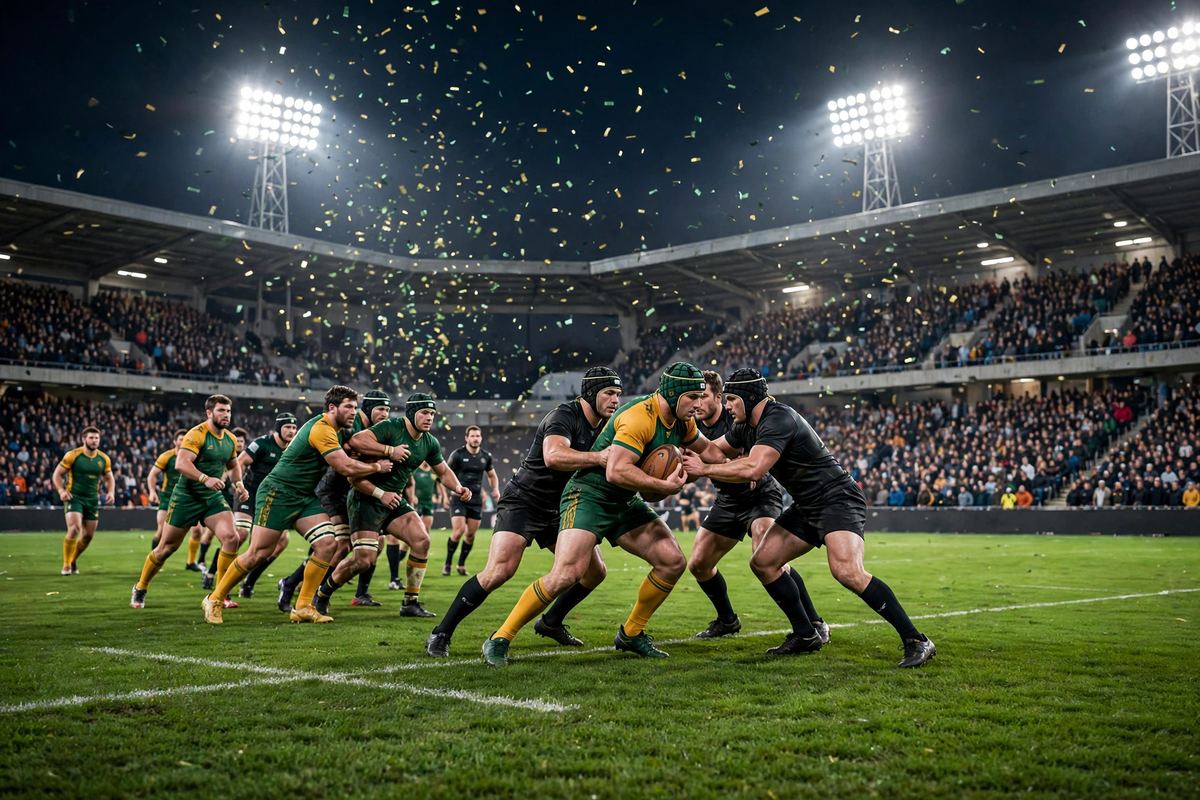
The biggest night in international rugby league
On Thursday, October 15, the 2026 Rugby League World Cup kicked off at Allianz Stadium in Sydney with the fixture the sport's fans had circled for months: defending world champions Australia, the Kangaroos, against arch-rivals New Zealand, the Kiwis. The match opened a month-long festival of rugby league that runs until November 15, when the men's and women's finals will be played at Suncorp Stadium in Brisbane. The tournament is jointly hosted by Australia, New Zealand and Papua New Guinea, features men's, women's and wheelchair competitions, and is staged across nine cities — Sydney, Brisbane, Perth, Port Moresby, Christchurch, Newcastle, Wollongong, Gold Coast and Townsville. Australia won the opening match 24-22. Jack Bostock scored a hat-trick on his Kangaroos debut, including the winning try in the 75th minute, and New Zealand fullback Kalyn Ponga left the field late with a suspected broken arm after scoring two tries.
The opening match was set up as a heavyweight contest. Australia arrived as the 2025 Ashes Series winners and the reigning world champions, having beaten Samoa 30-10 in the 2022 final. New Zealand arrived as the 2025 Pacific Cup champions, with a settled forward pack and a backline built around the confidence of fullback Kalyn Ponga, who declared his allegiance to New Zealand earlier in the season and was set for a senior international debut in the tournament. Organisers expected the match to draw the biggest international rugby league crowd in Sydney for almost two decades, with more than 150,000 tickets sold across the tournament before kickoff.
What the tournament looks like
The 2026 edition is deliberately leaner and more competitive than its predecessors. The men's tournament features 10 teams and 18 matches, with a streamlined format: Pool A of four teams and a combined Pool B and Pool C table of six teams, with four teams reaching the semi-finals. The women's and wheelchair tournaments run alongside the men's, and in total the event involves 26 teams representing 14 nations across the three competitions. Across four weeks, 51 to 53 matches are scheduled, depending on the count of wheelchair fixtures, in a format designed so that more teams than ever can genuinely contend.
The opening days set the tone. After Australia against New Zealand on Thursday, Australia's Jillaroos launch their women's title defence against Samoa at CommBank Stadium on Friday night. England open their men's campaign against Tonga in Perth on Saturday, October 17. The wheelchair World Cup gets under way in Wollongong on Friday, October 30. The semi-finals are scheduled for November 7 and 8, and the finals for November 15. For fans in the United Kingdom, matches fall in the morning, with kickoff times ranging from about 4:30 a.m. to 10:05 a.m., and the tournament is shown on Premier Sports.
Why this World Cup is different
The International Rugby League Board approved competition-specific rules for the 2026 tournament that borrow directly from the NRL and NRLW. The tournament uses the 2026 NRL and NRLW Premiership Rules and Interpretations as its laws, which allows it to integrate the technology fans know from club football: the Video Review Bunker, the Captain's Challenge, and shot clocks for scrums, goal-line dropouts and goal kicks. The Match Review and Judiciary process, the head-injury assessment policy and the on-field rules for trainers mirror the NRL and NRLW as well — standard practice at previous World Cups, where the hosts' disciplinary and medical frameworks are adopted.
One rule stands out for its drama: Golden Point will be used for all men's and women's matches if needed, ensuring a winner in every game. That matters under the draw structure, where points difference and pool position can decide who reaches the semi-finals. Women's matches will be 70 minutes long, as is standard in the NRLW and the Women's Pacific Championships. The aim, organisers say, is consistency and familiarity for fans, broadcasters and players, most of whom come from the NRL and NRLW.
The players to watch
The opening match alone offered a cast of established stars and new faces. For Australia, captain Cameron Murray returned for his second World Cup after scoring five tries in the 2022 tournament, including one in the final against Samoa. Latrell Mitchell, another 2022 winner, brought his trademark physicality at centre. Keaon Koloamatangi earned a first World Cup selection after a strong Ashes series, and David Fifita was set for his first World Cup for Australia after playing for Tonga in 2022. For New Zealand, the forward pack was described by coach Stacey Jones as a settled unit that knows each other's game, while Ponga's arrival at fullback gave the Kiwis a game-breaking threat. Keano Kini, last year's standout custodian, waited on the reserves bench.
Beyond the opener, the tournament's depth is its selling point. England, Tonga, Samoa, Fiji, Papua New Guinea, Lebanon, France and Cook Islands all arrive with squads capable of upsetting the favourites on a given day. The women's tournament features the Jillaroos defending their title against a field that has grown in professionalism and depth, while the wheelchair tournament — played concurrently — has become one of the sport's most spectacular and fast-growing formats. The spread of talent across the three competitions is the reason organisers describe this as the most competitive World Cup yet.
What it means for the host nations
Major tournaments are also about legacy. The Australian Government, which supports the event, has said its investment will help deliver a world-class tournament that inspires participation at junior level, including for Australians with disability, and strengthens Australia's reputation as a host of major sporting events as the country builds toward the Brisbane 2032 Games. For Papua New Guinea, hosting matches in Port Moresby is a landmark moment for a nation where rugby league is effectively the national sport. For New Zealand, Christchurch's fixtures give home fans a stake in a tournament largely played across the Tasman.
There is also a sporting contest beyond the World Cup itself: the battle for Pacific talent. Kiwis coach Stacey Jones has spoken openly about the competition for players of Pacific heritage, who may be eligible for several nations. The choices made by players such as Ponga and Fifita — switching allegiances or staying loyal — shape not only this tournament but the balance of international rugby league for years. The World Cup is where those choices are tested in front of the largest audiences the sport can offer. For more on Australia's sporting scene, see our reports on Matt Renshaw's Test century and Steve Smith's catching record, and for another global sporting event, Formula 1's return to Africa.
What happens next
The group stage runs from October 15 into early November, with pool matches across all nine host cities. The semi-finals on November 7 and 8 will narrow the field to the two finalists in each of the men's and women's tournaments, and the finals on November 15 at Suncorp Stadium will crown the champions. If the opening night is any guide — a full stadium, two settled and talented teams, and a rivalry with decades of history — the next month should deliver the kind of international rugby league that the sport's fans have been waiting four years to see.
Key facts
- Opening match: Australia vs New Zealand, October 15, 2026, Allianz Stadium, Sydney (8:05 p.m. AEDT).
- Tournament runs October 15 to November 15, 2026; finals at Suncorp Stadium, Brisbane.
- Hosts: Australia, New Zealand and Papua New Guinea; nine host cities.
- Men's tournament: 10 teams, 18 matches; women's and wheelchair tournaments run alongside.
- Rules: NRL/NRLW laws, Video Review Bunker, Captain's Challenge, Golden Point to decide drawn games.