
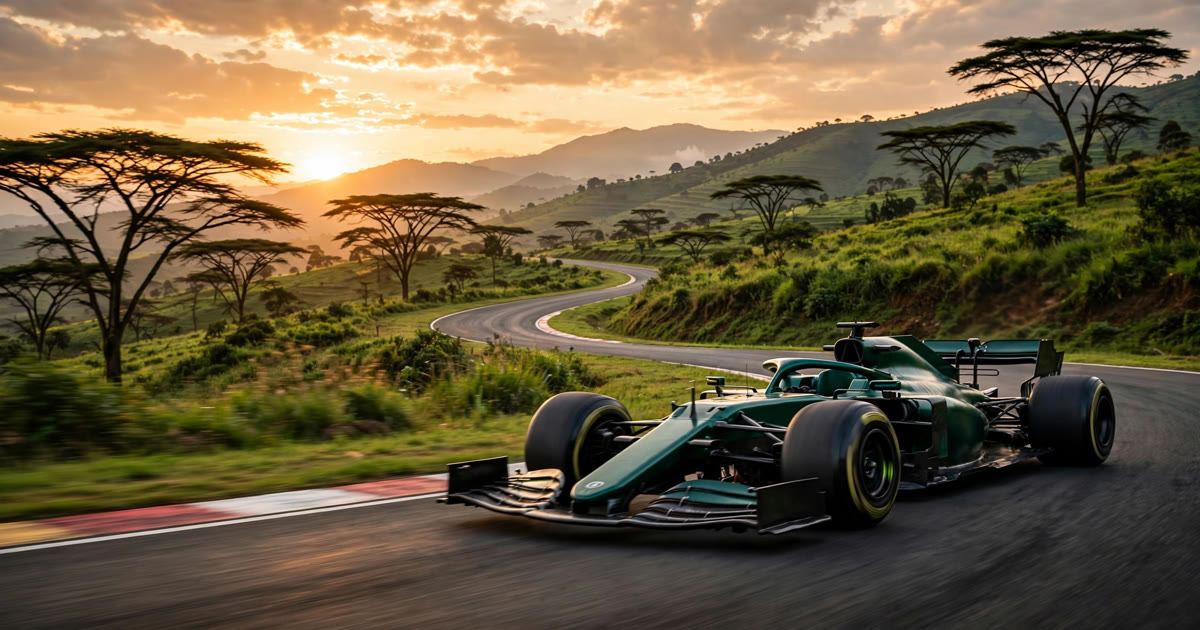
Formula 1 is coming back to Africa. In an announcement that is trending per news coverage across the globe today, the sport's bosses confirmed a landmark 10-year agreement that will bring the Formula 1 African Grand Prix to Rwanda in the early 2030s — the first time the championship has raced on the African continent since 1993.
The deal, announced at a press conference in Kigali on Tuesday and reported by outlets including Reuters, Formula1.com and DAZN, will see the event — officially titled the "Formula 1 African Grand Prix, presented by Visit Rwanda" — take place on a purpose-built circuit in Bugesera, around 40 kilometres (25 miles) south of the Rwandan capital, next to the new Kigali International Airport. The track has not yet been built, and the exact year of the first race is still to be confirmed, though 2032 has been widely mentioned as a realistic target.
Formula 1 president and CEO Stefano Domenicali called it "a landmark moment for Formula One," adding: "With Rwanda joining the calendar from the next decade, our sport will race in every inhabited continent, bringing the world championship closer than ever to fans around the globe."
Why this is a big deal
Formula 1 has not held a race in Africa since the 1993 South African Grand Prix at Kyalami, north of Johannesburg — won by Alain Prost. That is more than three decades without the continent hosting the sport's pinnacle series. Rwanda becomes only the third African country ever to host a Formula 1 race, after Morocco (the Moroccan Grand Prix at Ain-Diab in 1958) and South Africa.
The scale of the opportunity is enormous. Formula 1 says Africa is home to more than 100 million fans, with that number growing rapidly — and almost 60% of fans in key Sub-Saharan African markets are under the age of 35. That young, expanding audience is exactly what the sport has been chasing as it pushes into new markets around the world.
"Today belongs to Africa," said Paul Kagame, President of the Republic of Rwanda, at the announcement. "For more than three decades, the world's premier motorsport championship has raced without this continent, and that changes with this agreement."
The circuit: what we know so far
The planned Bugesera circuit will be built to FIA Grade 1 standards — the highest level of circuit licensing, required to host Formula 1. The layout, designed by former grand prix driver Alex Wurz and his design company, is expected to make use of the area's dramatic elevation changes and natural landscape to create a demanding track with strong viewing opportunities for fans.
The venue is part of a wider development programme led by the Rwanda Development Board covering sport, tourism, infrastructure and commerce. Beyond race weekends, the facility is intended to serve as a year-round destination capable of hosting international motorsport, major events, conferences and entertainment — a deliberate strategy to drive long-term economic growth and investment across the region, rather than relying on a single weekend each year.
Its position adjacent to the new Kigali International Airport is no accident: ease of access is critical for an event that must move teams, equipment and tens of thousands of fans into the country each year.
Rwanda's long game in world sport
This deal did not appear out of nowhere. Rwanda has spent years positioning itself as a host for major international sporting events as part of a tourism and business strategy, and talks with Formula 1 gathered pace from 2024. Kigali hosted the UCI Road World Championships, and in December 2024 the city staged the FIA's annual Prize Giving Ceremony, where Max Verstappen collected his fourth world championship trophy — a pointed signal of intent.
"This ten-year partnership is also an investment in Rwanda's future," Kagame said. "The circuit in Bugesera, alongside the new international airport, will bring jobs, skills, tourism and new business to our country and our region for decades to come, because our aim was never a single race weekend, but a lasting benefit for our people."
He added that the goal was for young Africans to "see themselves in it: as engineers, technicians, entrepreneurs and, one day, drivers."
Lewis Hamilton's wish, finally answered
No conversation about Formula 1 returning to Africa is complete without Lewis Hamilton. The seven-time world champion has been the sport's most prominent voice calling for an African race for years, arguing that the championship should visit every continent. Reporting on Tuesday's announcement noted directly that the deal answers Hamilton's long-standing plea — a fitting full-circle moment as his career enters its final chapters.
The announcement press conference was attended by the sport's full power structure: Kagame, Domenicali and FIA president Mohammed Ben Sulayem — underlining just how seriously Formula 1 is taking this project.
What still needs to happen
For all the celebration, there is a long road from Tuesday's announcement to lights-out at the first African Grand Prix. The circuit is a greenfield project: nothing has been built yet, and the timeline depends entirely on construction progress at Bugesera. The drivers are expected to be consulted on the final track design — a good sign for the circuit's sporting credibility, but another step in a multi-year process.
There are also questions every new venue faces: local transport infrastructure, accommodation capacity, pricing that works for the African fan base the sport says it wants to reach, and the environmental management of building a major motorsport facility in a sensitive landscape. Formula 1 and Rwanda say the sustainability of the event has been part of the planning from the start.
The 2026 season itself continues in the background — with Verstappen's recent sprint win keeping the championship battle alive — and the calendar keeps growing. The Rwanda deal shows where the sport believes its future growth lies: young fans, new continents, and long-term partnerships rather than one-off showcase races.
A short history of F1 in Africa
Africa's Formula 1 story began long before 1993. The first championship grand prix on the continent was the 1958 Moroccan Grand Prix at Ain-Diab near Casablanca, won by Stirling Moss. South Africa then became a regular calendar fixture: the South African Grand Prix ran at East London and later Kyalami from the 1960s through to 1985, hosting legendary title deciders, before returning for two final races in 1992 and 1993. Since Alain Prost's victory at Kyalami on 14 March 1993, the continent has been absent from the calendar entirely — even as Formula 1 expanded into the Middle East, Asia and the Americas.
The attempts to come back are not new either. For more than a decade, South Africa's Kyalami was repeatedly linked with a revival, and cities from Cape Town to Marrakech have pitched bids. What sets the Rwanda deal apart is the 10-year contractual commitment and a purpose-built, government-backed venue — the first time the return has moved beyond speculation and into concrete planning.
The bottom line
After 33 years, Formula 1 is returning to Africa — and Rwanda is the country making it happen. A 10-year deal, a brand-new Grade 1 circuit in Bugesera, more than 100 million African fans finally getting a home race, and a promise from the sport's bosses that this is a commitment for generations. If the circuit rises as planned, the early 2030s will open with one of the most significant calendar additions in Formula 1's modern history. Check back for more motorsport coverage, including guides to other major 2026 sporting events and the latest football headlines.