
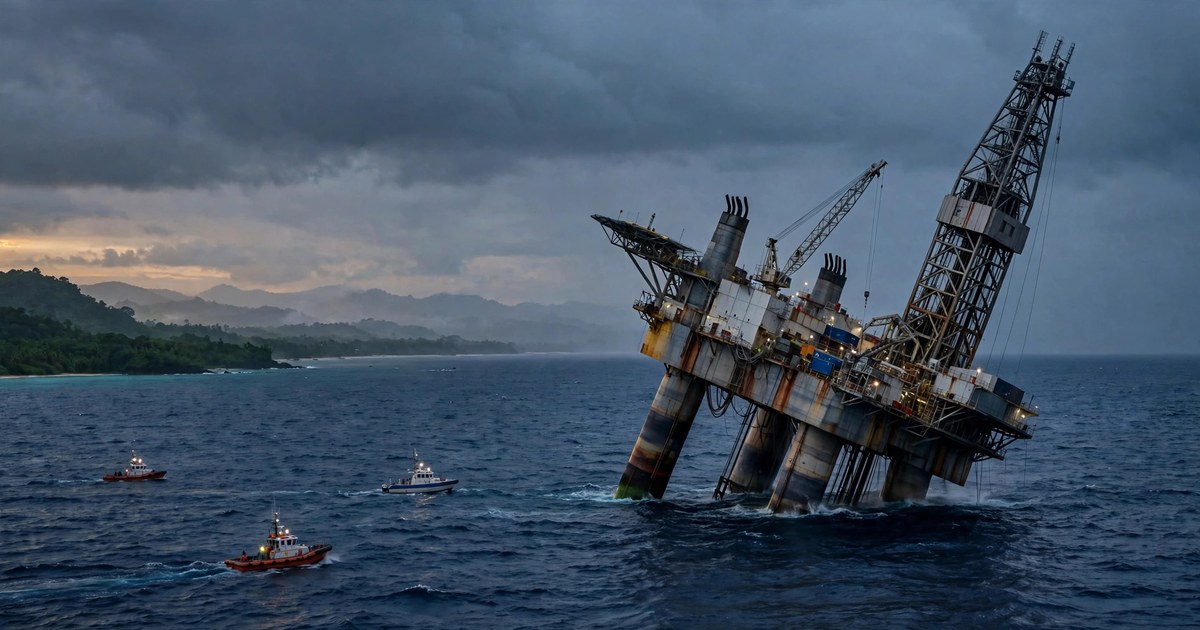
The Gabon oil rig sinks story began on Saturday evening, 24 October 2026, when the jack-up drilling rig Prospector 5 lost stability during preparations for a drilling campaign off the coast of Mayumba, in southern Gabon, and sank into the Atlantic. There were 115 people on board. The owner and operator, Borr Drilling, said on Monday, 26 October, that 110 of them were safe and accounted for and were being brought ashore, while search and rescue operations were continuing for the remaining five. The story has been trending per news coverage since then, as footage of the rig slipping beneath the waves circulated online and as the first reports of a death emerged from sources close to the incident.
What makes this sinking so closely watched is not only the number of people involved, but the way it happened. Prospector 5 had not yet begun drilling. It was in the jacking and preload stage, the careful process by which a jack-up rig plants its legs on the seabed and tests whether the ground beneath it will hold. Preliminary information from Borr Drilling points to a punch-through event during that stage: one or more legs penetrating the seabed without warning, the rig losing stability, and the unit then sinking. That is a preliminary finding, not a final cause. A technical investigation ordered by Gabon has still to establish exactly what happened, and readers should treat every detail about the mechanism as subject to that investigation.
Gabon oil rig sinks: what happened to Prospector 5?
Prospector 5 is a jack-up oil and gas drilling rig owned and operated by Borr Drilling. It had been contracted to support the drilling operations of BW Energy offshore Gabon, in the Dussafu Marin licence area near the MaBoMo production facility. BW Energy said in a statement on 25 October that the incident occurred during jacking operations in preparation for a planned drilling campaign, that the rig experienced a loss of stability and subsequently sank, and that 110 of the 115 people on board had been safely accounted for while five remained missing. The company also said production at the MaBoMo facility was shut down in line with standard procedure during ongoing drilling preparations, that there had been no reported damage to the facility or related equipment, and that there had been no accidental discharge of harmful substances to the sea from the facility.
The exact minute of the incident is reported differently in different accounts, and that difference is worth noting rather than smoothing over. Borr Drilling, as reported by Rigzone and Energy Voice, put the incident at approximately 8:37 p.m. local time on Saturday, 24 October, while the crew were conducting jacking operations. A statement from Gabon’s Ministry of Petroleum and Gas, as reported by Reuters, put the accident at approximately 9:40 p.m. on Saturday in the Dussafu Marin permit area near the Mabomont production facility. Both accounts agree on the essentials: Saturday evening, off Mayumba, during preparations for drilling, before any drilling had begun. The one-hour gap between the two reported times has not been explained in the public statements so far, and it is one of several details the technical investigation may clarify.
By Monday, 26 October, Borr Drilling’s public position was unchanged on the central numbers. In its latest update that day, the company said: “Of the 115 personnel on board, 110 are safe and accounted for. Search and rescue operations are ongoing for the five individuals who remain unaccounted for.” It said it was in contact with the families of the missing personnel, that the 110 accounted-for personnel were being brought ashore in Gabon where care and support were being provided, and that its onshore emergency response team continued to work with local authorities and its customer. The company added that extensive marine and air search and rescue operations remained ongoing, and that it was working with partners and authorities to ensure a robust investigation into the cause.
How a punch-through can make a jack-up rig sink
To understand why a rig can sink before it has drilled a single well, it helps to understand what a jack-up rig is. A jack-up is a mobile offshore drilling unit with long legs that can be lowered to the seabed. Once the legs are in contact with the ground, the hull is jacked up out of the water, so the rig stands on its legs like a table, stable above the waves, while drilling takes place. Before the hull is raised, the crew carry out preload operations: they deliberately load the legs, often by taking on seawater ballast, to push each leg into the seabed and prove that the ground can carry the rig’s weight. It is a test, carried out precisely so that a weakness in the seabed is found while the rig is still low and the crew can respond.
A punch-through is what happens when that test goes wrong in a particular way. In simple terms, a leg that has been supported by a firmer upper layer of seabed suddenly breaks through into a softer layer below. The leg plunges deeper without warning, the rig tilts, and the load shifts violently onto the other legs. As the Australian Geomechanics Society explains the general phenomenon, a punch-through is a situation in which one or more legs of a jack-up barge penetrate into the seabed without warning, having previously been supported. Whether that is what happened in full to Prospector 5, which legs were affected, and what the seabed conditions were at the Dussafu location are questions for the investigation. Borr Drilling’s wording is careful: “preliminary information indicates that the rig experienced a punch-through event during preload activities, resulting in loss of stability and the subsequent sinking of the rig.” Preliminary information is not a conclusion, and the company has not published the survey data, leg-load readings or seabed assessments that would let outsiders judge the finding for themselves.
Footage that has circulated since the weekend shows the scale of what followed. Video filmed from a nearby vessel, and widely shared on social media, shows the large rig listing heavily and slipping below the surface at night. News outlets including LADbible and UNILAD reported the footage on 27 October, describing a rig with 115 people on board sinking off the Gabon coast on Saturday. The footage is dramatic, and it helps explain why the incident travelled so quickly online, but it is not an official record. It does not, on its own, prove the cause, the timeline or the fate of the missing crew, and this article does not treat it as doing so. The verified facts remain those in the company and government statements and in Reuters’ sourced reporting, set out in this article with their sources.
Who was on board, and who is still missing?
Of the 115 people on board Prospector 5, 110 are safe and accounted for. That figure has been consistent across the statements from Borr Drilling and BW Energy since Sunday. The fate of the other five is where the public record is less settled, and the distinction matters. On Sunday, 25 October, Reuters reported, citing three sources familiar with the matter, that one employee had been killed and four others were missing. Reuters reported that an Indian national, one of the five initially unaccounted for, had been found dead, and that the four still missing included three Gabonese nationals and one other expatriate. The same account was given by Sylvain Mayabi Binet, secretary-general of the National Organisation of Petroleum Employees, who said the body of one of the five people initially reported missing, an Indian national, had been recovered.
At the same time, the Government of Gabon had not confirmed the death. Reuters noted that the government was instead saying five people remained missing and that search efforts were ongoing. Borr Drilling’s statement on Monday, 26 October, likewise still referred to five individuals who remained unaccounted for, and to search and rescue operations ongoing for those five. That is why this article describes one death as reported, rather than as officially confirmed, and why the headline says one reported dead and four missing, following the Reuters sourced reporting, while making clear in the body that the official statements available at the time still listed five people as unaccounted for. If Gabon’s authorities or Borr Drilling issue a confirmed update, that update, not the earlier sourced reports, should be treated as the authoritative account of the toll.
The mix of nationalities among the crew and the missing reflects the international character of offshore work in West Africa. Reports of the incident have mentioned Gabonese, Indian and other expatriate workers, and British nationals among those affected. Britain’s Foreign Office said it was providing support to a number of British nationals in Gabon and remained in contact with the local authorities, and that there were not thought to be any British fatalities. Borr Drilling said it was in contact with the families of the missing personnel, and Energy Voice reported that the company had urged family members seeking information to contact its Aberdeen office. For families, the gap between a sourced report of a death and an official confirmation is not a technicality. It is the difference between hearing a report and being told, officially, what has happened to a relative, and it is a further reason to report the toll with the attribution attached.
Search, rescue and investigation after the Gabon oil rig sinking
The search for the missing has been a joint effort from the start. Gabon’s Ministry of Petroleum and Gas said it had activated a crisis unit and ordered the navy to reinforce search and rescue operations at sea. Petroleum and Gas Minister Clotaire Kondja said in a statement that search and rescue operations continued without interruption and that the state had brought in reinforcements from the national navy. The crisis unit brings together representatives from the ministry, the navy, the state-owned Gabon Oil company, BW Energy and Borr Drilling. Borr Drilling described extensive marine and air search and rescue operations, and BW Energy said it was supporting the ongoing operations in close coordination with Borr Drilling, the relevant authorities and emergency responders.
Alongside the search, a technical investigation has been ordered. Minister Kondja said the ministry had launched a technical investigation into the cause of the accident, and Borr Drilling said it was working with partners and authorities to ensure a robust investigation was carried out. A technical investigation of this kind would normally be expected to examine the seabed survey and site assessment for the Dussafu location, the preload and jacking procedures followed on the night, the leg-load and stability data recorded during the operation, the condition and maintenance history of the rig, and the weather and sea conditions at the time. None of that material has been published yet, and no timetable for findings has been announced in the statements reported so far. Until it is, the punch-through account should be read as the preliminary explanation offered by the operator, not as an established finding.
Borr Drilling chief executive Bruno Morand said: “We are deeply concerned for those who remain unaccounted for and everyone affected by this incident. Our immediate priority is supporting the ongoing search and rescue efforts and the welfare of all personnel involved.” That statement of priorities, search first, welfare second, investigation third, matches the sequence in the public record: the immediate response was to account for the 110 people who were safe, to bring them ashore, and to keep searching for the rest, while the questions about cause were left to the investigation that followed. Rescue work after a structural collapse at sea is slow, dangerous and weather-dependent, and the same is true on land: a separate building-collapse rescue in Nairobi has shown in recent days how long it can take to establish, with certainty, whether anyone remains trapped.
Why the Gabon oil rig sinking matters for offshore drilling
Gabon is an established oil producer, and offshore drilling is central to its energy sector. The Dussafu Marin licence, where Prospector 5 was working, is operated by BW Energy, which holds a 73.5 per cent working interest in the licence, with Panoro Energy holding a 17.5 per cent interest, as reported by Reuters. The rig itself was contracted to support BW Energy’s drilling operations, and the sinking therefore touches not only Borr Drilling, as the rig’s owner and operator, but also the operator of the licence, the other interest holders, the regulator in Gabon, and the insurers and contractors who support offshore work in the region. The shutdown of production at the nearby MaBoMo facility, even as a standard precaution, shows how quickly a single incident can interrupt operations well beyond the rig itself.
For the wider offshore industry, the incident is a reminder of a risk that is well known but rarely seen at this scale in public. Jack-up rigs are used all over the world because they are versatile and comparatively quick to move between locations, but every move to a new location is a new test of the seabed. Site assessments, leg-penetration predictions and preload procedures exist to manage that risk, and a punch-through is precisely the failure those procedures are designed to prevent or to catch early. When one happens, the industry questions that follow are practical ones: was the site assessment adequate, were the preload loads and hold times sufficient, did the crew have clear criteria for stopping the operation, and did the rig’s monitoring give warning before stability was lost? The investigation into Prospector 5 will be read, across the industry, for its answers to those questions, and for any recommendations that follow.
There is also an environmental dimension, although the public statements so far are reassuring on the immediate point. BW Energy said there had been no accidental discharge of harmful substances to the sea from the MaBoMo facility, and no damage to the facility or related equipment. That statement covers the production facility, not the rig itself, which now lies on the seabed, and it does not settle longer-term questions about the rig, its fuel and drilling fluids, or any salvage or recovery operation. Those questions will depend on where the rig came to rest, in what condition, and what the investigation and the operators decide to do with it. The long-term effects of offshore oil spills are a reminder of why even a reassuring early statement is followed, in serious incidents, by sustained monitoring rather than by a single all-clear. Readers should not assume from the absence of a reported discharge that the environmental story is closed.
Energy infrastructure has been under strain in several regions at once in recent days, and the Gabon sinking arrives in that wider context. Oil sites have been targeted in attacks elsewhere, power systems have been hit by drone strikes in Sudan, and tanker traffic in the Strait of Hormuz has been the subject of claims and counter-claims. The Prospector 5 sinking is different in kind from those events: it was an industrial accident during a routine preparatory operation, not an attack, and no one has suggested otherwise. But it adds to the sense, in late October 2026, that the systems that produce and move energy are operating under unusual pressure, and that a single failure, whether caused by weather, by human error, by geology or by conflict, can have consequences far beyond the site itself.
What happens next, and what is still unknown
Three things happen next, in roughly this order. First, the search continues. Until the missing are found or the search is formally called off, the human story remains open, and any update to the toll should be treated as the most important development in the incident. Second, the technical investigation proceeds. Its findings, when published, will determine whether the preliminary punch-through explanation is confirmed, refined or replaced, and whether any procedural, technical or regulatory changes follow. Third, decisions are taken about the rig and the licence: whether production at MaBoMo resumes, on what timetable, and what happens to Prospector 5 itself, whether it can be recovered, salvaged or left in place under an agreed plan. None of those decisions has been announced in the statements reported so far.
A number of questions remain unanswered, and this article does not pretend otherwise. The confirmed toll, as opposed to the reported toll, is not yet settled in the official record. The exact time of the incident differs between accounts. The seabed conditions at the location, the preload data, and the crew’s actions in the minutes before the rig lost stability have not been published. The condition of the rig on the seabed, and any longer-term environmental assessment, have not been described. The cost of the incident, to Borr Drilling, to BW Energy and to Gabon, has not been quantified. Each of those gaps is a reason to keep following the official statements and the investigation, rather than to settle on a single dramatic explanation based on footage alone.
For now, the verified picture is this. On Saturday evening, 24 October 2026, Prospector 5 sank off Mayumba, Gabon, during jacking and preload operations before drilling had begun. Of 115 people on board, 110 are safe and accounted for. One death has been reported by Reuters, citing sources familiar with the matter, and four people remain missing on that reporting, while the official statements from Borr Drilling and the Gabonese government still listed five people as unaccounted for in their latest updates. A preliminary punch-through event has been offered as the explanation, a technical investigation has been ordered, production at the nearby MaBoMo facility has been shut down as a precaution, and no discharge of harmful substances from that facility has been reported. That is the story as it stands, and it will be updated as the search and the investigation produce confirmed facts.
Sources: Reuters reporting by Gnaneshwar Rajan and Colleen Goko, 25 October 2026, as carried by gCaptain and World Oil; Borr Drilling statements, 25-26 October 2026; BW Energy statement, 25 October 2026; Gabon Ministry of Petroleum and Gas statements, as reported by Reuters; Rigzone and Energy Voice reporting on the sinking and the search, 26-27 October 2026; LADbible and UNILAD reporting on circulating footage, 27 October 2026.