
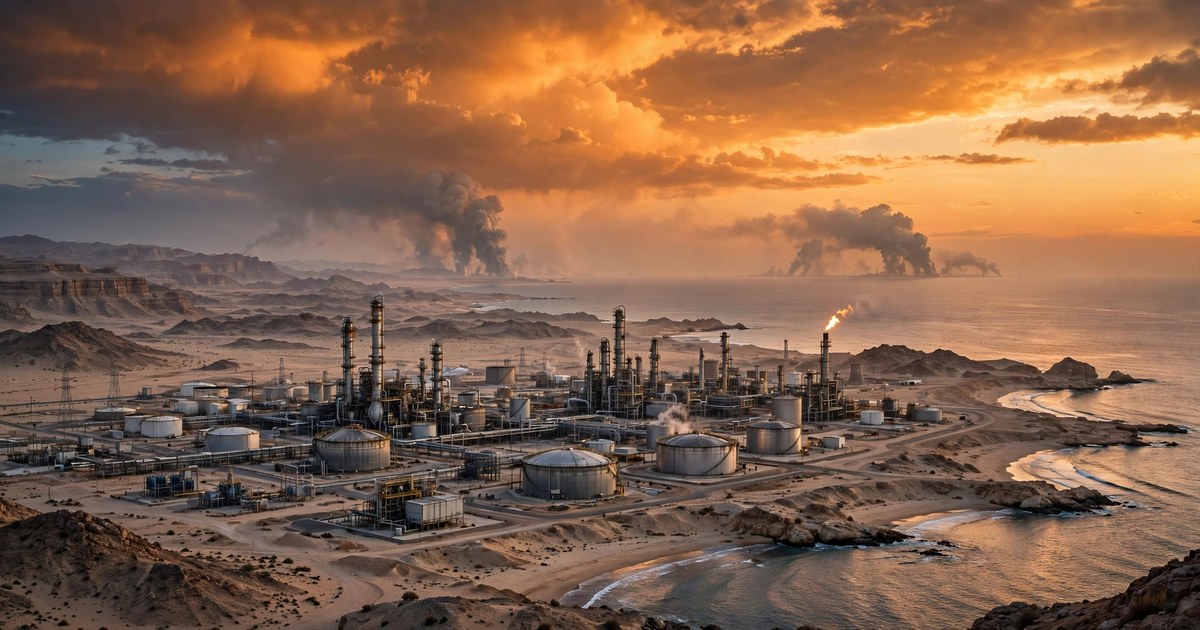
A Houthi attack on Saudi Arabia on Saturday, 24 October 2026, thrust the kingdom's oil infrastructure and the southern Yemeni port city of Aden back to the centre of a fast-escalating regional war. Yemen's Iran-allied Houthi movement said it had launched attacks on Saudi oil facilities and airports, while the Saudi-led coalition said it had shot down two missiles, in a day of claims and counter-claims that underlines how far the conflict has moved from the uneasy truce that held for most of the 2020s. The strikes, reported by Reuters on 24 October, are trending per news coverage as the latest and most geographically sweeping round of a confrontation that now touches oil markets, Red Sea shipping and the safety of millions of pilgrims.
What makes this round different is its breadth. Rather than a single missile aimed at a single city, the Houthis claimed a coordinated set of targets spanning the kingdom: airports in Riyadh and Dammam, an Aramco facility in Yanbu, the Rabigh oil refinery, crude pumping stations and the East-West Pipeline, plus an airport in Najran and an airbase in Khamis Mushait. At the same time, Yemen's Saudi-backed government said the Houthis fired three ballistic missiles at coast guard sites in Aden, the temporary seat of the internationally recognised government. Saudi authorities did not comment directly on the Houthi claims, though they reported missile debris falling near one of the purported targets. As with much of this war, the fog between claim and confirmed damage is itself part of the story.
What Happened in the Latest Houthi Attack on Saudi Arabia
According to the Reuters report published on 24 October 2026, Houthi military spokesperson Yahya Saree said the group had targeted King Khalid International Airport in Riyadh, an Aramco facility in Yanbu, the Rabigh oil refinery, crude oil pumping stations and the East-West Pipeline. He also said the group targeted King Fahd International Airport in Dammam, an airport in Najran and an airbase in Khamis Mushait. The Saudi-led coalition said earlier that it had destroyed two ballistic missiles fired by Houthis towards Yanbu and Taif.
Saudi Civil Defense added a detail with particular resonance: debris from intercepted missiles had fallen in the Mecca and Medina regions, home to Islam's holiest sites, which are visited by millions of Muslim pilgrims every year. It said parts of the intercepted missiles fell in Wadi al-Mughammas in Mecca, while debris also fell in areas in Jeddah, Taif and Rabigh. It was not immediately clear whether that debris was linked to the Houthis' reported targeting of the Rabigh oil refinery, and it was not immediately clear whether any of the reported attacks had actually hit their targets in the kingdom or had been intercepted.
On the second front, Yemen's Saudi-backed government said the Houthis fired three ballistic missiles at coast guard sites in Aden. Aden matters far beyond its size: it is the port city where Yemen's internationally recognised government is based, and the gateway to the Gulf of Aden. A strike there is a strike at the government's seat, not just at a military position. The Houthi claims and the government account have not been independently verified in full, and readers should treat the target lists as claims by the parties involved rather than confirmed damage assessments.
Why the Houthi Attack on Saudi Arabia's Oil Sites Matters
Oil is the reason this story travels far beyond the Middle East. Yanbu, on the Red Sea coast, hosts a major Aramco complex; Rabigh is home to a large refinery; and the East-West Pipeline carries crude across the kingdom to the Red Sea, allowing oil to bypass the Strait of Hormuz, where Iran has sharply curtailed shipping since the wider regional war began. A credible threat to any of these assets raises questions about supply, insurance costs for tankers and the price of crude, even when the missiles are intercepted.
The geography of the claims is also deliberate. Riyadh's King Khalid airport was already a symbol of the escalation: earlier rounds of Houthi strikes aimed at the airport killed and wounded hundreds, according to reporting of those attacks, and prompted the evacuation of diplomatic staff from the Gulf. Targeting airports, refineries and pipelines at once signals an attempt to stretch Saudi air defences across the whole country rather than overwhelm a single point. The reported debris falling near Mecca and Medina adds a further dimension, because any fighting near the holy cities carries political and religious sensitivity across the Muslim world.
For ordinary people, the practical consequences are less abstract than the oil price. Airport disruptions, airspace warnings and debris falling over populated areas all affect travel and daily life. The Saudi authorities' decision to report debris locations publicly suggests they want residents to understand that interceptions, even successful ones, can still rain fragments over cities. That transparency also serves as a warning: the threat is not hypothetical, and it is not confined to border regions.
How the Houthi Attack on Saudi Arabia Fits the Wider War
To understand why the Houthis are attacking Saudi Arabia now, it helps to rewind. Yemen's civil war erupted in 2014, when the Houthis, formally known as Ansar Allah, seized the capital, Sanaa. A Saudi-led coalition intervened in 2015 on behalf of the ousted government, and the fighting raged until a UN-brokered truce in 2022 largely halted cross-border attacks. That truce shattered in 2026. Fighting reignited in July as part of a broader regional escalation that began with United States and Israeli strikes on Iran in February, a conflict in which the Houthis sided with their major supporter, Tehran, and which has since included Iranian threats to undersea cables and warnings of new strikes.
In September 2026, the Houthis made rapid gains along Yemen's Red Sea coast, capturing the strategic port of Mokha and positions near the Bab el-Mandeb Strait, the narrow chokepoint linking the Red Sea to the Gulf of Aden through which a large share of world trade passes. In response, Yemen's internationally recognised government launched Operation Dawn of Yemen on 5 October 2026, backed by heavy Saudi air support, with the stated aim of retaking the coast and eventually Sanaa itself. Government forces have retaken some coastal territory, but the Houthis have answered with strikes deep inside Saudi Arabia, including the 15 October missile attack on the al-Maashiq presidential palace compound in Aden, which killed five people and wounded 16.
The October 2026 pattern is therefore one of escalation met with counter-escalation. The government offensive, supported by Saudi jets that struck hundreds of targets according to coalition figures, is designed to roll back Houthi control of the Red Sea coast. The Houthi missile campaign is designed to raise the cost of that offensive for Riyadh, hitting the assets the kingdom values most: its oil industry, its airports and its sense of security. Neither side has shown willingness to return to the 2022 truce, and outside powers, including Turkey and Pakistan under a joint defence pact with Riyadh, have moved closer to the Saudi side.
What Happens Next After the Houthi Attacks
Several things are worth watching in the coming days. First, whether Saudi Arabia confirms damage to any specific facility. So far the kingdom has reported interceptions and debris, not confirmed hits, and the gap between Houthi claims and confirmed damage will shape how seriously markets take the threat. Second, whether the Aden strikes expand: three missiles at coast guard sites suggest the Houthis want to contest the government's southern base, not only strike north into Saudi Arabia. Third, whether the United States and other allies increase their military support for Saudi air defence, as Britain already has with RAF Typhoon jets deployed to defend the kingdom, and as Turkey and Pakistan's joint defence pact with Riyadh signals.
The humanitarian stakes are severe. Aid agencies have warned for weeks that the renewed fighting is worsening conditions in Yemen, already one of the world's worst humanitarian crises after a decade of war. Each round of strikes makes aid delivery harder and pushes civilians further from safety. And the Red Sea dimension remains the global risk: if the Bab el-Mandeb Strait or the East-West Pipeline were seriously disrupted, the effects would reach shipping lanes, energy prices and food supply chains far from Yemen's shores.
For now, the 24 October attacks are best read as a message as much as a military operation: the Houthis are telling Riyadh that its oil wealth and its airports are within reach, and Riyadh is telling its citizens and the world that its defences are active. Until independent verification clarifies what was hit and what was stopped, that message, and the fear it creates, is the story. Worldlession will update this article as official confirmations emerge.
Sources: Reuters reporting on the 24 October 2026 Houthi claims and Saudi coalition statements, as republished on 24 October 2026; Council on Foreign Relations analysis of the Houthi threat to the Red Sea; Foundation for Defense of Democracies analysis of Operation Dawn of Yemen. Target lists attributed to the Houthi movement and the Saudi-led coalition have not been independently verified in full.