
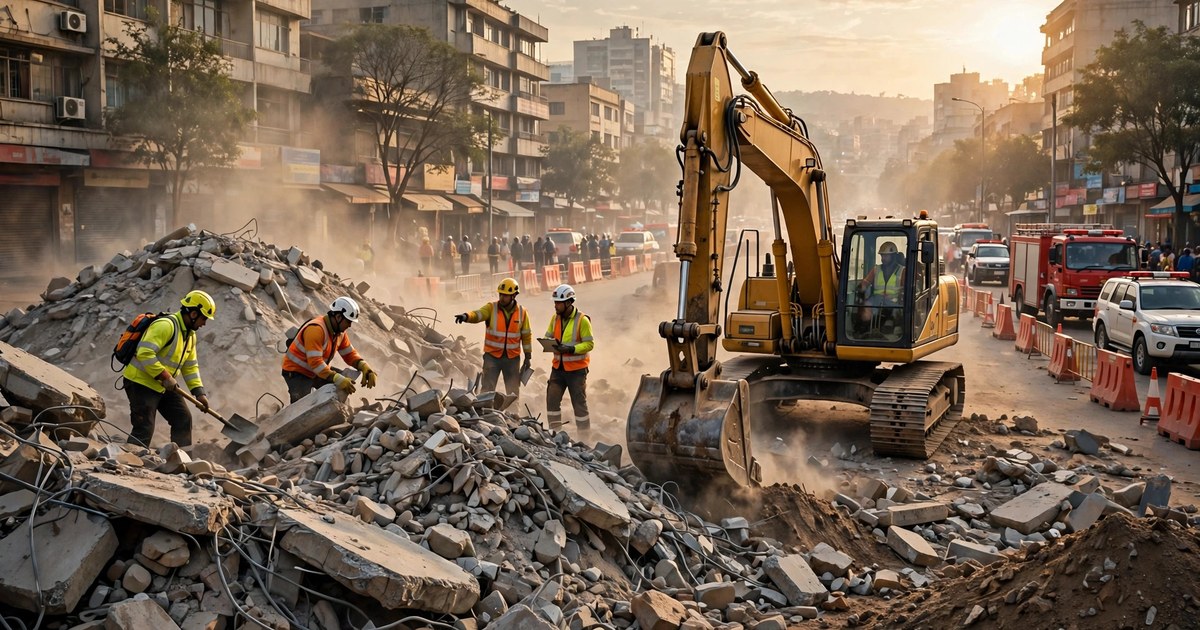
The Nairobi building collapse in Eastleigh has entered its second day, with rescue teams still digging through tonnes of concrete and twisted steel in search of people feared trapped beneath the rubble. A multi-storey building that was still under construction came down at about 1 p.m. local time on Friday, October 23, 2026, along 9th Street in one of the Kenyan capital's busiest commercial districts, turning an ordinary trading afternoon into a major emergency.
As of Saturday, October 24, at least seven people remained unaccounted for, according to Kenya's Interior Cabinet Secretary, Kipchumba Murkomen. Two survivors have been pulled from the debris alive and taken to hospital, offering fragile hope to families waiting behind police cordons. Police have now launched a manhunt for the building's owner and contractor, as investigators examine whether negligence or breaches of construction rules contributed to the disaster.
What happened in the Nairobi building collapse
The structure, described by local outlets as between 16 and 18 storeys high, was still under construction when it fell. The collapse reduced the tower to a huge pile of concrete slabs, dust and exposed reinforcement bars, and sent a cloud of dust across the surrounding streets. Eastleigh, in Kamukunji Sub-County, is a dense mix of wholesale shops, homes and street markets, usually crowded with thousands of traders and shoppers.
Sixty-seven construction workers were on site when the building came down. Sixty-six escaped unharmed and one was injured and taken to hospital, where his condition was reported to be stable. The greater fear, officials said, lay in the lower floors: 11 shops, including an electronics store, a butchery and a grocery, were operating on the ground floor and in the basement even though the building was unfinished.
One survivor, Joseph Kaula, a plasterer who had been working on the fifth floor, told the Associated Press he was the last person to walk out before the structure fell. "The whole area was filled with dust," he said. Relatives of people inside said some had phoned for help immediately after the collapse, but their phones soon went silent.
Nairobi building collapse rescue: the second-day search
The rescue operation is being run by a multi-agency team comprising the National Police Service, the Kenya Defence Forces, Nairobi City County emergency crews, the National Youth Service and the Kenya Red Cross. Rescuers have worked through the night with excavators, sniffer dogs and makeshift poles, and heavy machinery was initially slow to reach the scene, complicating the early hours of the operation.
On Saturday, Nairobi police commander Issa Mohamud said teams remained at the site, concentrating on clearing rubble and reaching the lower floors. "They are still clearing the rubble and we hope they reach the ground floors soon," he said. Rescuers reported making contact with some of those trapped, and Governor Johnson Sakaja said crews were clearing parts of the rubble to allow oxygen into voids where anyone might still be alive underneath.
The Kenya Red Cross said its search and rescue teams pulled a trapped man from the debris after hours of painstaking work and took him to Kenyatta National Hospital, and a woman was subsequently rescued alive as well — two confirmed survivors from the rubble. The organisation also reported that 26 people initially reported missing had been traced and accounted for, though it did not clarify whether that figure included the seven named by the Interior Cabinet Secretary.
Police lobbed tear gas at one point to disperse crowds that had gathered at the scene, as officers sought to keep access routes clear for emergency vehicles. Families of the missing have been urged to report to the Kenya Red Cross through its emergency response number, 1199, to help establish the whereabouts of their relatives.
Why were shops open in an unfinished building?
The central question now facing investigators is how businesses came to be operating inside a building that had never been certified as safe to occupy. Governor Sakaja said the structure had been approved for construction but had not been issued with a certificate of occupation, making the operation of businesses on the premises illegal.
Interior Cabinet Secretary Murkomen put it bluntly: the basement and ground floor had been rented to shops "despite the building still being under construction". The National Construction Authority said the site had been secured while a multi-agency team coordinated rescue operations and began preliminary investigations.
The incident has renewed long-running concerns about construction safety and enforcement of building regulations in Nairobi, particularly in densely populated commercial neighbourhoods where multi-storey developments are common. Kenya has suffered a series of deadly building collapses in recent years, often linked to poor workmanship, substandard materials, unapproved alterations and weak enforcement — a pattern that makes the Eastleigh case, and who allowed the occupation, a matter of intense public scrutiny.
Nairobi building collapse: who is accountable?
On Saturday, the National Police Service confirmed it had launched a manhunt for both the building's owner and the contractor. Police spokesperson Muchiri Nyaga said investigators were examining whether negligence or breaches of building rules contributed to the collapse.
"Any individual or entity found culpable of negligence or of violating building regulations will face the full force of the law," the police statement said. The police said a comprehensive investigation, conducted with other professional bodies, would establish the cause of the collapse and determine criminal liability. Neither individual had been named publicly at the time of the update.
Governor Sakaja has vowed that legal action will be taken against the owner, and said the building had failed to comply with construction guidelines. For the families, however, accountability is secondary for now: the priority remains the rescue, and every hour that passes makes survival less likely.
What happens next in Eastleigh
Rescue operations typically continue around the clock in the first 72 hours after a collapse, the window in which survivors are most likely to be found alive. The coming hours will determine whether more people are pulled from the rubble, and whether the missing count rises or falls as the lower floors are reached.
Investigators will then move from rescue to cause: examining the building's approvals, structural design, materials and construction records, and questioning who authorised the occupation of the ground floor and basement. Any findings could feed into prosecutions and into a wider debate about how Nairobi polices its construction boom.
For now, Eastleigh waits. The shops around 9th Street are shuttered or cordoned off, the excavators keep working, and the families of the seven missing people wait for news from beneath the concrete. The Nairobi building collapse is, trending per news coverage, one of the defining stories of the weekend in East Africa — and a stark reminder of what happens when buildings go up faster than the rules meant to keep them standing.
Sources: Associated Press and Al Jazeera reporting on the collapse, Capital FM, People Daily, Nairobi News, Kenya Red Cross updates and statements from the National Police Service and Kenya's Interior Cabinet Secretary.
Related reading: Kenya Confirms Imported Ebola Case: The Bundibugyo Virus Explained and Peshawar School Roof Collapse: What Happened at Al Khair.