
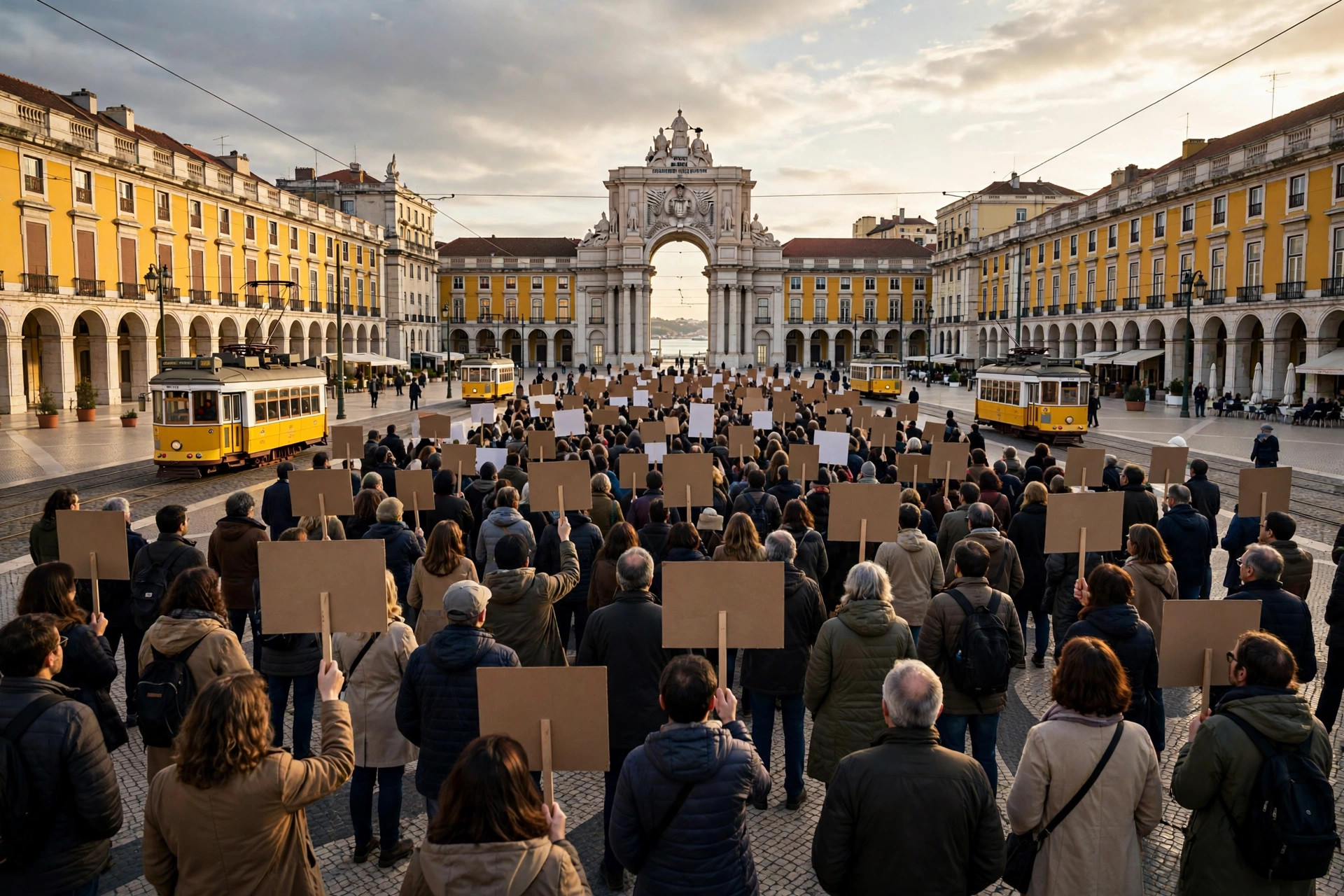
The Portugal public sector strike November 2026 brought much of the country's state machine to a halt on Friday 20 November, when teachers, doctors, nurses and local government workers walked out for 24 hours in a dispute over pay and the 2027 budget. Daily Guardian EU reported participation in schools at around 90%; many schools closed for the day, hospitals ran on minimum services, and waste collection was disrupted in towns and cities across the country. Five of Portugal's best-known museums and monuments shut their doors too. The stoppage was called by the Frente Comum, the main front of public administration unions, and it landed four days before parliament's final vote on the 2027 State Budget.
For anyone living in Portugal, or visiting that week, the strike was hard to miss. Classrooms emptied, routine hospital appointments were postponed, town hall counters went unstaffed, and bins went uncollected in some neighbourhoods. Yet the strike was not a one-day outburst. It was the sharpest point so far in a month of protest over housing, pay and the cost of living, and the unions have already set out what comes next: a national demonstration in Lisbon on Saturday 21 November, a rally outside parliament on 24 November, and a separate train drivers' strike from 23 to 27 November.
What happened on Friday 20 November
The strike ran from 00:00 to 24:00 on Friday 20 November 2026, covering the whole of Portugal's public administration. The Frente Comum de Sindicatos da Administração Pública, the Common Front of Public Administration Unions, had decided on the date at a meeting held outside the Assembleia da República, Portugal's parliament, on Tuesday 27 October. The Portugal Brief reported the decision that day, citing Lusa, ECO and RTP.
Schools felt the stoppage first. With teachers and non-teaching staff both covered by the strike, many public schools closed entirely, while others opened with skeleton staffing and no classes. Daily Guardian EU reported participation among school staff at around 90%. Teachers did not have to tell their schools in advance that they were striking, and no minimum services were required in schools, so headteachers in many places had no way of knowing until the morning how many staff would turn up.
Hospitals and health centres kept running, but at a reduced level. Under the doctors' strike notice, minimum services matched what each hospital or health centre runs on Sundays and public holidays. Emergency care, chemotherapy, radiotherapy, dialysis and transplants were guaranteed, according to HopinPortugal, but routine appointments and planned surgery were postponed in many places, and some health centres closed for the day. Doctors' federation FNAM had filed a notice covering doctors in the public, social and private sectors, from 00:00 to 24:00.
Local services were hit as well. Town halls, courts, tax offices, Social Security counters and Loja do Cidadão citizen shops were closed or short-staffed in many areas. Waste collection suffered: the local government union STAL proposed minimum services only where a service met an essential need, with staffing no higher than a Sunday night shift in the holiday season. Its notice also covered shifts beginning on the evening of 19 November, so overnight bin rounds were affected before the strike day even began.
Visitors felt it too. Jerónimos Monastery and Belém Tower in Lisbon, the Soares dos Reis National Museum in Porto, Guimarães Castle and Sagres Fortress all closed on 20 November, five of the country's most visited monuments and museums, according to Daily Guardian EU. Residence appointments at AIMA, the immigration and asylum agency, were also at risk, because AIMA staff are public administration workers.
The Portugal public sector strike November 2026 in numbers
The figures behind the day explain why the unions chose it. The Frente Comum is asking for a pay rise of at least 15%, with a minimum of €150 a month for every worker. It wants the lowest public sector salary raised to €1,150 from 1 January 2027, the daily meal allowance lifted to €13, and a 35-hour working week for all public workers. The Portugal Brief set out those demands in its 27 October report, and again in its 11 November report on the unions joining the strike.
Around 90% of school staff took part, according to Daily Guardian EU. Five national museums and monuments closed. The strike lasted 24 hours, from midnight to midnight. And the unions' claim rests on 83 proposals, which the Frente Comum delivered to the government on 30 September. In a leaflet dated 30 October, the Frente Comum said the government had still tabled no pay proposal after two meetings.
The numbers matter because they show a gap that has not closed. Pay in the public sector has lagged behind the rising cost of living, and the unions argue that the 2027 budget, as drafted, does nothing to close it. The government, for its part, had offered no new pay proposal by the time the strike was called, and none had appeared by the strike itself.
Who joined the strike — and why
The stoppage grew union by union in the weeks after the Frente Comum set the date. The Portugal Brief reported on 11 November that doctors, nurses, teachers and local government workers had all filed notices for 20 November.
Doctors came in through FNAM, the National Federation of Doctors, whose three regional unions filed a notice covering every doctor in the public, social and private sectors. The doctors' demands include the 15% rise in base pay, the repeal of SIADAP, the civil service appraisal system, a higher meal allowance and better career progression. Doctors did not need to be union members to join.
Nurses joined through SEP, the Portuguese Nurses' Union, which said on 3 November that nurses would strike on the night, morning and afternoon shifts. Teachers joined through FENPROF, the National Federation of Teachers, whose notice covers nursery, primary, secondary and university teachers and researchers in state, private and social-sector schools. Local government workers joined through STAL, the union for town halls, parish councils, municipal services and companies, including water, sanitation, street cleaning and waste collection.
Each group has its own grievances, but the shared demand is pay. The 15% figure appears in every union's notice. So does the complaint that staffing is too thin: the Frente Comum's campaign also calls for broader recruitment into public services, a review of the appraisal system and better careers.
What unions are demanding
The core demand is straightforward: a rise of at least 15%, with a minimum of €150 a month, for every public administration worker. The Frente Comum says the rise must apply to all workers, not only to those at the bottom of the scale, and it wants the lowest public sector salary set at €1,150 from 1 January 2027.
Alongside pay, the unions want the daily meal allowance raised to €13, a 35-hour week for everyone in public administration, and the repeal of SIADAP. They also want the 83 proposals they delivered on 30 September to be negotiated. The Frente Comum said the strike would be called off only if the government negotiated those proposals. By 30 October, after two meetings, the government had tabled no proposal at all, according to the Frente Comum's own leaflet, as reported by The Portugal Brief.
The timing was deliberate. The strike was set for 20 November, four days before parliament's final vote on the 2027 State Budget on 24 November. The message to the government and to parliament was that the budget, as it stands, does not answer the pay question, and that public workers were prepared to stop the state to say so.
What the Portugal public sector strike November 2026 means for the 2027 budget vote
The 2027 State Budget reaches its final vote on Tuesday 24 November, and the strike was designed to shape that vote. The Frente Comum chose the date precisely because the budget was still open to pressure: a strike four days before the vote puts the pay dispute in front of every member of parliament at the moment they decide the state's spending for next year.
Whether it works depends on what happens between now and the vote. The government has so far offered no new pay proposal, and the unions have shown they can bring schools, hospitals and town halls to a standstill. If the budget passes unchanged, the unions have already signalled that the dispute will continue into 2027, with the pay claim unresolved and the 35-hour week and meal allowance still on the table.
The 20 November stoppage followed an earlier public sector walkout on 2 November, when union reports put overall civil service mobilisation at around 60%, according to HopinPortugal. The strike also fits a wider pattern. Portugal has seen a month of protest in November 2026 over housing, pay and the cost of living, with a national day of action on housing on 14 November and cost-of-living protests spreading across Europe. The public sector strike is the largest single action in that wave, and the one most directly aimed at the budget.
What happens next: Lisbon march, train strikes and the 24 November vote
The protest does not end with the strike. On Saturday 21 November, the CGTP, Portugal's largest trade union confederation, holds a national demonstration in Lisbon, calling for higher wages and pensions. HopinPortugal reported that the march starts at 2:30 pm at Parque Eduardo VII, and runs through Marquês de Pombal and Rato to the parliament at São Bento. FENPROF said teachers would join the demonstration, and STAL filed a second strike notice for 21 November so its members could attend. Expect traffic restrictions and busy metro stations in central Lisbon.
Then, from Monday 23 to Friday 27 November, CP train drivers are due to strike, which will disrupt rail travel across the country for five days. The public administration strike itself did not cover public transport companies such as CP, Metro de Lisboa, Carris and TAP, according to HopinPortugal, so the train strike is a separate dispute arriving immediately afterwards.
A prison guards' strike is also running from 17 November to 3 January, with minimum services, which may affect prison visits, according to HopinPortugal.
On Tuesday 24 November, the day of the final budget vote, the SITEU nurses' union has called a 24-hour national strike, including in Madeira, and the CGTP will rally outside parliament. The Frente Comum's campaign will be watching the vote itself: if the budget passes without movement on pay, the unions are likely to keep the pressure on into December, when Portugal's 2027 pension increases and the December supplement will be in the news again.
Why it matters
The strike matters for three groups of people. For public workers, it is about whether pay keeps pace with prices: a 15% rise, a €150 minimum and a €1,150 base salary would be the largest single improvement in the claim, and the government has yet to answer it. For the public, it is about services: schools, hospitals, town halls and bins are the parts of the state people touch every week, and the strike showed how quickly they can stop. For travellers, the lesson is practical: Portugal's schools had already shut earlier in November when Storm Charles closed schools across the country, and the strike calendar for the month is still filling up, so anyone with a school place, a hospital appointment or a train to catch should check before travelling.
It also matters beyond Portugal. The same squeeze on pay and public services is driving protest elsewhere in Europe, from school funding protests in France to the wider cost-of-living demonstrations. Portugal's unions chose the budget vote as their pressure point. What parliament decides on 24 November will show whether a 24-hour stoppage of the state was enough to move it.
Sources: Daily Guardian EU, Bica, HopinPortugal, The Portugal Brief — November 2026.