
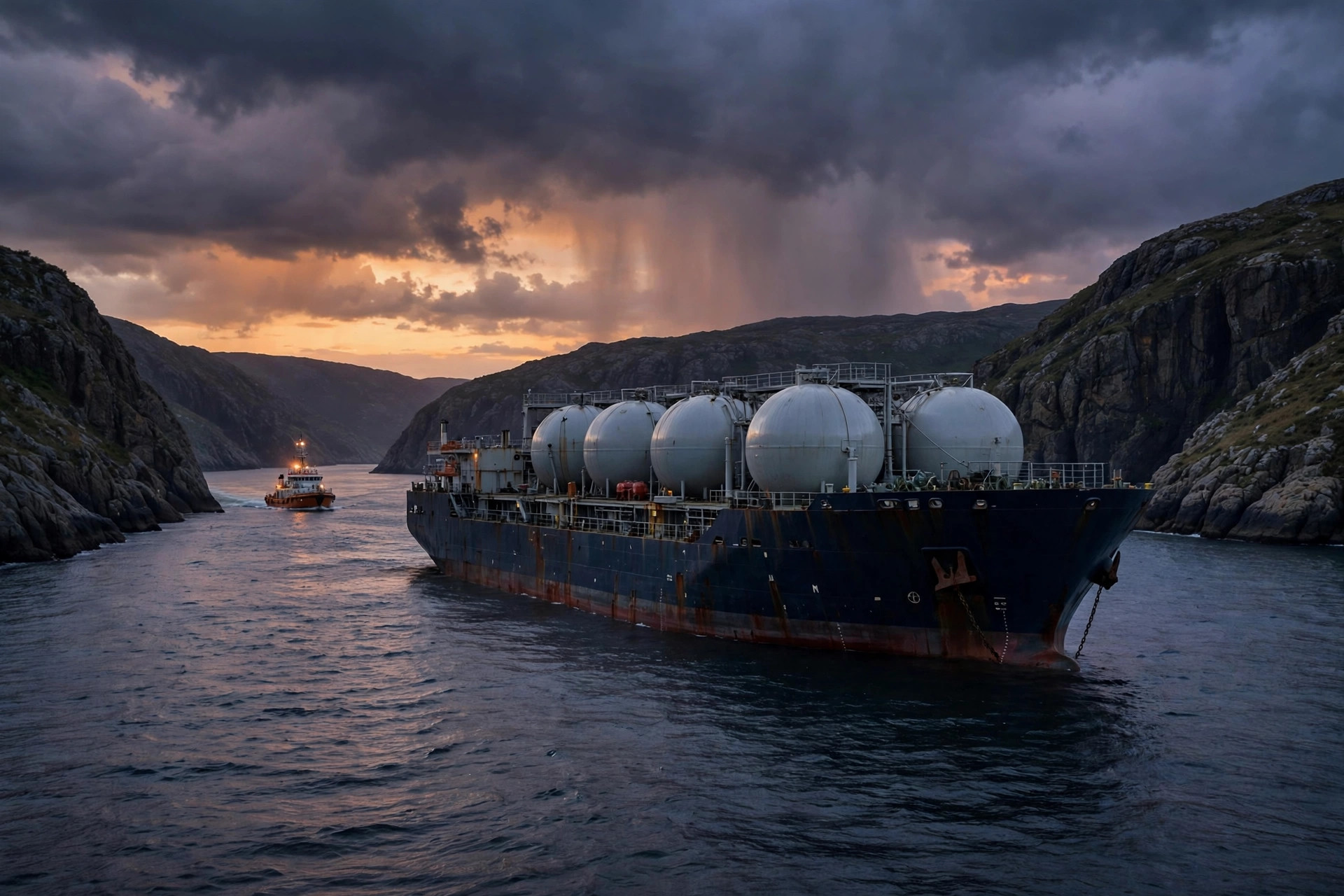
The MT Tara Gas tanker attacked Strait of Hormuz in two separate strikes, on 16 and 17 November 2026, has become the latest test of safety in one of the world's most important shipping lanes. The Panama-flagged LPG carrier, carrying 25 crew members — 24 of them Indian nationals — was hit first on the evening of 16 November and again the following day, forcing the entire crew to abandon ship. Twenty-one Indian seafarers were safely evacuated ashore at Khasab in Oman, two injured crew members were admitted to hospital, and one Indian national remains missing, with a search continuing alongside the Omani authorities. No group has claimed responsibility for the attack, and no blame has been officially assigned.
India's Ministry of External Affairs set out the position in a statement carried by TBS News and ANI: "We condemn the attack on the Panama-flagged LPG tanker MT TARA GAS in the Strait of Hormuz on 16 November 2026. Of the 24 Indian nationals on board, 21 have been safely evacuated ashore at Khasab, two injured Indian crew members have been admitted to hospital, while one Indian national remains missing." The statement is the clearest official account of what happened to the crew, and it is the basis for the figures in this article. The ministry said the search for the missing seafarer was continuing with the Omani authorities.
MT Tara Gas Tanker Attacked Strait of Hormuz: What Happened in the Two Strikes
According to Seatrade Maritime, the first strike came on 16 November at about 19:00 UTC, roughly seven nautical miles north of Khasab, a port town on Oman's Musandam Peninsula that overlooks the strait. The impact disabled the vessel and started a fire in the engine room. The crew fought the fire and kept the ship afloat through the night, but the vessel was no longer able to move under its own power. A second strike on 17 November forced the full crew to abandon the ship. By that point, staying aboard a drifting, burning gas carrier was no longer an option.
The ship is owned by Global Gas Inc and managed by Matrix Maritime Solutions, a company based in the United Arab Emirates, Seatrade Maritime reported. It flies the flag of Panama, a common arrangement in commercial shipping, where vessels are registered in one country, owned in another, managed in a third, and crewed by nationals of a fourth. That is why an attack on a Panamanian-flagged ship with an Indian crew, managed from the UAE and rescued in Oman, touches so many governments at once. The cargo was liquefied petroleum gas, or LPG — the propane and butane used for cooking and heating in homes and businesses. A fire aboard an LPG carrier is a serious danger, because the cargo is stored under pressure and is highly flammable.
ShipUniverse reported that 24 of the 25 crew members were accounted for, and that the vessel was drifting at 26°21.38′N, 56°16.30′E, according to navigational warning NAVAREA IX 445/26. A NAVAREA warning is a formal notice issued to ships in a region, telling them where a hazard is and what to avoid. The position places the drifting vessel inside the strait, the narrow waterway between Iran and Oman through which a large share of the world's seaborne oil and gas passes. Ships still moving through the area were warned to keep clear of the drifting carrier.
Background: Why the Strait of Hormuz Matters to the MT Tara Gas Tanker Attacked Strait of Hormuz
The Strait of Hormuz is a narrow channel, about 33 kilometres wide at its narrowest point, connecting the Persian Gulf to the open ocean. Almost all of the oil exported by Saudi Arabia, Iraq, Kuwait, the United Arab Emirates and Qatar passes through it, along with large volumes of liquefied natural gas. Any disruption there can move global energy prices within hours, because there is no practical alternative route for most of that cargo. That is why every incident in the strait is watched far beyond the region.
The attack on the MT TARA GAS did not happen in isolation. Figures from the International Maritime Organization, reported by Al Jazeera via The Library Estate, counted 136 security incidents in the strait and the wider Middle East between 1 March and 11 November 2026, with 35 of those in October alone. The numbers describe a steady pattern of danger rather than a single event: mines, drones and small-boat attacks have hit shipping in the region repeatedly through the year. Earlier in November, three tankers hit by mines in the strait, and an LNG tanker reported struck in the strait as well. The MT TARA GAS is the latest vessel in that sequence, and the first in this series to leave a crew member missing.
For seafarers, the risk is personal in a way that energy-market figures do not capture. Crews on these routes are often from India, the Philippines and other countries that supply the world's merchant sailors. They sign on for months at a time, far from home, and their families follow the news of each incident with dread. The 24 Indian nationals aboard the MT TARA GAS were working a routine voyage when the first strike hit. That is the human side of a shipping-security story: the cargo matters to markets, but the crew matters to the families waiting for news.
Why the Attack on the MT Tara Gas Tanker Attacked Strait of Hormuz Matters
The immediate question is the fate of the missing seafarer. The search continues with the Omani authorities, and until it ends, the story is unresolved for one family. The two injured crew members are in hospital, and the 21 who were evacuated ashore at Khasab are safe. That is the outcome that matters most, and it is the one the Indian government has put first in its public statements.
The wider question is what the attack means for shipping through the strait. Insurers, shipowners and charterers all price risk into their decisions, and a pattern of attacks raises the cost of moving cargo through the region. War-risk insurance premiums rise, some owners reroute or delay voyages, and the added cost eventually reaches consumers in the form of higher energy and goods prices. The 136 incidents counted by the International Maritime Organization over eight months show that this is not a one-off spike but a sustained problem that the shipping industry has to plan around.
There is also a diplomatic dimension. India has 24 of its nationals involved, Oman is hosting the rescued crew and running the search, the UAE is home to the ship's manager, and Panama is the flag state. Each of those governments has a formal role, and each will want answers about who carried out the attack and how a second strike could follow the first a day later. The fact that no group has claimed responsibility, and that no official attribution has been made, means the investigation matters as much as the rescue. Assigning blame without evidence would be a mistake; the record so far is that the attack happened, the crew was largely saved, and one person is still missing.
Key Facts About the MT Tara Gas Tanker Attacked Strait of Hormuz
The facts, as reported by the sources named in this article, are as follows. The vessel is the Panama-flagged LPG tanker MT TARA GAS, owned by Global Gas Inc and managed by Matrix Maritime Solutions of the UAE. The first strike was on 16 November 2026 at about 19:00 UTC, about seven nautical miles north of Khasab, and it disabled the vessel and caused an engine-room fire. The second strike was on 17 November and forced the full crew to abandon ship. The crew numbered 25, of whom 24 were Indian nationals. Twenty-one Indian crew members were evacuated safely ashore at Khasab, two injured Indian crew members were admitted to hospital, and one Indian national remains missing. The vessel was last reported drifting at 26°21.38′N, 56°16.30′E under NAVAREA IX 445/26. The International Maritime Organization counted 136 security incidents in the strait and the wider Middle East from 1 March to 11 November, including 35 in October alone.
India's Ministry of External Affairs condemned the attack and said the search for the missing seafarer was continuing with the Omani authorities. That statement, carried by TBS News and ANI, is the authoritative account of the crew's condition. No group has claimed responsibility, and this article makes no attribution.
What Happens Next After the MT Tara Gas Tanker Attacked Strait of Hormuz
The search for the missing crew member comes first, and it will continue until the Omani authorities and the Indian government say otherwise. The rescued crew members will need medical checks, consular help and transport home, and the two injured seafarers will need hospital care. The Indian government will be in close contact with their families, as it has been since the attack was reported.
Then comes the question of the ship itself. A drifting LPG carrier with fire damage is a hazard to navigation and to the environment, and it will need to be towed to a safe anchorage or port once the area is secure. Salvage teams will assess whether the vessel can be repaired or whether the damage is too severe. The cargo will need to be dealt with safely before any repair work can begin.
The longer question is security in the strait. With 136 incidents in eight months, shipping companies and governments will be asking what more can be done to protect crews and cargo — the same question raised by talks on reopening the strait and by earlier reports of tankers hit by mines in the strait. The answers may involve naval patrols, better warning systems, higher insurance costs, or diplomatic pressure. Whatever the response, the MT TARA GAS will be remembered as the incident that left one Indian seafarer missing — and as a reminder that behind every shipping statistic, there are people on board.