
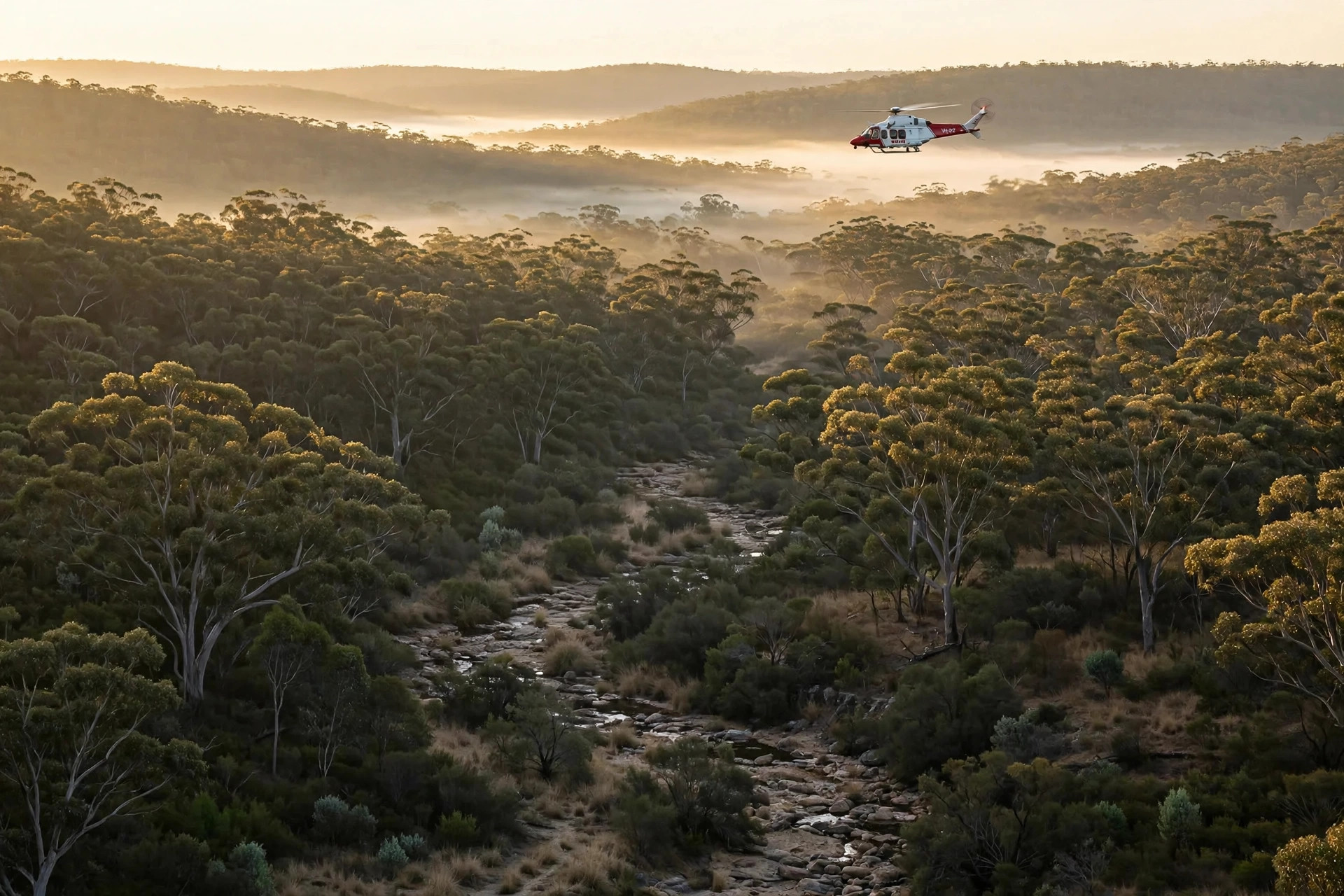
A 17-year-old boy with autism was found alive on Thursday, 12 November 2026, after six days lost in dense bushland in eastern Victoria, Australia. The missing autistic teen found alive in Australia had survived on a packet of chips and creek water, sheltered under two towels, after falling down a steep cliff into a remote gully. A Victoria Police Air Wing helicopter crew spotted him asleep on a flat rock beside a creek, about two kilometres from his campsite, and winched him to safety.
Police identified the teenager only by his first name, William. His surname has not been released, and the Associated Press said it would not publish his family name to avoid identifying him. His family has said he has Level 2 autism, which the Australian advocacy group Autism360 describes as requiring substantial support. The rescue ended a search that involved more than 100 emergency personnel and volunteers, police dogs, divers and helicopters, working through steep, thickly forested country near Walhalla, a former gold-mining town about 185 kilometres east of Melbourne.
Missing autistic teen found alive in Australia: how the helicopter crew spotted him
The breakthrough came from something small. On the morning of Thursday, 12 November, a Victoria Police Air Wing helicopter crew flying over bushland in the Cowwarr area spotted a fishing tackle box sitting in thick vegetation about two kilometres east of Stoney Creek. The crew looked closer, and then saw William lying near a creek. Senior Constable Emma Quick, who was on board the helicopter, said the crew realised he was alive when he lifted his head. Pilot Dave Wylie said much of the country they were flying over is so thick that the forest floor is invisible from the air, meaning a crew can pass directly over a missing person and never see them.
William woke to the sound of the helicopter and gave the crew a thumbs up before rescuers winched him to safety, Acting Police Inspector Jason Benbow told reporters. Video shot from the rescue helicopter showed him shirtless and sunburned, wearing shorts and boots, with two towels doing the job of blankets. He was flown to a search base at Cowwarr and reunited with his mother, Elizabeth, who had been waiting there. "Amazingly, William is in good spirits and for the most part, in good health," Victoria Police said in a statement reported by the Associated Press.
The six-day search near Walhalla, Victoria
William had gone camping with a teenage friend at Walhalla East in Gippsland, in Victoria's east, on what the Australian Broadcasting Corporation described as his first independent camping trip. He was last seen at about 4pm on Friday, 6 November, near Stoney Creek Road, between Cowwarr and Walhalla, after walking back towards the drop-off point to collect additional camping gear. He was wearing only a pair of shorts and work boots, and he had not taken his phone.
When he did not return, his family reported him missing, and a large search began. More than 100 emergency services personnel and volunteers took part, including police, State Emergency Service volunteers, search-and-rescue teams, police dogs, divers and helicopters, according to Victoria Police and the Associated Press. The terrain made the search slow: Benbow said William had trekked for days up and down very steep terrain after falling down a cliff into a remote gully, and had spent the final two days in the same location near the creek because the steepness of his surroundings made it difficult for him to move.
Temperatures in the region dropped as low as 3 degrees Celsius during the six days he was missing, the Bureau of Meteorology reported. Spring weather in the alpine region had otherwise been mild, with little rain, according to the Associated Press — conditions that likely helped him survive nights outdoors with so little clothing or shelter. The search covered difficult ground around Cowwarr, Stoney Creek and the surrounding wilderness, and police later said finding him would not have been possible without the police helicopter.
Missing autistic teen found alive in Australia: how he survived six days
William survived on a family-sized bag of chicken-flavoured chips, his only food for six days, and water from the creek, according to reports from the Sydney Morning Herald and the Australian Broadcasting Corporation. He rationed the chips across the week. The two towels he had with him served as blankets at night. He was sunburned on his face and upper body, and had cuts and scratches to his legs, but he was able to walk with help and to speak to rescuers.
He also kept his spirits up by singing. William told Channel Seven from his hospital bed that he sang John Denver's song "Take Me Home, Country Roads" to keep himself going during the cold nights in the bush, and that there were times when he did not think he would be found. His mother, Elizabeth, told Sunrise she had an out-of-body experience when she was reunited with her son, and joked that he was grounded for life and would never be leaving the house again.
The survival story is striking because of how little he had with him. He had no phone, no tent, no sleeping bag and no food beyond the chips. He had only the clothes he was wearing, the towels, and the creek water. The steep gully that trapped him also sheltered him near water, and the mild, mostly dry spring weather spared him the rain and colder nights that the region can produce in November.
What happened in hospital after the rescue
William, the missing autistic teen found alive in Australia, was taken to Latrobe Regional Hospital after the rescue so his condition could be monitored. He spent a night in intensive care after his blood pressure dropped because of dehydration, and was then due to be transferred to The Alfred hospital in Melbourne for further testing and specialist review, according to the Australian Broadcasting Corporation and the Associated Press. Latrobe Regional Hospital chief executive Don McRae said William was in a stable condition and in good spirits, with his mother by his side.
His mother had earlier told reporters that he appeared to be in perfect health, and police said he was in good spirits and mostly in good health when found. The hospital stay was precautionary as much as anything: six days with almost no food, limited water, sunburn and cold nights can leave dehydration and other problems that only show up after the immediate relief of rescue. Doctors kept him under observation rather than discharging him the same day.
What happens next — and what the rescue shows about bush safety
William's transfer to The Alfred in Melbourne was for further tests and specialist review, and no date for his discharge had been announced at the time of reporting. His family has not announced any public statement beyond the interviews his mother gave, and police have not released his surname. The search operation has been stood down, and the focus has shifted to his recovery.
The rescue also carries a practical lesson for anyone heading into Australian bushland. A phone, a charged battery, warm clothing, water and a way to signal for help are the basics that separate a short delay from a multi-day search, and a tackle box left visible in the scrub was the clue that finally led a helicopter crew to look twice. Searchers, volunteers and the police air wing worked for six days across country where the forest floor cannot be seen from the air, and the outcome depended on that one small object catching a crew's eye. For families of teenagers with autism, the case also shows why support needs matter on trips away from home: William's Level 2 autism means he requires substantial support in daily life, and his first independent camping trip became a test of that support in the hardest possible conditions. He passed it, with help from a packet of chips, two towels, a song, and a helicopter crew that did not give up. Readers in Australia can also read our report on flash flooding on Australia's east coast in October 2026, and the High Court challenge to Australia's social media ban.