
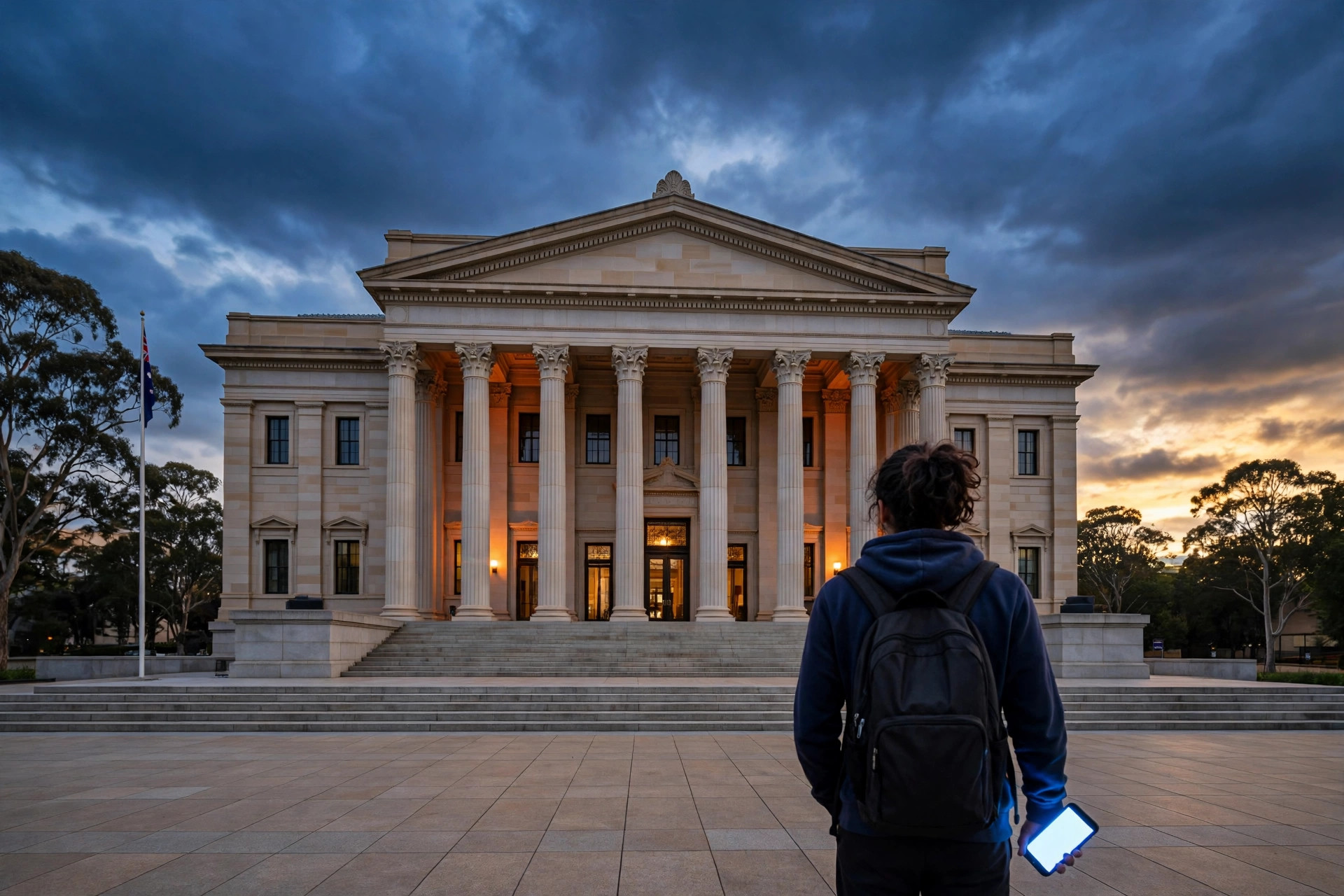
Australia's world-first ban on social media accounts for children under 16 went before the country's highest court in the first week of November 2026, and the Australia social media ban High Court challenge has become the sharpest test yet of a law that governments around the world have been watching closely. Over two days, 3 and 4 November, all seven justices of the High Court in Canberra heard two constitutional challenges — one brought by Reddit, the other by the Digital Freedom Project — and then adjourned without a ruling. No date has been set for the decision, and court watchers expect it to take months. What the justices decide will settle whether the ban survives in its current form, whether Reddit falls under it at all, and how far Australia's Constitution protects political discussion by people too young to vote.
How the Australia Social Media Ban High Court Challenge Reached Canberra
Parliament passed the ban in late November 2024, within a single week, after allowing only 24 hours for public submissions — a speed Reddit's lawyers later made central to their case. The law inserted Part 4A into the Online Safety Act 2021. It requires ten named platforms — Facebook, Instagram, Threads, Snapchat, TikTok, YouTube, X, Reddit, Kick and Twitch — to take reasonable steps to stop Australians under 16 from holding accounts. It does not punish children or their families: the obligations, and the fines, fall on the platforms.
The ban took effect on 10 December 2025. Since then, government data cited in court reporting puts the number of accounts blocked, suspended or deactivated at more than 5 million across the ten platforms. Meta alone reported that Facebook and Instagram had removed access from 756,000 accounts as of 30 June 2026. The Digital Freedom Project filed its constitutional challenge in the weeks before the ban took effect; two Sydney 15-year-olds, Noah Jones and Macy Neyland, were named as plaintiffs when the case was filed, according to the Associated Press. Reddit filed separately, and the High Court joined the two cases into a single special case heard by all seven justices.
What Reddit and the Digital Freedom Project Argued
Reddit's barrister, Perry Herzfeld SC, told the court the ban was "ill thought out" and a "profound restriction on political debate". His argument, as reported by Reuters, was that the law cuts teenagers off from one of the main places they encounter news and political discussion. Reddit's submission described online platforms as a "common source of news and political information" in Australia, and Herzfeld pointed to communities such as the subreddit r/Australia, where teenagers read and take part in political conversation.
Both challengers rest their cases on the implied freedom of political communication in the Australian Constitution. The argument is not that the Constitution grants a free-standing right to use social media. It is that the ban burdens political communication — discussion of public affairs that the Constitution is taken to protect — and that the burden is not justified by the law's purpose. The Digital Freedom Project, led by New South Wales Libertarian parliamentarian John Ruddick, argues the same point from a civil-liberties position: a blanket age ban, it says, is a blunt tool that sweeps up legitimate discussion along with the harms it targets. The group is also suing the eSafety Commissioner and Communications Minister Anika Wells.
Reddit has a second, separate argument. The company says it should not be covered by the law at all — that it is not an "age-restricted social media platform" within the meaning of Part 4A. If the court accepts that point, Reddit could escape the ban even if the law itself survives. The challengers also attacked the way the law was made: rushed through Parliament in a week in 2024, with a single day for public submissions, they say, it was never properly tested before it became the world's first ban of its kind.
How the Government Defended the Ban
Communications Minister Anika Wells, a named defendant in the proceedings, attended the hearing and told reporters outside the court that the laws were under attack and that the government would defend them. She has also said the government will accept the court's eventual ruling. Inside the courtroom, government lawyer Stephen Lloyd described the ban as a modest measure with positive effects, and Joanna Davidson SC opened the government's substantive case by arguing that children are more vulnerable than adults to the addictive features built into social media, because their brains are still developing.
Davidson set out seven risks she said flowed from platform design: addictive use, disrupted sleep, depression, anxiety, suicidal ideation, worse disordered eating, and the intensification of ADHD symptoms. Her presentation continued into the second day of the hearing, 4 November. The government's position is that any burden on political communication is justified by the scale of those harms — and that the ban is proportionate because it targets accounts, not access to information itself: under-16s can still read much of the internet, just not hold accounts on the ten named platforms.
The maximum fine for platforms that fail to comply is itself a point of confusion in the public record. Reuters reported that the government had doubled the maximum penalty to A$99 million. Other coverage, including reporting from ABC News, has cited A$109.2 million. The two figures have not been reconciled in public reporting, and this article does not treat either as settled. What is not in dispute is that the penalties are large, and that the eSafety Commissioner's enforcement powers have been widened alongside them.
What the Australia Social Media Ban High Court Challenge Could Decide
The hearing adjourned on 4 November with no ruling, and no date has been set for the decision. High Court judgments of this kind commonly take months. Three broad outcomes are possible. The court could uphold the law in full, leaving the ban in place and confirming that Parliament can impose age-based platform restrictions. It could strike the law down, which would force the government back to the drawing board and reopen the question of more than 5 million blocked or suspended accounts. Or it could take a middle path — for example, accepting Reddit's argument that it falls outside the law's definition, while leaving the ban itself standing for the other nine platforms.
The case is not the only one this month in which a court is being asked to settle a contested government decision. Islanders challenging the transfer of the Chagos Islands had their own hearing in the High Court — see Chagos High Court hearing: islanders challenge transfer.
Why It Matters — and What Happens Next
This is the first constitutional test of an age-based social media ban anywhere in the world, and that is why the hearing drew attention well beyond Australia. Governments in Britain, the European Union and several US states are considering similar age restrictions, and all of them will read the High Court's reasoning when it lands. If the court upholds the ban, it becomes a tested template other countries can copy. If it strikes the law down, the result will be a warning that age bans must be drawn far more narrowly — or paired with the kind of evidence the court found missing here.
The case also matters because of what has already happened on the ground. More than 5 million accounts have been blocked, suspended or deactivated since December 2025, and those accounts belong to real teenagers who have now spent almost a year outside the platforms where much of their peer and political life happens. Whatever the court decides, the government will have to answer for that record: either the ban worked and the numbers justify it, or it did not and the disruption was for nothing. Big technology firms are under pressure on several fronts this month, from courtrooms to boardrooms — Tesla, for instance, discontinued the Cybertruck in November 2026.
What happens next is a wait. The court has adjourned, no ruling date has been set, and a decision is likely months away. When it comes, watch three things: whether the court accepts the implied-freedom argument at all, whether it rules separately on Reddit's claim that it is not covered by the law, and what it says about the evidence of harm — because that reasoning, more than the result, is what other countries will copy. Until then the ban stays in force, the ten platforms must keep enforcing it, and under-16s in Australia remain locked out of their accounts.
Key Facts at a Glance
- The High Court heard the challenge on 3–4 November 2026 in Canberra, before all seven justices; the hearing has adjourned and no ruling date has been set.
- Challengers: Reddit and the Digital Freedom Project, led by NSW Libertarian MP John Ruddick.
- The ban, in force since 10 December 2025, requires ten platforms to take reasonable steps to stop under-16s holding accounts; children and families face no penalties.
- More than 5 million accounts have been blocked, suspended or deactivated, according to government data cited in court reporting.
- The maximum fine is reported as A$99 million by Reuters after doubling, and as A$109.2 million in other coverage — the figures conflict and neither is treated here as settled.
- Communications Minister Anika Wells is a named defendant; the government says it will accept the court's ruling.