
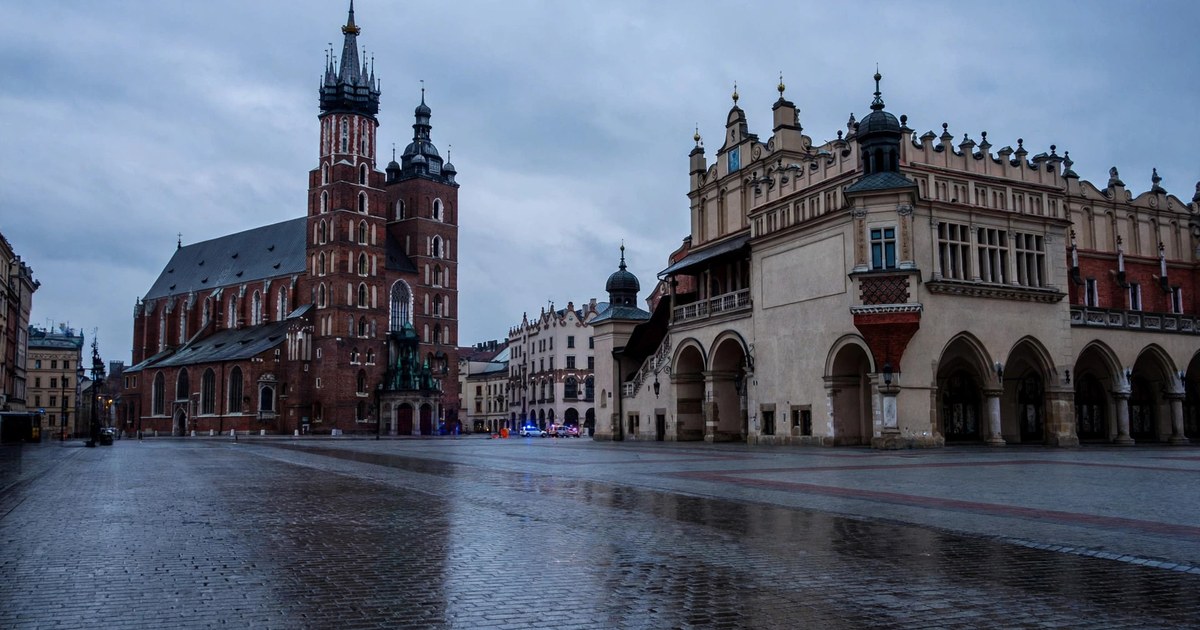
The Krakow shooting turned one of Europe's busiest tourist squares into a crime scene on Saturday afternoon, 7 November 2026. At around 3 p.m. local time, a man drove a car onto the Main Market Square — Rynek Główny — in the heart of Poland's second-largest city and began firing at random people from inside the vehicle, according to Małopolska Police. At least six people were killed and 15 injured before officers shot the gunman and took him to hospital. The gunman, a 24-year-old Polish citizen, died in hospital early on Monday 9 November, Małopolska Police said, after two days in critical condition. Four of the dead were women and two were men, police said. The motive is under investigation, but Interior Minister Marcin Kierwiński said the attacker was fascinated with far-right ideologies and held "very radical views," the Associated Press reported, and Prime Minister Donald Tusk called the attack terrorism, saying: "Until now, we have not had such drastic cases of terrorism in Poland."
The square, lined by St Mary's Basilica and the Cloth Hall, is one of Europe's largest medieval squares and sits at the centre of Krakow's UNESCO-listed Old Town. On a Saturday afternoon it is normally packed with tourists, shoppers and street performers. Within minutes of the first shots, it was sealed off by police, with ambulances across the square and a medical air rescue helicopter landing on the cobblestones.
What happened in the Krakow shooting
Police began receiving reports at around 3 p.m. local time (2 p.m. GMT) that a man in a car had entered the Main Market Square and was firing at random people. A spokesperson for the Krakow police told TVN24 that the gunman was wearing military-style clothing and was using a military-type long gun. The city's municipal transport company, MPK, said a tram driver had reported being fired upon at around the same time while passing near the square, and Polish media reported that a tram on route 1 came under fire from a passing car shortly before the main shooting.
The fire service said the shots came from a Subaru with no licence plates that entered the square from Sławkowska Street. Police said the gunman drove through the square firing indiscriminately, then left the area. Officers confronted him a short distance away, at the junction of Stradomska and Dietla streets, about half a mile from the square. The suspect returned fire, wounding police officers, before officers shot him, detained him and took him to hospital. Police shot him within three minutes of the attack beginning, officials said, and he died of his injuries early on Monday 9 November.
Emergency services worked at the scene for hours. Images from the square showed police officers and ambulances across the area, and a Polish Medical Air Rescue helicopter landed in the square itself. Broadcaster Republika, which had a crew on the square covering a planned anti-government protest, showed footage of paramedics treating victims. The square was closed off as police turned people away.
The casualty figures moved during the afternoon as hospitals reported in. The fire brigade's first report, carried by TVN24, put the toll at two dead and 10 injured. Małopolska Police later confirmed five deaths and said more than a dozen people were wounded. The toll then rose to six after one of the injured died, with 15 injured in total, according to The Times and CNN. The figures may change again as police release more information.
Who was killed and injured in the Krakow shooting
Nine people were killed by the gunman in the Krakow shooting — six in the Main Market Square (four women and two men) and three more, his parents and sister, at the family home in Ostrowiec Świętokrzyski, according to police. Fifteen more were injured in the square. A British citizen is among the six people killed in the square, national police chief Marek Boroń said, according to the Associated Press, and five of the injured are foreign nationals, including people from Austria, Germany, Portugal, Russia and Britain, an Interior Ministry spokesperson told Reuters. Police have not released the names of the victims. The gunman himself died in hospital on 9 November, bringing the total number of deaths in the weekend's violence to 10.
At least two police officers were among the injured. One officer is in a critical condition after being shot three times, with surgery under way on Saturday evening, Interior Minister Marcin Kierwiński said. Police have not described the second injured officer's condition in detail. The injured were taken to hospitals across Krakow, and the medical air rescue helicopter that landed in the square flew at least one of the seriously wounded to hospital.
The rising toll is a reminder that the numbers from a breaking story are provisional. What began the afternoon as a report of two dead became five, then six in the square — and then three more at the gunman's family home, taking the number he is accused of killing to nine. Anyone following the Krakow shooting should treat the figure of nine killed by the gunman, plus the gunman himself, as the latest count, not a final one.
The suspect: what police have said so far
Police said the suspect is a 24-year-old Polish citizen and the only perpetrator. Officers denied media reports that they were looking for a second person. His name has not been officially released, but Polish media, citing unofficial police and ministry sources, have identified him as Michał O., a 24-year-old lathe operator from Ostrowiec Świętokrzyski. Interior Minister Marcin Kierwiński said the attacker was fascinated with far-right ideologies and held "very radical views," the Associated Press reported — the first official indication of a motive.
Katarzyna Cisło, a spokesperson for the Krakow police, told TVN24 that the perpetrator was wearing military-style fatigues and used a military-type long gun in the attack. Police found many other weapons, as well as ammunition, in his car. Polish radio station RMF FM reported that the suspect used an AR-15-type rifle; police have not confirmed the exact weapon. Gazeta Krakowska reported that the gunman fired on officers before they returned fire.
Prime Minister Donald Tusk said on X that police were investigating the attack, and that he was being kept informed by the interior ministry. Justice Minister Waldemar Żurek said prosecutors, police and all the relevant services were already working at the scene, and appealed for calm.
How Poland responded: mourning and investigation
Tusk called the shooting "tragic" and said police were investigating "the background and all the circumstances" of the attack. Żurek said the perpetrator would be "severely punished". Krakow's mayor, Łukasz Gibała, declared an official period of mourning in the city until 11 November. Bartosz Grodecki, head of the National Security Bureau, travelled to the scene on Saturday afternoon.
The Main Market Square remained closed on Saturday evening, with police asking people to stay away from the area while the investigation continued. Prosecutors are now working alongside police at the scene. Prime Minister Donald Tusk has already called the attack terrorism, and the National Prosecutor's Office has opened a formal terrorism investigation. With the suspect now dead, no charges can be brought against him; the investigation continues into the attack itself, including how he obtained his weapons.
The attack comes at a tense moment in Polish politics, where Tusk's government has been locked in a constitutional standoff with the president's camp. That context does not explain the shooting — no motive has been announced — but it is the backdrop against which Poland's leaders are now responding to it.
Why the Krakow shooting matters and what happens next
Public shootings are rare in Poland, which has far stricter gun laws than the United States, where a Halloween shooting in Fairfield, California, left one person dead and six injured last month. That rarity is part of why the attack has shocked the country: a gunman firing at random in a crowded square, in daylight, in a city better known for its medieval old town than for gun violence. The Krakow shooting is also the second mass shooting to draw worldwide attention in days, after a gunman killed eight people in villages in Turkey's Afyonkarahisar province.
The questions now facing investigators are concrete. How did a 24-year-old obtain a military-style rifle and the other weapons police say they found in his car? Was the attack planned — the cache of weapons suggests preparation rather than a spur-of-the-moment act — and what was the motive? Police have now given a first indication of motive — the interior minister says the attacker was fascinated with far-right ideologies — but how he obtained the weapons remains unanswered, and nothing further should be assumed until police say so.
What happens next will unfold in stages. The suspect's death means there will be no trial: the National Prosecutor's Office is investigating the attack as a terrorism offence, and police are still establishing how the gunman obtained his weapons. Prime Minister Donald Tusk has already described the attack as terrorism. The city remains in mourning until 11 November. And the debate the shooting will inevitably reopen — about gun access in Poland, and about security in crowded public squares — has barely begun.
For now, the facts are these: six people went to Krakow's Main Market Square on a Saturday afternoon and did not come home. Fifteen more are in hospital. And the toll does not stop at the square: police later found three more bodies — the gunman's mother, father and sister — at his home in Ostrowiec Świętokrzyski, about 150 km (93 miles) northeast of Krakow, CNN reported, bringing the number of people killed by the gunman on Saturday to nine. A city that prides itself on its old town is grieving, and a police investigation is only beginning.
Sources: BBC; The Times; CNN; Reuters; Associated Press; RMF FM; TVN24; Gazeta Krakowska; Małopolska Police; Polish Prime Minister Donald Tusk; Polish Justice Ministry; Krakow City Hall.