
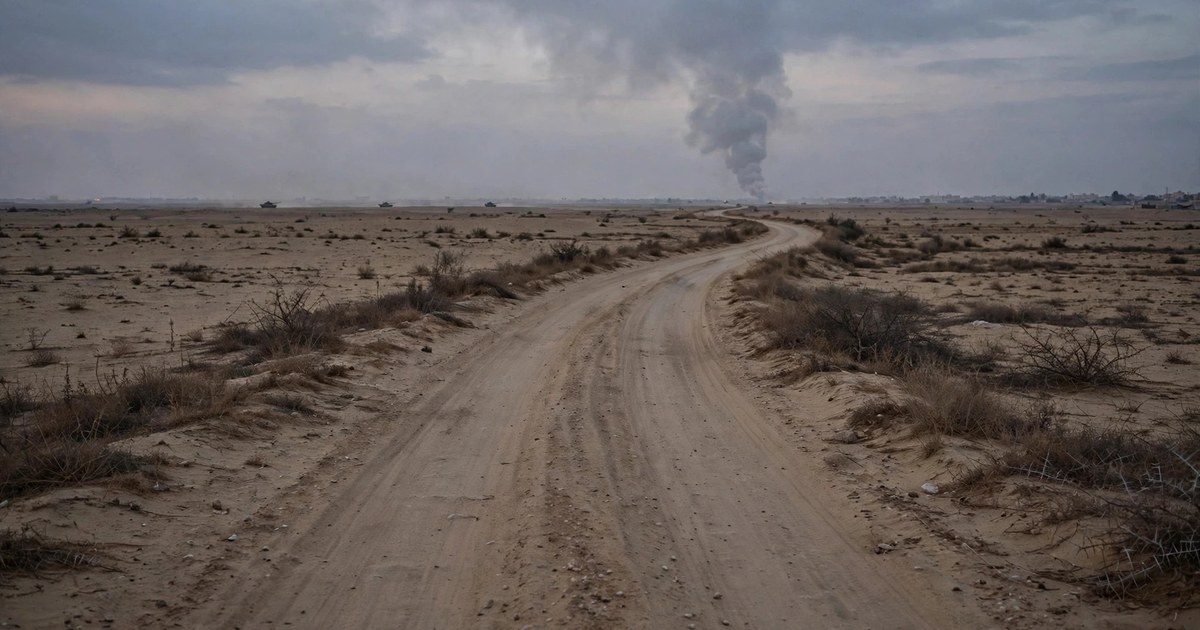
The Israel Gaza ground operation crossed the Yellow Line on Wednesday, 18 November 2026, in what residents described as the first ground raid since the October 2025 ceasefire — a move Reuters, Al Jazeera and NBC News all described as the first Israeli ground advance beyond the line since the truce began. Hospital officials said three Palestinians were killed in Gaza on Wednesday, and families fled shelters near the Nuseirat and Bureij refugee camps as tanks rolled onto the main Salah al-Din road. The operation came on the same day the US-backed Board of Peace warned the United Nations Security Council that the ceasefire is in danger of collapse.
Israel Gaza Ground Operation: What Happened in Central Gaza on 18 November
Israeli tanks advanced into an area of the central Gaza Strip on Wednesday morning, witnesses told Reuters, and the Israeli military said its forces were targeting Hamas infrastructure outside the areas Israel controls. Tanks rolled onto the main Salah al-Din road, Gaza's main north-south route, west of the Yellow Line — the boundary of the roughly two-thirds of Gaza that remains under Israeli control despite a ceasefire that has lasted more than a year.
The advance centred on the area around the Nuseirat and Bureij refugee camps. Al Jazeera correspondents reported tanks operating east of Nuseirat and north of Bureij, with intense artillery shelling, gunfire and airstrikes from around midday. An AFP journalist saw Israeli tanks position themselves east of the Nuseirat camp, and a Gaza security source told AFP there was intense artillery shelling north of Nuseirat and military vehicles in central Gaza amid ongoing gunfire and airstrikes since midday.
Three Palestinians were killed in Gaza on Wednesday, according to hospital officials and Gaza's civil defence agency. An Israeli airstrike on the town of al-Mughraqa, north of Nuseirat, killed one person and wounded several others, an official at al-Awda Hospital told Al Jazeera. Medics told Reuters two other people were killed in separate incidents in Deir al-Balah and Gaza City; the Israeli military said it was not aware of any incident in Deir al-Balah, and told AFP it had targeted "terrorists" in the first two strikes. It was not immediately clear whether the three attacks were linked to the ground operation.
Witnesses said the raid, gunfire and tank shells forced some families in nearby shelters to flee. Al Jazeera's Hind Khoudary, reporting from Gaza City, said many Palestinians were fleeing areas in central Gaza as the operation got under way. The Israeli military body that oversees civilian affairs in the territory, COGAT, said the army had closed the stretch of the Salah al-Din road near the operation and told residents to stay away until further notice. One resident told Al Jazeera the army issued no evacuation order for people living in the area — only an announcement that a military operation would start, infrastructure would be destroyed and demolitions would take place.
Strikes on Gaza have continued through the ceasefire. Israel killed a Hamas commander in a Gaza strike reported in Israel Kills Hamas Commander Samir Abu Younis in Gaza Strike, six people were killed in a strike on Nasser Hospital, reported in Nasser Hospital Strike Kills 6 in Gaza, and the first winter storm of the month flooded 70,000 tents, as reported in Gaza Storm Flooding: 70,000 Tents Flooded.
What Is the Yellow Line in Gaza?
The Yellow Line is the demarcation from the first phase of the October 2025 ceasefire, under US President Donald Trump's 20-point plan to end the war. Israeli forces withdrew to the line within 24 hours of the ceasefire taking effect on 10 October 2025, after which a 72-hour period began for the handover of Israeli captives held in Gaza. Trump first published a map of the line on his Truth Social platform. The line ran the length of the Strip, leaving its east — mostly farmland and border areas — in Israeli hands and its coastal west to the population.
At the start, the line left Israeli forces in control of about 53 percent of Gaza, according to the UN Office for the Coordination of Humanitarian Affairs (OCHA), confining more than two million Palestinians to the remaining 47 percent, about 172 square kilometres. Israeli troops have since marked the line physically, placing yellow-painted concrete barriers topped by yellow poles along it, in some places farther west than the original demarcation.
The line has not stayed where it was drawn. OCHA's access-and-movement map of Gaza, released on 16 November 2026, shows access restrictions now covering about 65 percent of the territory, leaving about 35 percent — roughly 128 square kilometres — for the whole population. Israel itself has said it controls about 70 percent of Gaza, a UN official told the Security Council in June. Reuters, in its reporting on Wednesday's operation, described the Yellow Line as the boundary of the two-thirds of Gaza still under Israeli control.
The line is also where much of the ceasefire-period violence has happened. The UN Human Rights Office verified 1,076 conflict-related Palestinian deaths between the ceasefire announcement and the end of July 2026, and 331 of them occurred near the Yellow Line. A UN commission of inquiry reported in October 2026 that the Yellow Line was developing into an expanding boundary of Israeli control. For Palestinians living near it, the UN's Middle East coordinator said in October, the ceasefire existed "in name only".
Why Israel Says It Launched the Gaza Ground Operation
The Israeli military told AFP it had launched "a precise operation" west of the Yellow Line "to remove a threat" posed to its troops, adding that there was Hamas infrastructure in the area and that it was responding to Hamas ceasefire violations. A military spokesperson told Reuters the operation was targeting "Hamas infrastructure" west of the Yellow Line and that troops had struck a militant in southern Gaza earlier on Wednesday. The military said the operation involved Israeli army and Shin Bet security agency personnel, and added: "We reserve the freedom to act and manoeuvre whenever necessary to eliminate any immediate threat in the Gaza Strip."
Israel, which says Hamas has recently been regrouping and rearming, has stepped up attacks against the group. Defence Minister Israel Katz said on Wednesday that Israel will not withdraw troops from Gaza until Hamas is disarmed and the territory is demilitarized.
Hamas condemned the operation as a "flagrant violation of the ceasefire agreement" and "a dangerous escalation", saying it showed Israel had reneged on its obligations. The group pointed in particular to the forced evacuation of homes northeast of Nuseirat camp. The Israeli military did not immediately respond to the comment. Hamas has accused Israel of attempting to derail the US-brokered ceasefire agreement, while Israel accuses Hamas of ceasefire violations of its own.
Israel Gaza Ground Operation and the Ceasefire: What the Board of Peace Report Says
The operation landed on the same day as a blunt assessment of the ceasefire itself. The Board of Peace, the body overseeing President Trump's plan to end the Gaza war, accused both Israel and Hamas of failing to meet their commitments to end hostilities, leaving Gaza's population in dire conditions and the ceasefire in danger of collapse. Its 12-page report, seen by Reuters, is the board's second to the United Nations Security Council since the US-backed ceasefire came into effect 13 months ago.
According to the report, reviewed by The National, deadlines for transferring civilian governance and deploying an international stabilization force have been missed. The committee for the administration of Gaza, which is to take over civilian governance, has not yet entered the enclave, and the International Stabilization Force also remains undeployed. The report criticizes ongoing Israeli military strikes, Hamas militant activity and the dragging out of political and security arrangements.
The human cost since the ceasefire began is still rising. Gaza health authorities say at least 1,600 Palestinians have been killed since the ceasefire took effect, while the Israeli military says five Israeli soldiers have been killed. Palestinian authorities say more than 74,000 people in Gaza have been killed in the military campaign Israel launched there after Hamas-led fighters killed about 1,200 people in southern Israel in an attack on 7 October 2023. The October 2025 ceasefire halted major fighting, but it has not stopped Israeli attacks or secured Hamas' disarmament — and Wednesday's ground operation is the clearest sign yet of how far the truce has frayed.
What Happens Next in Gaza
The ceasefire remains in place, but no source has reported that it has ended or collapsed — and the Board of Peace warned on Tuesday that the fragile agreement could collapse if it was not fully implemented, accusing both parties of failing to meet their obligations. The Israeli army has not said how long Wednesday's operation will last, and COGAT's road closure and stay-away order remain in force until further notice.
Three things are worth watching. First, whether the tanks withdraw to the Yellow Line or stay in the area around Nuseirat and Bureij — a longer presence would be a further step toward the line becoming a permanent boundary rather than a temporary deployment line. Second, whether the Board of Peace report moves anything at the Security Council, where it is expected to be discussed this month, and whether the civilian administration committee and the international stabilization force finally deploy. Third, whether the exchange of fire across the region widens: the United States and Iran exchanged fire around Qeshm, Kuwait and Bahrain this week, covered in US Iran Exchange Fire: Qeshm, Kuwait and Bahrain, and the Gaza operation adds pressure to an already strained truce.
For the more than two million Palestinians now concentrated in about a third of Gaza, the practical meaning of Wednesday is simpler: another displacement, another stretch of road closed, and another reminder that a ceasefire line drawn on a map can move — and that when it does, the people living beside it are the ones who move first. The Israel Gaza ground operation matters because it tests whether a line drawn as a temporary deployment boundary has become a permanent one, and whether a ceasefire that has survived 13 months of violations can survive a ground operation across it.
Sources: Reuters; Al Jazeera; AFP; The National; United Nations Office for the Coordination of Humanitarian Affairs (OCHA); InDepthNews.