
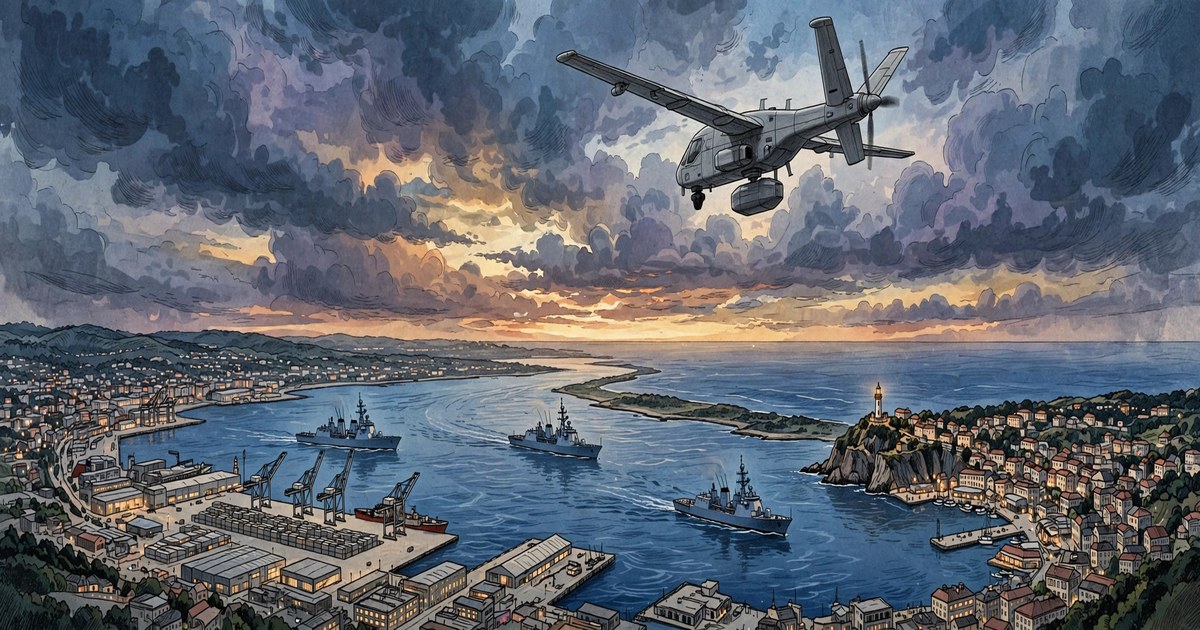
Iran shoots down US drone — that is the claim from Tehran on Sunday, 25 October 2026, in an incident that has sharply raised fears of a fresh escalation between the United States and Iran. According to Iran's army, its air defence systems destroyed an American LUCAS drone over the southern port city of Bandar Abbas, a city that sits just across the water from the Strait of Hormuz, the narrow passage through which a huge share of the world's oil and liquefied natural gas travels every day.
The announcement, carried by Iran's semi-official Tasnim news agency and reported by Reuters, came only hours after US President Donald Trump said Washington could launch fresh strikes against Iran as soon as Sunday — or, in his words, reach a "nice, big, beautiful agreement" instead. The two messages, delivered almost simultaneously, capture the strange dual track of this crisis: open threats of war alongside talk of a deal, with neither side yet committing to either path.
As of Sunday evening, the United States military had not confirmed that any drone was shot down, and independent verification of Iran's claim was not available. That uncertainty matters. In a confrontation where claims and counter-claims are themselves weapons, what each side says — and what it withholds — can move oil prices, shipping decisions and military postures within hours. This article explains what is confirmed, what is claimed, and why the Bandar Abbas incident matters far beyond one drone.
What happened when Iran shot down the US drone over Bandar Abbas
According to the Iranian Army's public relations department, air defence systems operating under Iran's integrated air defence network intercepted and shot down a US LUCAS drone over Bandar Abbas on Sunday. Bandar Abbas is the capital of Hormozgan province and Iran's most important southern port, sitting on the northern shore of the Strait of Hormuz. The city is also home to significant naval and military infrastructure, which makes its airspace one of the most closely watched in the region.
LUCAS stands for Low-cost Uncrewed Combat Attack System. It is a one-way attack drone — a loitering munition designed to fly to a target and strike it — and its design is widely described as a copy of Iran's own HESA Shahed-136 drone. Iranian state media put the unit cost at around $35,000, a fraction of the price of larger American systems such as the MQ-9 Reaper. That low cost is itself part of the story: both sides in this confrontation now field cheap, expendable drones in large numbers, which makes the skies over the Gulf crowded, contested and prone to miscalculation.
Iran said this was not the first LUCAS drone it has brought down. Another LUCAS drone was shot down by the Iranian Army in July while flying over southern Iran, according to Iranian media. And on Tuesday, the Islamic Revolution Guards Corps (IRGC) said its air defence forces had intercepted and shot down an American MQ-9 Reaper long-endurance drone over the Strait of Hormuz. Taken together, the three claims describe a pattern of sustained American drone activity near Iranian territory — and a sustained Iranian effort to shoot those aircraft down and publicise each interception.
Trump's strike warning: "maybe tomorrow" or a big deal
The drone incident landed in the middle of an unusually public American debate about whether to strike Iran again. On Saturday, President Trump said a strike could come "maybe tomorrow" — meaning Sunday — or that a major agreement could be reached instead. He has repeatedly declined to say when any military action would happen, telling reporters he would not telegraph the timing of a possible operation.
At a rally in the US state of Georgia on Saturday, Trump added a striking detail: he said he was unsure who he was negotiating with in Iran following the deaths of some of the country's leaders. "Iran's top first and second-tier leaders are dead," he said, adding: "I have to stop now because I need to figure out who we're negotiating with." The remark underlines how much the leadership landscape in Tehran has changed since the wars of 2025 and 2026, and how that complicates diplomacy. Negotiating a durable agreement is hard when the other side's chain of command has been repeatedly hit.
Iranian officials have responded with warnings of their own. Foreign Minister Abbas Araghchi said a renewed war would not change Iran's policies, while parliament speaker Mohammad Bagher Ghalibaf warned of a response "beyond their imagination". Major General Ali Abdollahi, Chief of the General Staff of Iran's Armed Forces, said on Saturday that the US president "must only dream" of American forces entering the Persian Gulf again. The rhetoric on both sides is maximalist; the question is whether it is posturing for a negotiation or preparation for another round of fighting.
Why the Iran US drone incident matters for the Strait of Hormuz
Bandar Abbas matters because of geography. The Strait of Hormuz, a few dozen kilometres from the city, is the only sea passage from the Persian Gulf to the open ocean. Roughly a fifth of the world's petroleum liquids pass through it, along with a large share of global liquefied natural gas exports. Any military incident near the strait therefore has an immediate global audience: energy traders, shipping insurers, Gulf governments and the navies that patrol the waterway.
The drone shootdown is also connected to a wider pattern of attacks across the region. The Saudi-led coalition in Yemen said on Sunday it had intercepted 10 Houthi ballistic missiles fired at southern Saudi Arabia and a cruise missile aimed at Khamis Mushait. Explosions were heard in Riyadh as the capital's international airport was due to resume flights after a two-week closure following earlier Houthi attacks that killed 13 people, including one American. Houthi military spokesperson Yahya Saree said on Saturday that the group had targeted King Khalid International Airport in Riyadh, an Aramco facility in the Saudi port city of Yanbu, the Rabigh oil refinery, crude oil pumping stations and the East-West Pipeline — and warned travellers again on Sunday to avoid Riyadh's airport, calling it a military target. Readers can follow the airport story in our report on Riyadh airport reopening after the Houthi closure, and the earlier attack on Saudi energy infrastructure in our coverage of the Aramco headquarters strike in Dhahran.
For shipping and energy markets, the practical effect of incidents like the Bandar Abbas drone shootdown is measured in risk premiums: higher insurance costs for tankers, rerouted vessels, and oil prices that spike on headlines even when no cargo is actually disrupted. The last time the strait became a war zone, in the first half of 2026, the disruption was real and prolonged. Nobody in the region wants a repeat — but the incentives to demonstrate resolve keep producing incidents that edge closer to one.
How the US-Iran confrontation reached this point
To understand why a single drone matters so much, it helps to recall how fast this confrontation has escalated. The United States and Israel waged a first 12-day war against Iran in June 2025. A second, longer war began on 28 February 2026 and lasted 40 days, ending in early April. According to reports from the region, a joint US-Israeli strike in late February killed Iranian Supreme Leader Ali Khamenei, triggering the wider conflict; Ali Larijani, Secretary of the Supreme National Security Council, was killed in an Israeli strike in mid-March.
That second war ended with what has been described as the Islamabad Memorandum of Understanding — an agreement reached after 40 days of fighting. Iranian officials now say Washington has repeatedly violated that memorandum through continued drone flights over Iranian territory, which is how Tehran frames the Bandar Abbas interception: not as an escalation, but as enforcement. Washington, for its part, has pointed to warnings from US intelligence officials that Iranian efforts to target American personnel in the Middle East have reached advanced stages — a memo from the Director of National Intelligence to Secretary of State Marco Rubio was cited in recent reporting — and to the continuing Houthi attacks on Saudi Arabia as evidence that the Iranian network remains active.
Diplomatic efforts involving Pakistan and Qatar have been trying to bridge the gap, but by Sunday they had produced no breakthrough. The result is a standoff in which each side's "defensive" action looks offensive to the other: American drones over southern Iran, Iranian air defences shooting them down, Houthi missiles toward Saudi Arabia, Saudi and coalition interceptions in return, and a US president publicly weighing a strike "tomorrow" against a "beautiful agreement". It is a structure built for accidents.
What to watch next in the Iran US drone standoff
Several things will determine whether the Bandar Abbas incident fades or ignites. First, whether the United States confirms or denies the drone loss — and whether any wreckage is displayed publicly, as Iranian media have done with previous interceptions. Second, whether Trump's "maybe tomorrow" window passes without a strike, which would suggest the threat is leverage for a deal rather than a decision. Third, whether the Houthi campaign against Saudi airports and energy sites pauses or intensifies, since Riyadh's tolerance for continued attacks is a key variable in the wider war.
Fourth, the diplomatic track: Pakistan and Qatar are mediating, and any sign of direct or indirect US-Iran contact would be the strongest signal that a deal is genuinely on the table. And fifth, the oil and shipping response — if insurers raise war-risk premiums for Gulf transits or tankers begin avoiding the strait, the economic pressure on all parties rises sharply, which historically has pushed both sides toward restraint rather than escalation.
For now, the honest summary is this: Iran says it shot down an American drone over a strategically vital port city; the United States has not confirmed it; the American president has said a strike could come at any time or a deal could be reached instead; and the region's other conflicts — from Yemen to Saudi Arabia's airports — are moving in the same dangerous direction at the same time. That combination is why this story is trending per news coverage worldwide today, and why the next 48 hours matter more than the last 48. Meanwhile, the world's other big democratic story is unfolding in South America, where Brazil's presidential runoff between Lula and Bolsonaro is being decided by voters today.
We will update this article as the United States responds and as further details of the Bandar Abbas incident are confirmed.