
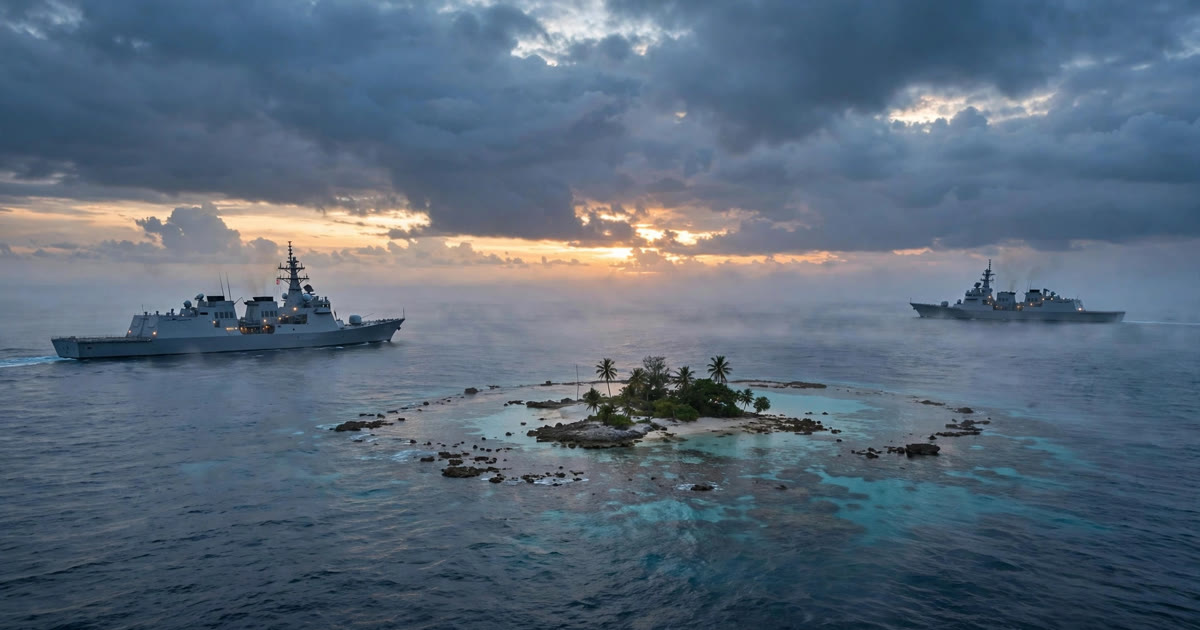
China's military said on Tuesday, 20 October 2026, that it had dispatched naval forces to track and monitor the USS Charleston, a US warship it accused of "illegally" entering waters near the disputed Sabina Shoal in the South China Sea in the early hours of the day. The US Navy did not immediately respond to a request for comment. Hours later, at the opposite end of the same waterway, Taiwan's coast guard reported its own standoff: a Chinese coast guard ship had entered restricted waters near the Taiwan-controlled Pratas Islands. Two separate confrontations, one US warship and one cross-strait flashpoint, on a single day — making this the most consequential 24 hours in the South China Sea in months. The story is trending per news coverage.
According to a statement from the Chinese military's Southern Theatre Command, reported by Reuters, the USS Charleston sailed into waters adjacent to Sabina Shoal in the Spratly Islands without Chinese government approval. "The US action infringes upon China's sovereign rights and interests, jeopardises maritime security, and is detrimental to regional peace and stability," the statement said. "The US side should immediately cease such activities."
A spokesperson for the Philippine military pushed back publicly, telling reporters the US ship "did not trespass into 'Chinese territory,'" and adding that no nation had the authority to require prior permission for "lawful transit through international waters" — a direct endorsement of the American position.
Why Sabina Shoal is a flashpoint
Sabina Shoal sits inside the Spratly Islands, a sprawling archipelago whose reefs, rocks and sandbanks are claimed in whole or in part by China, the Philippines, Vietnam, Malaysia, Brunei and Taiwan. Of those rivalries, the China–Philippines contest has been the sharpest all year, and Sabina Shoal is at its centre.
China claims almost all of the South China Sea as its own territory, a position rejected by a 2016 international arbitration ruling under the UN Convention on the Law of the Sea. Beijing does not recognise that ruling. The Philippines, which has a mutual defence treaty with the United States, treats the surrounding waters as its exclusive economic zone — and the friction has repeatedly turned physical.
Just last month, a China Coast Guard vessel rammed a Philippine boat on a refuelling mission near the same shoal, according to the Philippine Coast Guard; China blamed the Philippine side for the collision. That history is why a US warship showing up at the same shoal now carries more weight than a routine transit: it inserts American military power directly into the most inflamed corner of the dispute.
A rare American move
What makes Tuesday's incident stand out is its rarity. The US Navy generally describes such missions as "freedom of navigation operations" — deliberate sailings designed to challenge what Washington considers excessive maritime claims. But according to Reuters, the last known American freedom of navigation operation in the South China Sea was more than a year ago.
The return of a US warship to these contested waters is therefore a deliberate decision to reassert American presence at a moment of heightened Chinese activity. For Washington, such an operation serves two audiences at once. It reassures allies — above all the Philippines, whose mutual defence treaty with the US is meant to deter exactly the kind of grey-zone pressure Manila has been facing — that the United States will physically contest China's claims. And it signals to Beijing that the South China Sea is not a closed lake.
Washington and Beijing only recently reached a fragile trade understanding in Kuala Lumpur, and the two governments have been managing a crowded list of disputes — from China's export controls on advanced solar technology to sanctions pressure over Russian oil. A naval confrontation in the South China Sea now tests whether that fragile equilibrium can survive a military incident at sea.
The legal fight behind the water
The legal backdrop is worth understanding because both sides argue from it. The Philippines points to the 2016 arbitral tribunal ruling, which found that China's sweeping "nine-dash line" claim had no legal basis under the UN Convention on the Law of the Sea and that several of the features China occupies — including artificial islands Beijing has built and militarised — generate no territorial sea. China dismissed the ruling before it was even issued, calling it "null and void," and has continued to patrol, build and assert jurisdiction as if the case never happened.
The United States is not a party to the UN Convention on the Law of the Sea, but it conducts freedom of navigation operations precisely to prevent excessive claims from hardening into accepted practice through uncontested enforcement. That is the legal logic behind the USS Charleston's presence: sail through, demonstrate the right, and deny Beijing the precedent of unchallenged control.
In practice, these operations have become a choreography. The US Navy sails; China's Southern Theatre Command announces it tracked and expelled the vessel; both sides claim the law is on their side; and the ships steam on. The risk lies in the moments when the choreography breaks — the close encounters, the rammings, the water cannons — as last month's collision near this same shoal showed.
The Pratas standoff
Meanwhile, roughly a thousand kilometres to the north, Taiwan's Coast Guard Administration said a Chinese coast guard vessel had entered restricted waters near the Pratas Islands on Tuesday. The Pratas — known in Taiwan as Dongsha — are a small archipelago lying roughly between southern Taiwan and Hong Kong, more than 400 kilometres from Taiwan's main island, and security experts consider them vulnerable precisely because of their isolation.
This was not the first clash there this month. On 1 October, a Taiwan Coast Guard ship fired a water cannon at a Chinese fishing boat that ignored repeated warnings to leave restricted waters near the Pratas. The boat suffered engine failure and had to be towed away by a nearby Chinese vessel. Beijing reacted furiously: on 13 October, Chen Binhua, a spokesperson for China's Taiwan Affairs Office, said Taiwan must "bear the consequences" of what he called a "violent and dangerous" act that endangered lives and property, accusing Taipei of "maliciously stirring up cross-strait confrontation."
Then on Sunday, 18 October, Taiwan said it had driven away 16 Chinese ships involved in what it called "maritime harassment" around the island — part of a record surge in Chinese coast guard, research and other government vessels. Taiwanese official data show 244 such ships around Taiwan's main island in July, compared with 55 in June and 58 in July last year. China's government recognises no Taiwanese sovereignty claims, including over the Pratas. Tuesday's incursion near the Pratas fits this pattern of escalating grey-zone pressure.
How each side reads Tuesday
For China, tracking and publicly denouncing the USS Charleston is useful on multiple fronts. Domestically, it demonstrates resolve; diplomatically, it frames the United States as the provocateur and presses Southeast Asian states to view Washington — not Beijing — as the source of instability. The Pratas incursion serves the same logic toward Taiwan: steady, deniable pressure that stays below the threshold of open conflict while eroding Taipei's control of its own waters.
For the United States and Taiwan, Tuesday is a reminder that deterrence in the Indo-Pacific is tested in small increments. The Trump administration has been deepening economic and security ties with Taiwan, and a US warship operating openly in waters Beijing claims sends a message that reaches beyond the sea itself. Neither side reported shots fired or dangerous manoeuvres on Tuesday, which suggests both navies managed the encounter professionally — the outcome every admiral on both sides prefers.
What happens next
The immediate question is whether Tuesday was a one-off signal or the start of a renewed American naval presence in the South China Sea. If the US Navy resumes regular freedom of navigation operations, expect China to shadow every sailing and publicise each one — a pattern that produces headlines but also raises the risk of miscalculation, as nearly happened during close ship-to-ship encounters in recent years.
Watch Manila's next move: the Philippines is the country with the most at stake around Sabina Shoal, and its response to both last month's ramming and this week's US sailing will shape whether the shoal becomes a permanent crisis zone. Watch the Pratas Islands too. Taiwan's isolated outpost is the most likely spark for a cross-strait incident, and Beijing's "bear the consequences" warning has not been withdrawn.
For now, the ships have gone their separate ways. But the claims, the mutual defence treaties and the naval hardware are all still crowded into the same water — which is why, trending per news coverage, analysts will be watching the South China Sea far more closely in the weeks ahead.